
Review: SWIVE, Crescent Theatre
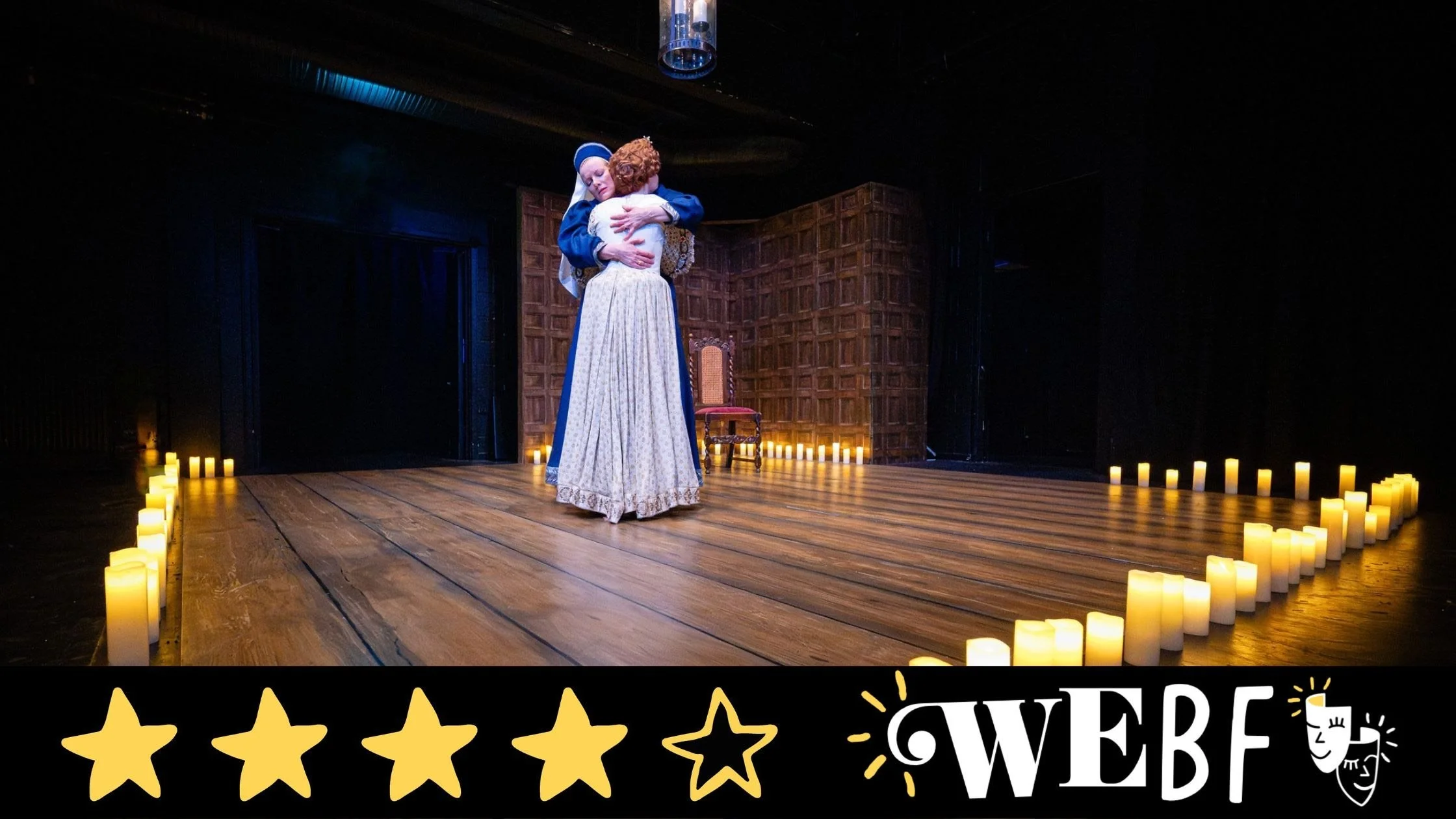
Photo credit: Graeme Braidwood
Ella Hickson’s Swive is a celebration and deep dive into the life of Elizabeth I, one of Britain’s most iconic and fascinating rulers. A sharp and stimulating four-hander play, it works beautifully in the Crescent Theatre’s Ron Barber Studio, the intimacy of the space lending the production a confessional quality, as if the audience is being trusted with a private view of the famous monarch.
Michael Barry’s set design is deliberately minimalist, with a bare stage bordered by flickering candlelight, a clear nod to the staging of the Sam Wanamaker Playhouse at Shakespeare’s Globe where the play first premiered. This stripped-back design puts the emphasis squarely on the performers.
The play takes its name from an archaic word for sexual intercourse, something Elizabeth famously never had. In Swive, Hickson never confirms or denies Elizabeth’s virginity, but shows how the weaponisation and control of her sexuality was instrumental in Elizabeth’s rise to power, and subsequent forty-four year reign.
The first half of the play sees Alex Crutchley as an exceedingly precocious and hot-headed teenage Princess Elizabeth, fully aware of her own charms and power, but who understands that her survival depends on appearing harmless. She flirts with her guardian Thomas Seymour, before coolly sacrificing him to protect herself in an emotive court scene, and later fumes at her sister Mary, for conceding so much power to her husband.
Liz Plumpton shines as an older Queen Elizabeth, offering a nuanced performance that balances regal authority with glimpses of vulnerability. Plumpton captures Elizabeth’s careful calculations and how she used her autonomy of her body against the expectations of the men who surrounded her throughout her rule. She commands the stage with such authority that it becomes impossible to look anywhere else.
Across both halves of the play, Elliott McDowell is a reassuring presence as William Cecil, a steady fixture in Elizabeth’s life since she was a toddler and her trusted chief minister during her reign. McDowell’s portrayal is measured and eloquent and gives Cecil a magnetic presence that subtly pushes against Elizabeth in every scene.
In his debut performance, Richard Shaw shows impressive range, first as the leery Thomas Seymour opposite Crutchley’s Elizabeth, and then as Robert Dudley, he becomes a genuine contender for the older Queen Elizabeth’s affection.
Whilst set firmly in the sixteenth century, the play has moments when it examines Elizabeth’s story through a modern lens. There are some playful dance sequences set to modern pop tunes and bathed in neon rave lighting, which feel as fun for the actors as they are for the audience, offering a welcome reprieve from the politically charged and heavier moments of the story. One modern-dress moment works particularly well: Liz Plumpton’s shift into a businesswoman’s outfit while remaining Elizabeth I reframes the pressure to marry and produce an heir in a way that feels pointed and effective. Not all of the contemporary touches land, however. A scene in which the washerwoman suggests the crown’s jewels could be sold to feed multiple families adopts a modern voice that jars with the period, and the inclusion of an ensemble of staff members in their Crescent Theatre uniforms paired with ruffs and skirts repeatedly pulls the audience out of the world of the play. Even so, the production’s willingness to experiment ultimately gives the play much of its energy and charm.
Jess Shannon’s confident direction allows the script and performances to take centre stage. The production moves effortlessly between intimate moments of prayer, and more stylised sequences, making good use of the studio space. The result is a production that feels alive, playful, and unafraid to take risks, making Elizabeth’s journey relatable for a contemporary audience.
Some prior knowledge about Elizabeth I is definitely warranted (although there are some helpful articles in the programme which provide a good refresher for anyone who hasn’t thought about the Tudors since GCSE history!) but overall, the production remains engaging and easy enough to follow.
Swive is a tight ninety-five minute journey through Elizabeth’s life and legacy, with a huge amount of politics, feminism and history packed in. It’s an enjoyable and thought-provoking production and the Crescent Theatre should be applauded for its ambitious programming and confident execution.
**** Four stars
Reviewed by: Kirstie Ewer
Swive plays at Birmingham’s Crescent Theatre until 24 January, with further info here.