
Review: MOTHER COURAGE AND HER CHILDREN, Shakespeare’s Globe
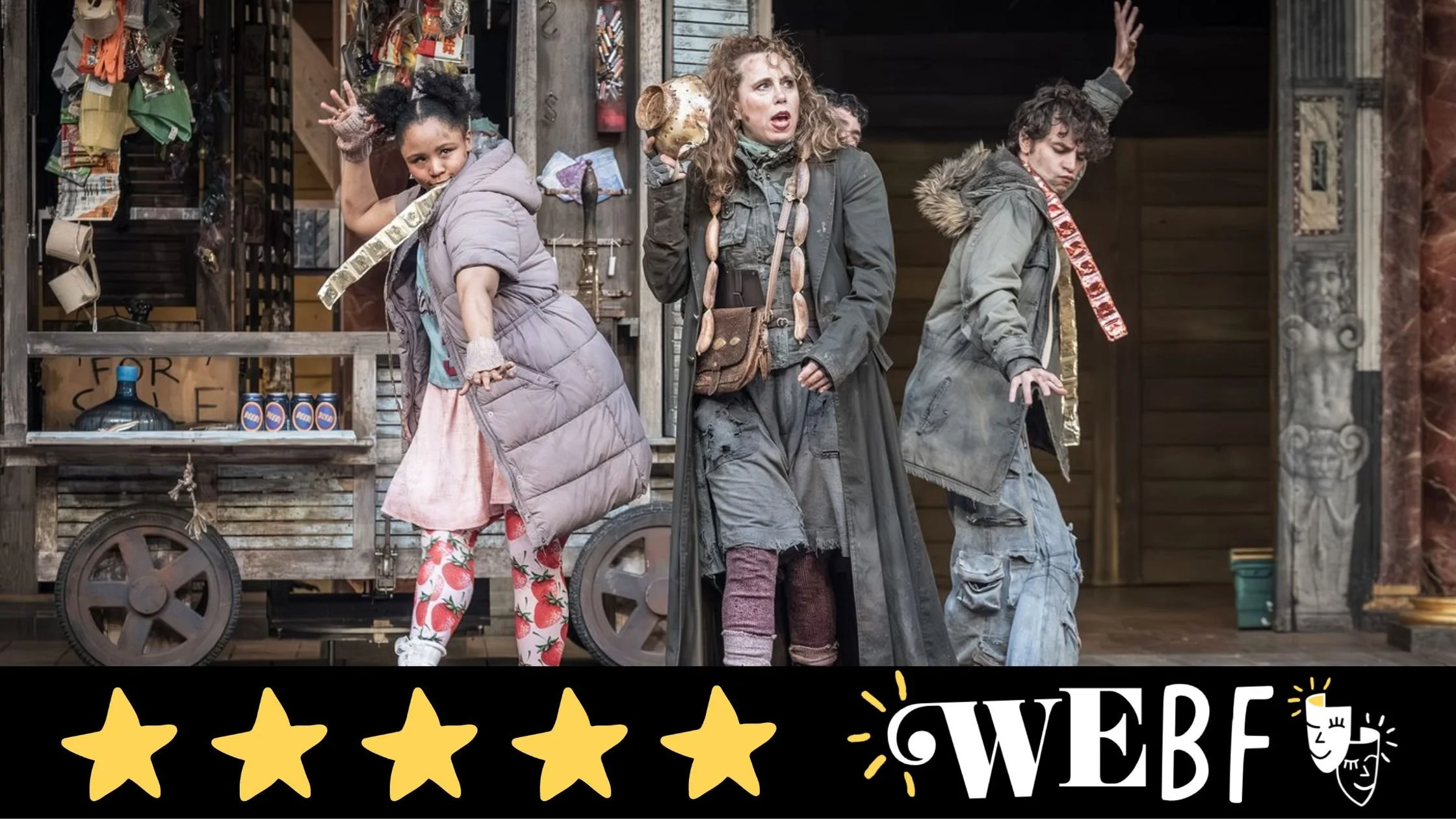
Photo credit: Marc Brenner
Brecht finding his way for the first time to the landmark Shakespeare’s Globe can make one cock the head slightly and think: really, there has never been any Brecht performed here before? That aside, something about this partnership feels immediately right. In Anna Jordan’s new translation, directed by Elle While, the conventions of Brechtian theatre seem to unlock naturally within the Globe’s open-air structure and direct relationship with its audience. It feels communal and confronting.
Mother Courage and Her Children, written in 1939 as Brecht lived in exile from Nazi Germany, is one of his great plays in opposition to fascism and the machinery of war. It is a well-known text in the canon of theatre, and one that continues to endure because the world keeps making room for it. War, survival, profit, motherhood and compromise are human themes Brecht forces into view. The story follows Mother Courage, a trader, survivor and mother, dragging her cart through a war-torn world where trade, loyalty and survival are constantly being weighed against one another. She has learnt to make a living from war, selling what she can in order to keep herself and her children alive. It is bleak, brash and gritty, but this production also finds humour, music and moments of a strange kind of hope in the dystopia of war.
Michelle Terry, also Artistic Director of Shakespeare’s Globe, embodies Mother Courage with force and stamina. She is a woman at the centre of the story: a mother, a fighter, a survivor, and someone not above compromising her values when needed. Terry does not soften her into a conventionally accessible maternal figure; she capitalises on her force. This is a woman constantly weighing up what can be lost, what can be sold, and what must be endured, tapping into something instinctive: an animal response to danger, to protect, to carry on, to survive. The tragedy is that her survival instinct is also the thing that helps destroy what she is trying to save.
Mother Courage’s young adult children each embody the values their mother sees in them, and the production draws this out successfully. Vinnie Heaven’s Eilif carries the violence and glamour of war, while Rawaed Asde’s Swiss Cheese offers us futile innocence and honesty in a dishonest world. Most harrowing is Rachelle Diedericks as Kattrin, Mother Courage’s silent daughter. Kattrin becomes a symbol of purity in a world that takes advantage of it, but Diedericks never allows her to become passive. Her presence is loud. The actor owns this portrayal, making Kattrin’s silence one of the production’s most powerful forms of resistance.
Jordan’s translation understands that Brecht’s didactic conventions land differently now. Brecht offered information so audiences might think; today, we live in a world where we are flooded with information and still struggle to know what to do with it. This production consciously leans into that contradiction. Written in response to one world of war, and about another, it speaks sharply to the wars of today. For example, Simon Scardifield’s General, with a purple-suited, Trump-esque demeanour, brings the satire into a recognisable contemporary frame without needing to overstate the point. The portrayal of convenient relationships with faith, power and profit feels both absurd and painfully familiar.
Visually, takis’ design gives the world a ramshackle, war-torn texture. Mother Courage’s cart sits at the centre of the production, constantly evolving as a structure of goods, shelter and burden. It is practical and symbolic at once: a home and a trap. The set works in close conversation with the choreography, allowing the world to feel unstable and always in motion.
Movement directors and choreographers Lucy Cullingford and Anna Morrissey find a physical language that is relentless, gritty and visceral, while still allowing human softness to sit within the necessity of survival. There is a sense of people being pushed forward by systems and needs larger than themselves.
Music, a well-loved Globe convention as much as a Brechtian one, is also very powerful here. Composer James Maloney and the musical team create a complex sound world where upbeat rhythms and moments of lightness sit in sharp contrast to despair. Loud gunshots and banging drums jolt the space (if you are jumpy, be prepared). This contrast works well, keeping the production unstable and very alive.
Brecht’s theatre is designed to put the audience in a confronting position, and here that feels particularly effective. The Globe makes us witnesses, not distant observers. War is not hidden behind illusion; it is presented in front of us, with all its trivial human justifications and moral bargains exposed. From the comfort of a Western audience, there is an uncomfortable awareness that what is staged as theatre is, for too many people, life today. This production of Mother Courage and Her Children at the Globe arrives at a time when the story needs to be told again somehow. It feels like a key work under Terry’s leadership.
***** Five stars
Reviewed by: Stephanie Osztreicher
