
Review: LEAR, Pitlochry Festival Theatre
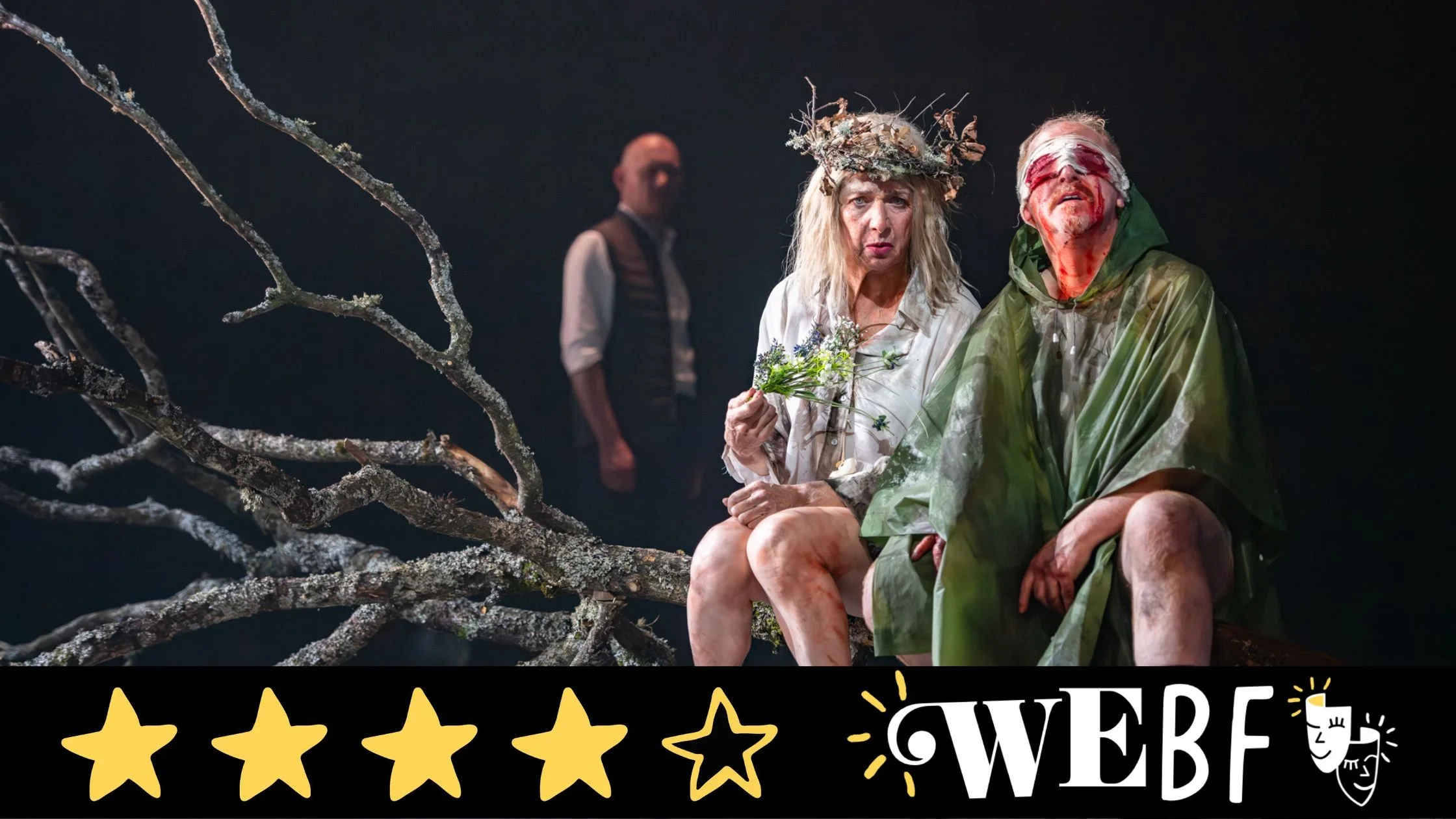
Photo credit: Tommy Ga-Ken Wan
Pitlochry Festival Theatre has only programmed Shakespeare seven times before in its 75 year history, so it seems fitting that in this era of change for the theatre, Finn den Hertog’s Lear should take centre stage, bringing Shakespeare back to Scotland’s Theatre in the Hills.
The ‘King’ has been dropped from the title because Lear in this production is a woman, a queen, a mother, and a matriarch. As we watch Lear slowly fall into madness, becoming nothing but a shell of the steely Margaret Thatcher-esque ruler from the opening scenes, the deeply human nature of this tragedy reveals itself. This is a story of mother and daughters, of female rage, jealousy and, ultimately, of the futility of politicking and war.
Maureen Beattie is a devastating Lear. Her authoritative delivery of her early scenes, banishing daughter Cordelia and the loyal Kent without a hint of regret, physically pushing subjects who cross her, creates a powerful, sharp ruler, with a simmering rage just below the surface. As the play progresses, however, Beattie’s performance takes a heartwrenching turn, as Lear’s mind begins to fail her and her body weakens. She staggers across the stage, windswept and confused, before her final moments, pyjama-clad and confined to a wheelchair. When she finally reunites with Cordelia, her pained, whispered delivery conjures a tragic, sharply real woman who has lost everything.
Although Beattie is the centre of this play, the rest of the ensemble brings this tragedy to life around her. Forbes Masson’s Gloucester is at first obsequious and comedic, before his horrifying fate (played out graphically on stage with the help of a stiletto heel) turns him into a blood-soaked figure of agony. As Lear’s daughters Goneril and Regan, Jenny Hulse and Lindsey Campbell bring cold, calculated fury to their brutal actions. In the dual roles of Cordelia and the Fool, Ailsa Davidson brings pathos, humanity and just the right amount of humour, while Dylan Read’s Edgar displays startlingly eerie physicality as he embrace his ‘Poor Tom’ persona. Reuben Joseph imbues the villainous Edmund with an unmistakable charm, often breaking the fourth wall to include the audience in his dastardly plots.
Emma Bailey’s designs are very effective, first depicting a run-down stately home covered in dust sheets with exposed wiring, before stripping back to a stark, empty stage with a fallen tree as its focal point. Kai Fischer’s lighting provides further dimension, with the pivotal storm scene being particularly evocative. Mark Melville’s sound design, wonderfully enhanced by Brìghde Chaimbeul’s features smallpipes music, creating an ominous, tense atmosphere.
Den Hertog’s direction is clear and poised. Of particular note are the many moments of stillness in the second half, with almost the entire company staying onstage observing from a distance while small scenes take place. These are cleverly juxtaposed with Vicki Manderson’s stylised movement and Robin Hellier’s scant but intense fight sequences. On the whole, the text is clear and delivered with conviction - it is particularly pleasing to hear Shakespeare’s words in the actors’ own accents, many of them Scottish, although there are a few scenes where the naturalistic delivery means some lines are lost, unfortunately.
This is an ambitious, unsettling production which embraces both the traditional and modern, creating a Lear that feels both timeless and deeply relevant to the world of today. With a mix of measured stillness, shocking graphic violence, and bitter tragedy, this Lear is a triumphant return for Shakespeare to Pitlochry, which leaves us hoping that Alan Cumming and his team here continue to programme the Bard for more inspired retellings like this one.
**** Four stars
Reviewed by: Lorna Murray
Lear plays at Pitlochry Festival Theatre until 1 August, with further info here.