
Review: IPHIGENIA, Arcola Theatre
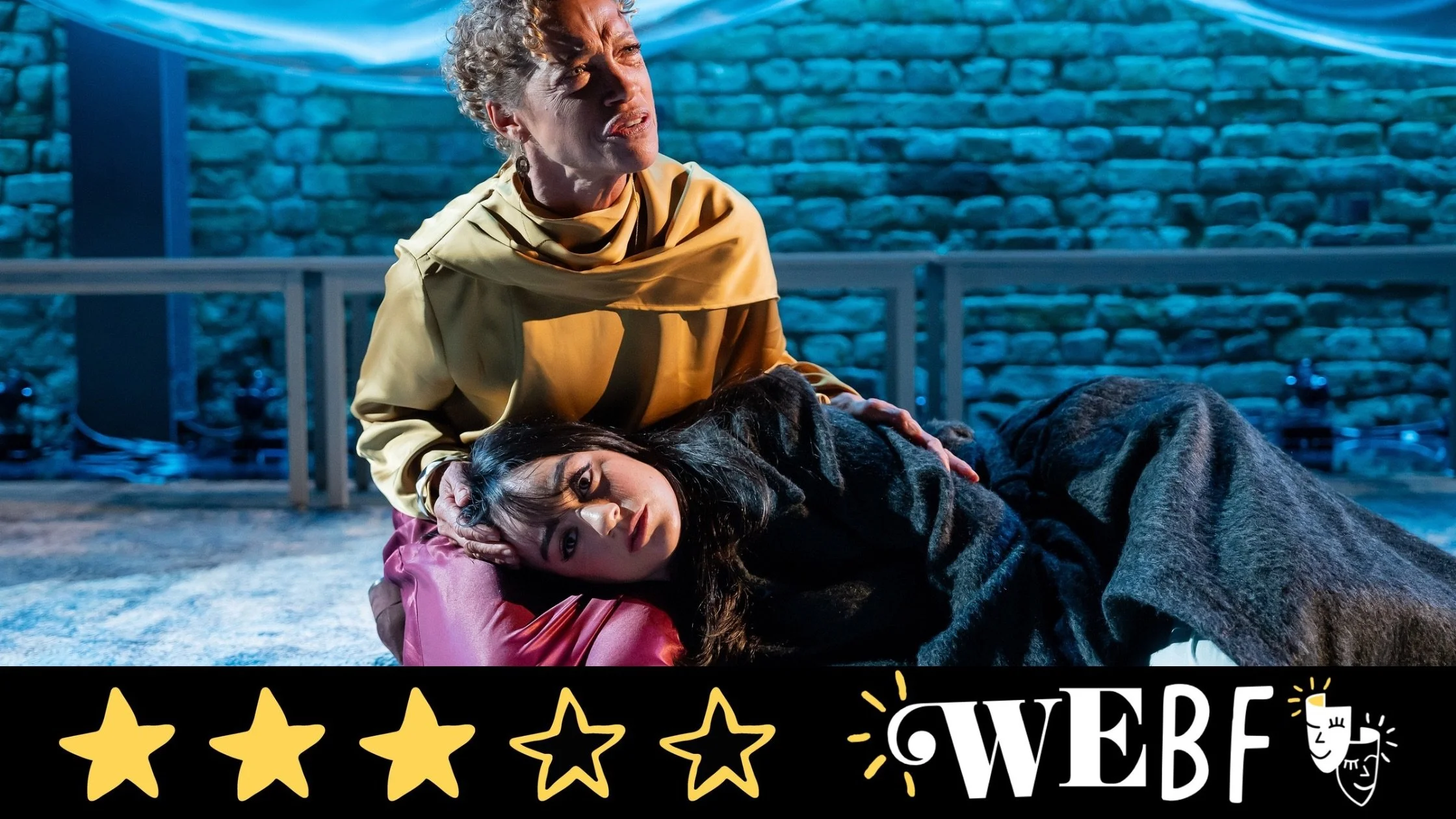
Photo credit: Ikin Yum
In the face of war, there are sacrifices made for what we are told is a greater good, and in Iphigenia in Aulis, this sacrifice is distilled into a poignant and heartbreaking reality for Agamemnon, Clytemnestra and their daughter, Iphigenia. What begins as a quarrel between gods and men unfolds into something devastatingly human, proving that gods, warriors and mortals alike are not exempt from personal destruction. In this adaptation, translated by Stephen Sharkey and directed by Serdar Biliş for the Arcola Theatre, this ancient tale of a father’s greatest sacrifice, his daughter, is brought into a present dialogue.
Using just three actors, Simon Kunz as Agamemnon presents a military commander in conflict with being a father and husband. Mithra Malek takes on the ill-fated Iphigenia, while Indra Ové’s Clytemnestra is a mother with no bargaining left, grounded in strength and fierce honesty. They are joined by Kalia Lyraki, who holds the space with live traditional singing and instrumentation, bringing a quiet, mystical presence.
What the production achieves well is clarity in its storytelling. A young Iphigenia is called to be sacrificed so that war may continue, summoned under the pretence of marriage to Achilles. As the truth of her fate unfolds, the emotional stakes are clear. There is no easy way out for Agamemnon; refusal would only lead to further destruction. The intimate setting of the Arcola places the audience in direct confrontation with the tragedy. It is rich in its ancient grandeur, yet immediately accessible and translatable to the present day.
Attempting to connect further, testimonies from women across the world intermittently play on a video projected into the space and onto whiteboards held by the actors. These voices speak of fathers, motherhood, sacrifice, and war from different cultural perspectives with stark honesty. They are real, and it is easy to feel strongly for them, to question the themes of the play through their personal accounts. The actors themselves step out of character at points to share something of their own lives. We all have a family, and the world in chaos we live in is also ours. The play reaches outward, drawing parallels between myth and lived experience.
When these interruptions land, there are glimpses of something immediate that cut through the formality of the text. However, although undoubtedly powerful, the question remains: does the text need that? The text itself should be able to uncover this sentiment within its audience. That may be debatable, but the transitions between autobiography and performance in this instance lack finesse and physical clarity, and as a result, the intention becomes diluted rather than strengthened.
There is a sense throughout of a production trying to bridge two worlds: the traditional weight of Greek tragedy and a contemporary, intimate retelling. The drama reaches for closeness but does not fully achieve it. The tragedy remains, but its emotional impact sits just out of reach. The pacing is well held, and the openness of the performers, despite the slight distractions of the production, remains vulnerable and present. However, the overall craft needed to fully stitch these elements together could be more refined.
Iphigenia is a production with clear intention and thoughtful ideas but one that, at times, tries to make the story relevant, rather than allowing its inherent relevance to speak for itself. The question remains: does Iphigenia need to be forced into the present? Its questions already live there. And while this version reaches for that connection, it only partially arrives.
*** Three stars
Reviewed by: Stephanie Osztreicher
Iphigenia plays at London’s Arcola Theatre until 2 May, with further info here.
