
Review: GHOSTS, Jermyn Street Theatre
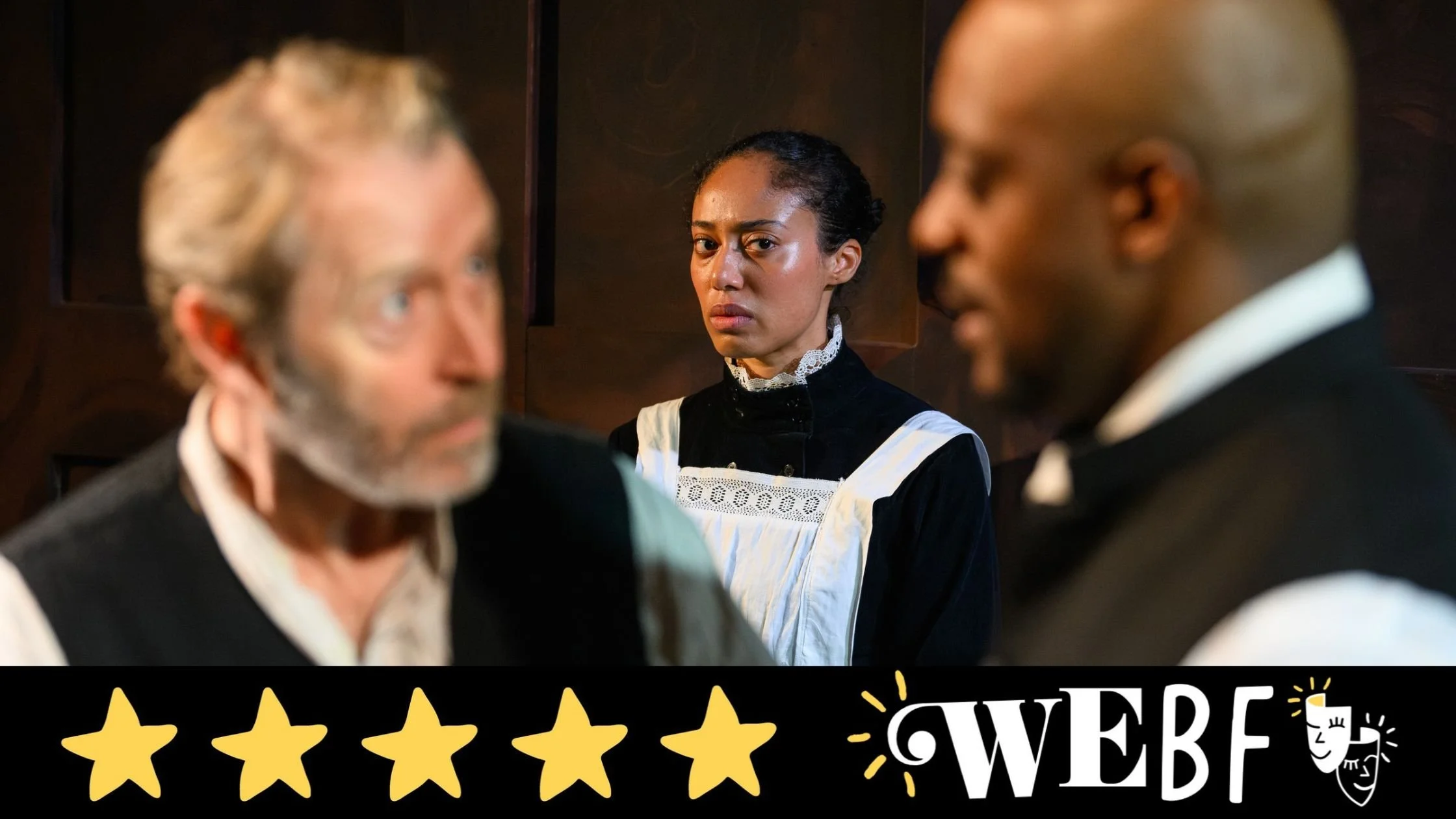
Photo credit: David Monteith-Hodge
A Henrik Ibsen adaptation is always an exciting and exhilarating prospect. A playwright known for regularly tackling taboo subjects in much more reserved times, Ibsen is a rebellious, anti-establishment playwright who loves nothing more than to hold a mirror up to society’s morality and directly challenge its attitudes and the status quo. Ghosts continues that trend, with incest, venereal disease and euthanasia, just some of the topics raised in this electric new production at the Jermyn Street Theatre. However, the central theme at the very core of this play is that of the secrets that parents keep to protect their offspring from the ghosts of the past, which threaten to shatter their idealised view of them. Ibsen also takes sharp aim at the religious puritans of the time, relishing the opportunity to challenge their hypocrisies through those subservient to them.
Richard Eyre first adapted his take on Ghosts in 2013 for the Almeida Theatre, and his tight 90-minute version is re-staged here as a chamber piece. Cara Evans’ gorgeously varnished panelled walls line the back of her intimate set but cannot contain the bombshells that will be unleashed when Helene Alving’s son, Oswald, returns home to mark the opening of an orphanage commemorating his late father. Eyre’s adaptation is compact and crisp, beautifully crafted while preserving the very essence of Ibsen’s challenging dramatic conceit. Here, he entrusts the directing reins to the next generation in the form of Jermyn Street Theatre’s Carne Deputy Director, Kwame Owusu, who brilliantly stages this piece in the tiny 70-seat auditorium with confidence, precision, care and elegance. The intimacy of the space further adds to the intensity of the drama, as if the audience are merely an extension of the drawing room set.
The five-piece cast are all very strong and engaging from the start. Oliver Alvin-Wilson, as Pastor Manders, is wonderfully controlled and authoritative as the buttoned-up but flawed moral proponent whom Ibsen so deliciously enjoys poking and prodding, unravelling his social hypocrisy and challenging the ethics of his faith. Ibsen loves to tackle major societal conventions through the everyday turmoil of his characters. Alvin-Wilson’s duelling debates with Flora Montgomery as Helene Alving about her tumultuous marriage, their near romance and the morality of only applying insurance for the orphanage in the eyes of God are tense and thrilling to witness. Montgomery perfectly and subtly conveys the inner tortures that haunt Helene, a wife and mother who has lived a life of regret and deep unhappiness. It feels as though a direct lineage could be drawn between her and several of Ibsen’s other female protagonists, principally Nora in A Doll’s House. The weight of their own perceived shortcomings as mothers torture them yet equally forces their inner turmoil to bubble up and erupt, while the men in their lives are excused their discretions as merely sowing their wild oats. Ibsen’s continual advocacy for women through complicated, gritty portrayals marks him out as one of the original male proponents of early feminism.
Cecilia Appiah, as Regina, is an endearing yet feisty housemaid who represents the new age of working-class women, openly displaying a passion for learning French in preparation for a better life beyond service. Once the ghosts of Regina’s past are revealed to her, Appiah’s anger is vividly felt as she too challenges the patriarchy, in a manner that would have been revolutionary in Ibsen’s time. Peter F. Gardiner provides some comic relief as Regina’s father figure Jacob, but his character arc is perhaps a little underserved.
While Montgomery demonstrates Ibsen’s forthright rebellion through Helene, she must balance this anger with protecting the future of her son to stop him repeating his father’s mistakes, as Oswald begins to channel signs of a living, breathing ghost of his father. As her offspring, Joe Pitts shows how the lack of maternal support during Oswald’s formative years has led him to a life of uncertainty in his identity. While dressed as a gentleman, he always carries an air of dishevelment, with lovely costume design from Natalie Johnson. This helps to outwardly disguise the tortured soul of a bohemian artist who has a need to drink heavily and smoke his father’s pipe to dull another kind of more debilitating pain, all while romantically pursuing the housemaid, Regina. From the moment he appears on stage, Pitts is electric. He completely embodies the role with exquisite, underplayed charisma and control. In the closing moments of the play, his performance is so astonishing in conveying his pain that it is almost unbearable to watch, yet you cannot take your eyes off him, as Ben Ormerod’s lighting design tragically closes the show.
Ghosts is a forthright, angry scream from the past that sends a chill down the spine. We are in spooky season, but here the spirits do not merely walk among the living; they threaten to take them over and if the religious leaders are not willing to acknowledge them, then it will take seismic change from the usually quietest souls to halt their march. This production is quite simply pure exhilaration and a joy to behold.
***** Five stars
Reviewed by: Phil Meikle
Ghosts continues at Jermyn Street Theatre until 14 November, with further info here.
