
Review: EDGAR A. POE’S LAST CALL, Camden People’s Theatre
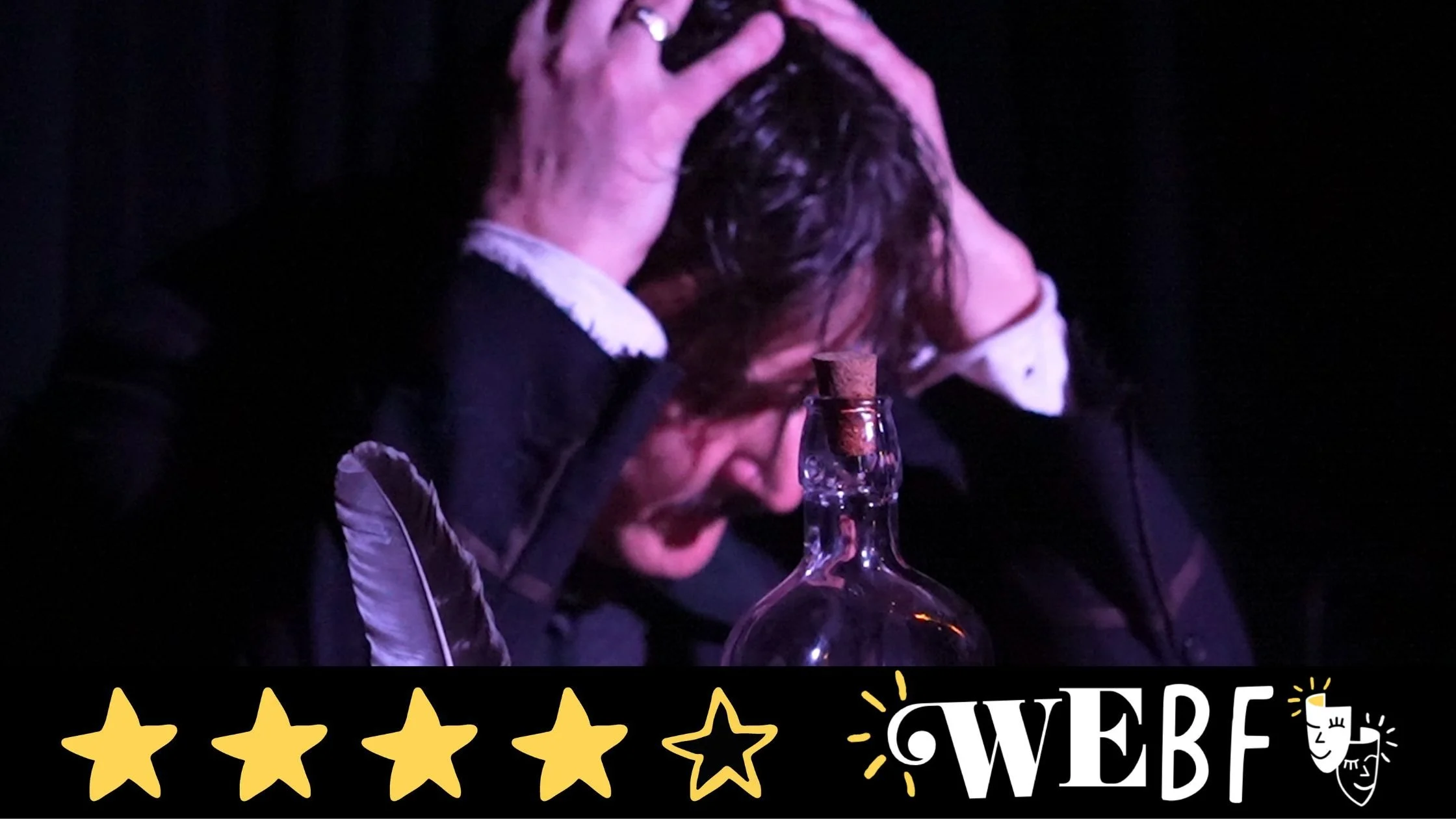
Photo credit: Alexia Haick
Edgar A. Poe's Last Call doesn't start in the theatre. It starts in the bar.
That's something of a surprise to an audience who, like me, are probably waiting for the auditorium doors to open when Edgar Allan Poe suddenly storms in and orders a brandy. And so it begins. Within minutes, Scott Robinson has introduced us to his version of Poe: a "dreamer and a drunkard" as he describes himself, and a man who is funny, difficult, arrogant, unreliable and somehow rather charming at the same time. He's also frightened.
Robinson's play imagines the mysterious final hour of Poe's life, although Poe himself doesn't know it's his final hour. He's heading off to be married for a second time and despite everything that's happened to him, seems hopeful about what might come next. Perhaps this is it. Perhaps he'll finally get the life he's always wanted.
The audience, of course, knows that he won't.
That knowledge gives everything a sense of foreboding, particularly when Poe talks about the future. You're constantly looking for clues, wondering if something he says or does might explain what happened to him, but he's a difficult man to pin down. Just when you think you understand him, he'll say something that makes you question him all over again.
Robinson is particularly good at keeping all those different versions of Poe going at once. He's very funny when he needs to be, and there's plenty of arrogance and theatricality, but the fear underneath never completely disappears. That matters because without it, Poe could easily become a collection of familiar mannerisms and quotations rather than someone we actually want to spend an hour with.
And then there's Virginia. The ghost of Poe's beloved first wife seems to be everywhere, and gradually this supposedly simple account of his final hour begins to feel more like one of his own stories. Poe's memories become mixed up with his creations as Roderick Usher, Berenice and Virginia herself speak to him through unseen voices. Interestingly, Poe never seems confused about what's real. Even when his characters talk directly to him, he knows exactly who they are. He created them, after all. It's the audience who might be less certain.
Poe is so closely associated with horror that the production has plenty of familiar imagery to play with, and it uses it well. The moment the sound of a beating heart begins, it's almost impossible not to think of The Tell-Tale Heart, for example. The mostly dark room, lit by lamps with occasional bursts of much brighter light, adds to the feeling that we're somewhere we probably shouldn't be, listening to a man whose memories are becoming increasingly difficult to escape.
The intimacy of Camden People's Theatre helps enormously. There's nowhere for Robinson to hide and, more importantly, nowhere for Poe to hide either. We're close enough to catch the smaller reactions as well as the bigger moments, and the production is at its best when it takes advantage of that closeness rather than trying too hard to frighten us. It's creepy rather than genuinely scary, but that suits the story far better.
One of the best things about Edgar A. Poe's Last Call is that it never feels like a recital dressed up as a play. It would have been very easy to have Robinson simply stand in front of an audience and perform Poe's greatest hits, but there's much more theatre here than that. The props, lighting, music, recorded voices and movement all have something to do, while beginning the performance in the bar immediately breaks down the usual barrier between Poe and the people watching him.
There are times when the number of references to Poe's life and work threaten to crowd the story a little, particularly if you're already familiar with the material and find yourself mentally ticking them off as they appear. But the central idea is strong enough to keep pulling everything back to that room and that final hour.
Having said all that, one of the highlights is a recital.
Robinson's performance of The Raven is exceptional, becoming less about hearing a famous poem and more about watching a man lose his grip as he speaks it. It's intense and increasingly frantic, and for those few minutes, the Poe we've been getting to know and the Poe of popular imagination become one and the same.
But it's Annabel Lee that proves to be the most painful choice. Ending with those words, knowing Poe's history with Virginia and knowing what the audience knows about the hours ahead, changes them. It's a much quieter ending than The Raven might have provided, but a better one because by then, the production has moved beyond Edgar Allan Poe the horror writer and found something much sadder underneath.
There's no neat answer about exactly what happened to Poe, because history hasn't given us one, and the production doesn't pretend otherwise. Nor does it need to. The mystery of Poe's death might be what gets us into the room, but Robinson makes the man spending his final hour there much more interesting.
Instead, Edgar A. Poe's Last Call takes a life filled with extraordinary writing, grief, alcohol, love, death and all the mythology that's grown around Edgar Allan Poe since, and whittles it down to one final hour.
An hour in which, devastatingly, he still thinks he might be happy.
**** Four stars
Reviewed by: Lisamarie Lamb
