
Review: ATONEMENT, Chichester Festival Theatre
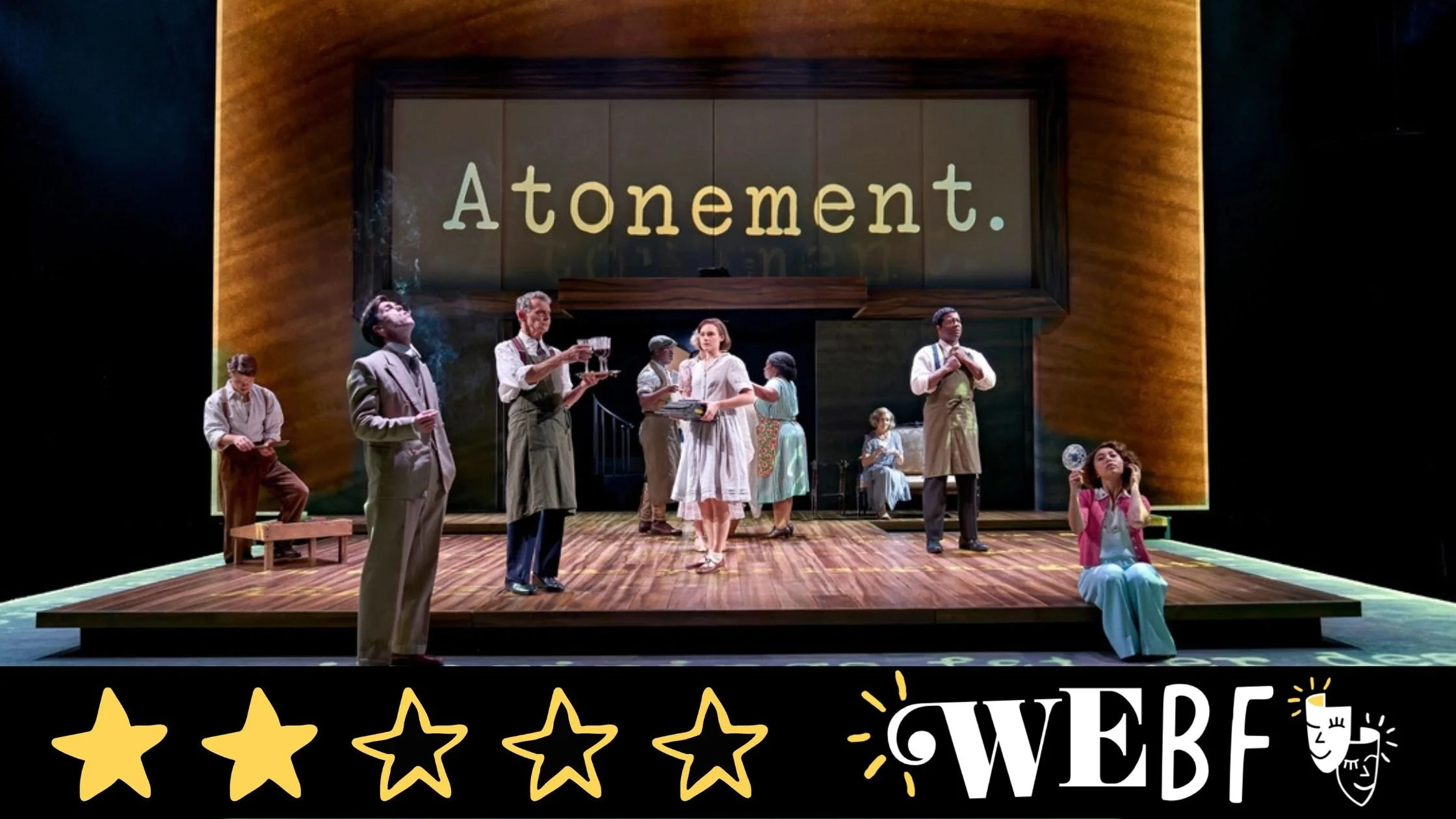
Photo credit: Manuel Harlan
For those who saw and enjoyed the 2007 film of Ian McEwan’s 2001 novel, the latest retelling of Atonement, now adapted for the stage by its screenplay writer Christopher Hampton, will be interested to see this fresh look at a family destroyed by a child’s lie for which in older life she seeks to offer atonement. For those who are unfamiliar with the tale, it is a somewhat laboured difficult story to follow as a result of its direction and staging on the huge thrust stage at Chichester Festival Theatre. It retains a cinematic quality but as we discover at the end, it is a collection of half-remembered scenes narrated by seventy-three-year-old Briony Tallis (played by Jessica Turner as a late replacement after the withdrawal of Sian Phillips), the perpetrator of that lie with its tragic consequences.
The adaptation and direction makes some curious decisions that distract rather than engage the audience in the narrative perhaps driven by trying to fill the enormous thrust stage when it is, again, a story that would sit much more comfortably in the Minerva Studio or behind a proscenium arch. The long, drawn out tedious first half is a slow burner, which takes forever to get to the key event in 1935, and then we missed that crucial moment which was lost in the darkness while we were distracted elsewhere on stage. The second act style is different; a confusing myriad of flashbacks between 1940’s London and Northern France, and 1939 London before World War II starts, then a leap forward to 1999 when we realise that we are being asked to piece together what really happened in 1935.
There are directorial choices by Adam Penford that seem a little strange and distract from the core narrative. A gratuitously naked Robbie Turner in a bath (played by Jasper Talbot), an old French man slowly plodding across the stage ignored by the retreating British troops, a soldier waiting to escape the beaches of Bray asleep amongst a group of dishevelled French down and outs, and a dying French man appearing to recognise the nurse, Briony Tallis (played by Isabella Dempster). All of the scenes feature the two key protagonists of the piece, the 13-year-old Briony who accuses the housekeeper’s son, Robbie, of raping her cousin Lola Quincy for which he serves five years on prison. Yet though the scenes portray the situations they find themselves in, they don’t assist the emotional engagement in their story but distract us from focusing on it.
The staging too by Anthony Ward is grandiose in structure and light on detail. A huge letterbox look into the upstairs room of the house where the 1935 scenes are set, accessed by a spiral staircase, dominates the stage while other scenes are played with limited furnishings on a wooden stage which echoes as people tread across it. Projections helpfully show what is being typed or written or translate the words of French speaking characters but naturally move our focus to the screen rather than the performance. The result is that we never engage or care about the characters and their fate. The posh, clipped English characters portray a world that is now forgotten. Only Miriam Petche as Briony’s sister Cecilia shines through the narrative as loyal and likable with her consistent love for Robbie making her the tragic heroine.
Other characters appear and disappear without trace. Their mother Emily (Debra Gillett), their brother Leon (James Brackway), the cousin Lola (Yanexi Enriquez), and the chocolate manufacturer Paul Marshall (Tom Chapman) are all important characters in the narrative yet have limited stage time and the actors reappear as other characters adding to the air of confusion.
We are asked to believe that Briony develops into a writer later on in life, the author of the book Atonement, and that if her first play in 1935, The Trials of Arabella, had been staged by Lola and her two brothers, instead of in 1999, the outcome of events in 1935 might have been different. Her message then was “love is all very well, but you have to be sensible”. We can see the tragic consequences of her infatuation and imagination and the irreversible consequences of her lie, and we ought to have sympathy for her regret and seeking of atonement at the end of her life, but the adaptation and staging left us detached, uncaring and still trying to piece together the story at the end.
** Two stars
Reviewed by: Nick Wayne
Atonement plays at Chichester Festival Theatre until 20 June, with further info here.