
Review: ARE YOU WATCHING?, Royal Court Theatre
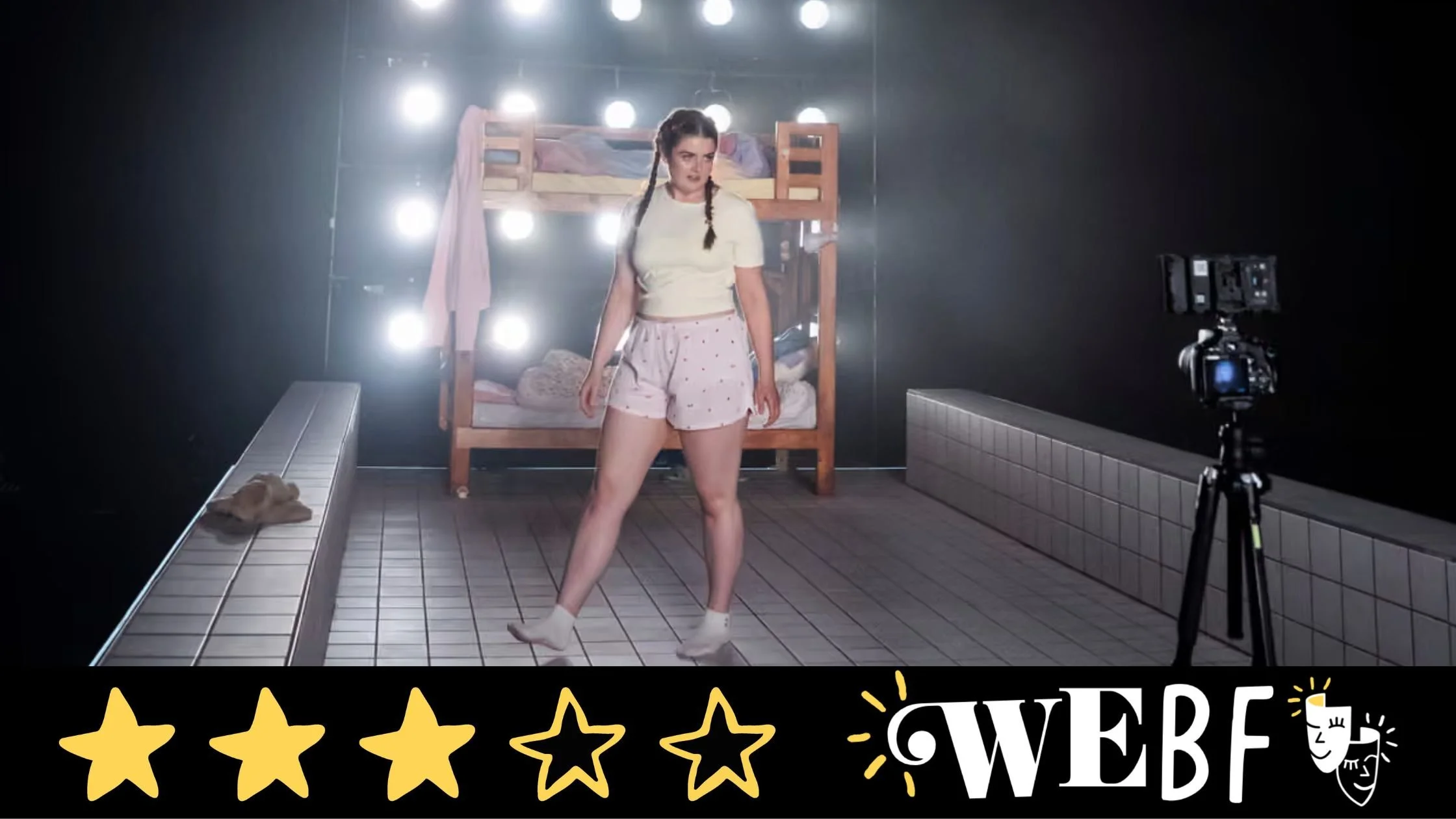
Photo credit: Tristram Kenton
Are You Watching? is a debut piece of work for Georgie Dettmer as a writer, performed at the Royal Court Theatre in the intimate space of their Jerwood Upstairs space. The Royal Court could be described as hosting a myriad of influential works across its almost 70 years and offers a great platform for writers. It prides itself on representing challenging and provoking work that takes risks and this is certainly a piece that is bold and risqué!
It is an incredibly uncomfortable watch that “asks audiences to consider when the lines blur between entertainment and abuse.” With multiple incredibly weighty concepts exploited, from a missing child that hints towards a sinister incident not dissimilar and with reference to the disappearance of Madeline McCann, to themes of deepfake manipulation and organised rape. As an audience, we are sideline witnesses to a staged experiment into varying categories of pornographic material, its connection with sexual arousal and introduced to darker realms surrounding volatile sexual pornography. It also bears mention to inappropriate use of AI generated material and manipulated child imagery. Delivered in an episodic type structure cross cutting between its multiple storyline threads, it is constantly alternating perspectives. Braided through the core of the piece is a narrative that parallels the drugging and raping of Gisèle Pelicot by her husband and other arranged men. What makes this increasingly uncomfortable again is this narrative being delivered by two teenagers having a sleepover, discussing this in relation to sexual exploration material.
Visually, nothing particularly graphic is viewed by the audience, although the final scene is visually disturbing as we reference later and sound effects support the themes strongly; the majority of the content is suggested, implied and described. It would undoubtedly be a step too far if this was not the case but therefore would be fair to say that it is a testament to Dettmer’s writing, the direction by Jess Edwards and the strength of the cast's delivery that, as an audience, we are made to feel so uncomfortable watching this unfold on these factors alone.
The set designed by Georgia Wilmot is essentially a white empty pool with a solitary set of bunk beds at one end where the teenagers (played by Kosar Ali and Abby McCann), who serve as the frame characters, are continuously onstage. This provides some perspective to the audience and cyclically leans into multi-level voyeurism. The audience are only two rows deep in a very intimate setting either side of the pool which adds to the tension of the environment, themes of spectatorship and questions of complicity as consumers.
Bethany Gupwell’s lighting design is simple but abrupt, brash and purposeful. It serves to differentiate between the episodes and build dramatic atmosphere, which it absolutely achieves. However, for a piece that’s already incredibly intense, sometimes this can be overpowering and startling.
Each thematic episode contains such hefty content but it is a fast paced piece that leaves it’s audience attempting to make sense of or form an opinion on a context. With the rapidity in pace, there’s not much opportunity to develop an emotional connection with any one of the characters before the piece has moved on or returned to continue a previous character’s story. This seems to have been the authors intention, as also detailed in the author’s notes in the play script - “we should get a sense that everything is happening everywhere and all at once.” However, it may be fair to expect themes of this nature to incite reactions of a shocked nature of which there was one only one occurrence of an audible gasp throughout the 65 minutes. The audience spend the rest of the time looking in and feeling almost uncomfortably numb with some element of morbid curiosity, which is what we feel the piece was aiming for in terms of exemplifying its themes of complicit voyeurism and possible humanity desensitisation, particularly in relation to material created and viewed online.
Some of the storylines don’t seem to conclude, for example, the missing child strand is never resolved but this again may have been a creative choice to embed a further possible stark reality. The teenagers’ closing monologue is presented whilst splashing in a pool of blood which may serve as an attempt to break the audience out of this numbness; it is open to interpretation but a rather harrowing sight.
The cast are clearly very skilled as performers. Simply six in total, aside from the teenagers aforementioned played Ali and Mccann, the remaining four - Billy Bolt, Lucy McCormick, Maimuna Memon and Nicholas Rowe - all deliver multiple roles in excess of 3 or 4 characters each with dedication and enthusiasm, with the transition either being made onstage, categorised through subtle accessorising or through a brief exit, alternating in pairs. Character transitions are fluid and although clear it was the same performer, it was easily identifiable which character was being portrayed and their individual plot narratives.
There are some moments of dark humour within the piece that do not so much serve as comic relief or momentarily release the tension but more to challenge the audience as to whether to react as if they are watching a piece of theatre or to be uneasy due to the disturbing and taboo topics that they surround. Many of these moments are woven into Bolt’s role as Comms Manager.
As we become ever absorbed in the age of technology, there are undoubtedly crucial points raised by this daring piece in terms of image altering software, the changing and sharing of material and digital abuse. It raises major concerns on consent and delivers a sharp critique of digital consumption, but it does come with multiple trigger warnings and is certainly not one for the faint hearted!
*** Three stars
Reviewed by: Claire Baker
Are You Watching? plays at London’s Royal Court Theatre until 4 July, with further info here.
