
Youth Pathways…
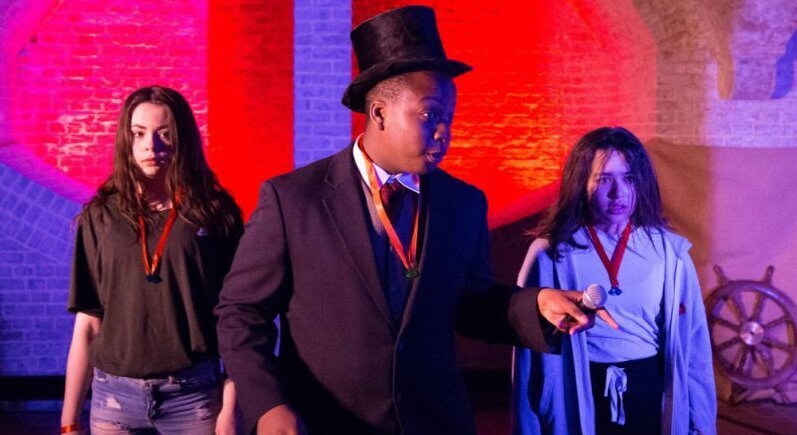
Photo credit: Les Enfants Terribles
Besties, on 12 October, we announced our new collaboration with Theatre Pathways, a weekly Substack series that highlights professional development opportunities into theatre across the UK for young people. This access to information and networks can encourage more young people to give it a go as a career development. We are excited to focus on this important area which is essential for finding and supporting more young people to enter the industry and helping more develop a passion for live theatre that we all enjoy.
The Campaign for the Arts recently shared that this summer's results found that at A-level, the arts' share of entries has fallen to a new record low - down 34% since 2010, with the sharpest drop in five years and the arts' share of GCSE entries is down 47% since 2010 – and this year stayed stagnant at just 7% of entries. This is worrying trend. These studies develop life skills as well as potentially open up career paths and should be part of the standard curriculum.
The Campaign for the Arts also shared that the Young Creatives Commission Interim report ‘Levelling the Pitch.' which was produced in partnership with the Roundhouse, highlighting this growing gap between young people’s widespread interest in creative activity and their ability to access the opportunities, support and relationships they need to develop those interests.
The evidence gathered by the commission highlighted some of the key challenges:
47 per cent of teachers in independent schools said that more than two and a half hours of arts teaching were timetabled each week, compared with just 6 per cent of teachers in state schools, according to a 2026 survey.
46 per cent of young people who had not taken part in art or music-related activities did not know where they could go for opportunities locally.
85 per cent of young people from global majority backgrounds who felt represented in music believed that a career in music was achievable, compared with 59 per cent of those who felt unrepresented, according to Youth Music research.
The report highlighted that the issue is not simply one of providing more activities. Young people told them they need opportunities they can find, enter, return to and develop over time. They value creative activity for many different reasons, including expression, enjoyment, confidence, connection and belonging, as well as the opportunity to develop skills and explore future education or employment. Progression into a creative career is one possible destination but should not be the measure of every valuable creative experience. West End Best Friend and Theatre Pathways want to be part of that process of promoting opportunities.
It is clear that as we set out in our Future of Theatre article - Youth Engagement that to develop these opportunities needs our support. Ideally, we need a National Youth Strategy for Theatre, a collaboration between the Government, ACE, Commercial Partners, Equity, regional venues, casts, crews, and audiences. We think there are three priorities: school curriculum, community hubs and philanthropy. We were therefore delighted to see in the ACE guidance for the five-year NPO awards to be applied for later this year, covering the period 2028 to 2033, ACE stated:
“Increase opportunities in those places for children and young people to have greater access to publicly funded culture and more chances to develop their creative potential”
If this secures commitment from venues and producers to deliver these opportunities and ACE provides the funding, we will have an important building block, but it is not enough. We will need schools commitment to make the time in the school day for these activities and teachers willing to coordinate trips out to venues to experience live theatre. Then perhaps we will have the activities to attract philanthropic giving to fund this activity and make it more accessible to all.
What we need to create is a series of alternative pathways for young people to try and see what suits them.
At school: English Literature, Drama and Technical skills, such as Design and Technology, develop an interest and knowledge, but they need to be combined with school productions to apply them and visits to the theatre to see professionals in action.
Out of school teenage years: Stagecoach, Summer Youth Projects and other classes develop that interest in a social space, building confidence and testing what aspects the young person enjoys most.
Drama school: Not everyone can secure or afford one the limited places at LAMDA or RADA but there are plenty of other good schools around the country to develop these skills and collaboratively learn how to stage a production. There are plenty of drama faculties at universities too.
NODA societies is another place to develop the all-round skills for a career in theatre. There are believed to be over 2,500 National Operatic and Dramatic Association societies around the UK; some fortunate to control their own venue, many use professional venues while other use the traditional village hall setting. A good society will provide several opportunities a year to appear on stage or work behind the scenes to create theatre and are excellent places to learn, shine and test a person’s interest. Many have separate affiliated youth groups.
We have experienced all of these in our lifetime and are always delighted by the standards that can be achieved in these organisations. School productions of Sweeney Todd, Evita and Phantom of the Opera; RADA productions featuring - for example - a young Patsy Ferran; Summer Youth Projects of titles like The Addams Family; and NODA shows in East Berkshire have all created some of the most memorable nights in a theatre in the last twenty years.
One key element we believe in is the need to not just fund and commission work, but to evaluate and track participants. We need to recognise that attendance at a first session establishes contact, but it does not show whether the experience was accessible, worthwhile or sustainable. Yet without that, the exercise is fun but pointless. Not everyone will go on to a career in theatre, but what everyone gains from the experience should be evaluated and celebrated and those that go on are the icing on the cake. We want everyone to experience the process, develop life skills and hopefully become part of future audiences, that is the main goal.
There are many examples of work where professional companies set out to offer these development opportunities to young people. A few examples to inspire other to expand their offer are:
Les Enfants Terrible promote engagement with students, schools and young people with workshops and teaching resources to inspire the next generation. We saw their exceptional Alice’s Adventures Underground production at Waterloo. They are currently promoting Puppetry Skills on 14 October, Making Immersive Theatre on 25 November, and Immersive Theatre for Actors on 10 February. All workshops are led by their Founder & Creative Director James Seager, and their Head of Engagement Sinead O'Callaghan. These are for professionals, but they have a schools licensing option.
The BalletBoyz annually stage an event at Richmond Theatre for its Trust for young people in the area and is a fascinating demonstration of how they support and develop young people’s interest.
Producers Empire Street always offers eye-catching casting that attracts a younger audience, and we were delighted to see The Stage Debut Awards gave Sadie Sink the Best West End Debut award when they were announced on 27 September. It was a standout West End performance of the last year. We wrote, ”In Sadie Sink and Noah Jupe, they have cast perfectly - not only do they both deliver the lines with clarity and meaning, but you can sense their instant infatuation and passionate longing. They create that sense of adolescent all-consuming first love and belief that they can’t live without you. It makes sense of the tragic story and is totally believable.”
Another exciting offer is from Melting Pot and Birmingham Repertory Theatre with their touring production of The Curious Incident of the Dog in the Night-Time, the 2003 book by Mark Haddon, adapted for the stage by Simon Stephens. It is a story of an ADHD child called Chris who discovers a dog killed in a garden with a pitchfork and their relationship with their mother and father. It has now been reimagined and restaged for an extensive UK tour. They have re-gendered the lead character Chris as a neurodivergent 15-year 3 month and 2-day old young woman. The portrayal was developed with LAMDA students, and two young actresses make their professional debuts in the role: Alex Keenan with an alternate Imi Price, who are themselves neurodivergent and bring lived experience to the performances. In doing so, they bring an authenticity and power to the story that fills the much larger stages and grabs and holds your attention from the first moment as she is found weeping over the dead dog and assaults a policewoman to the last joyous explanation of how she solved a A-level maths question.
Interestingly, the performance we saw was a house full of mainly school drama students, the story is on the GCSE Curricula and hopefully provided an inspiration for young people to go to the theatre more often. The combination of how this production was reimagined at LAMDA giving two professional debuts and the audience it attracted is a shining example of the way forward in programming and school engagement with the Arts.
Youth development in theatre from school to professional debuts is an essential part of the future of theatre in the UK, whether it is a school production, an amazing Summer Youth Project, or amateur dramatics, these opportunities provide young people a chance to develop their skills and confidence. Some may go on to drama school.
We must all support and champion the theatre pathways and encourage young people with an interest to develop along those paths. To reiterate, it needs a robust collaboration between the Government, ACE, Commercial Partners, Equity, Regional venues and casts and crews to create, promote and sustain these pathways for the benefit of the individual participants AND for the future of theatre audiences.
Nick Wayne
Nick has been involved as a Trustee/Director in UK Producer and Venue Organisations for twenty-six years, seen over 1350 productions, visited over 160 of the UK Venues, seen overseas productions in USA, Canada, France, Hungary, Austria, Czech Republic, and Australia and invested in over 40 West End Productions. You can read his long form articles on Stage Whispers UK - Nick Wayne