
Review: WE HAD A WORLD, Hampstead Theatre
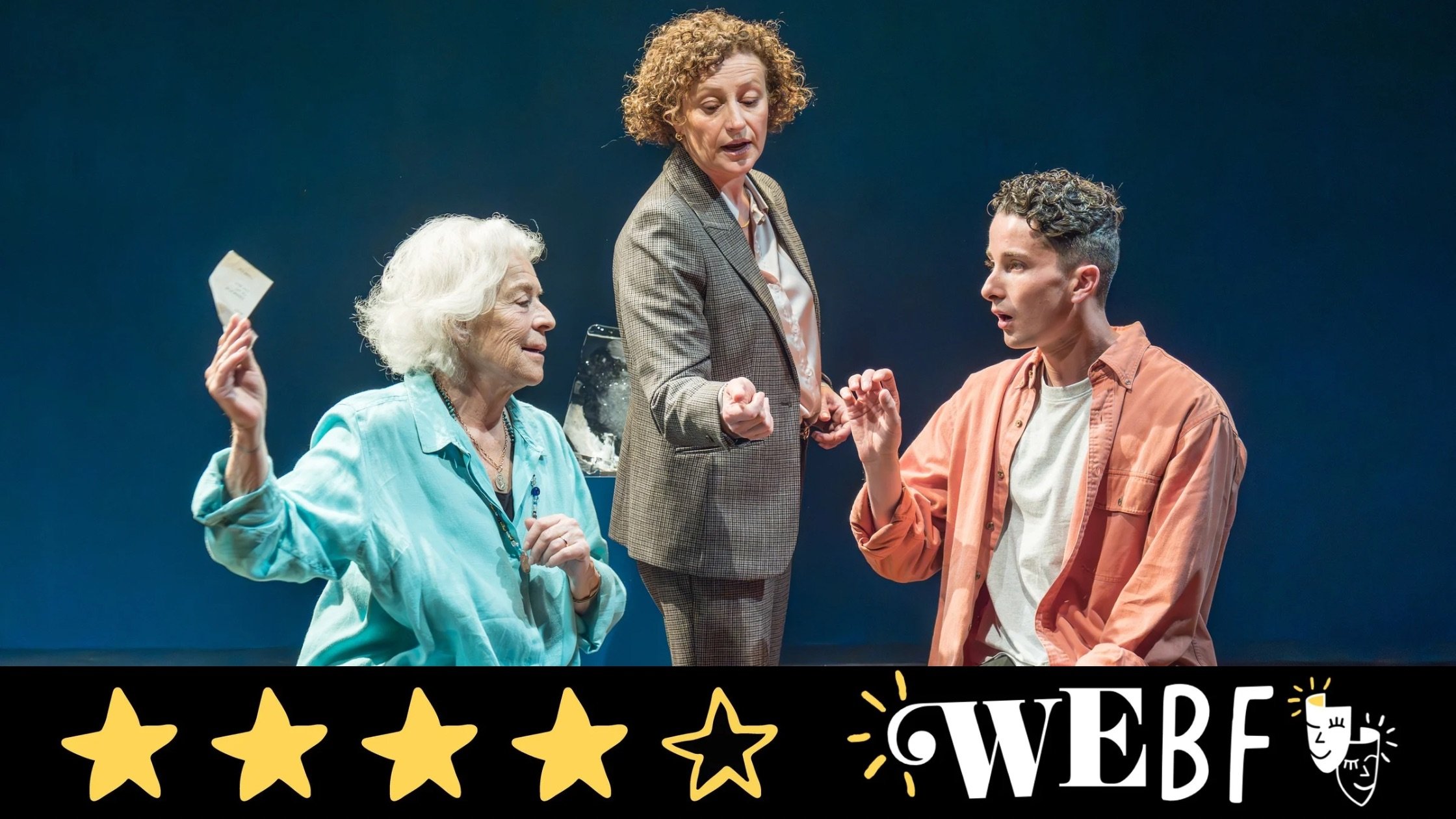
Photo credit: Marc Brenner
We’re back at Hampstead Downstairs again, always a welcoming venue, and this time for new play We Had a World from US writer Joshua Harmon, author of Bad Jews. As we enter Hampstead Downstairs, configured with seating on three sides, we see a young man in his underwear, sitting and reading. The playing area is a parquet floor, outlined in a rectangle of light which is echoed above. Behind him a block of ice is melting, symbolising his concerns, and as reflected in the title of the piece.
Joshua is the central character and our narrator, as well as being a thinly fictionalised version of the author. Reality and fiction come and go in this cleverly interweaved text and we are left wondering how much is biographical and how much is dramatic artifice. We meet many of Joshua’s family, at least we are told about them; but only his mother and grandmother appear. It’s a very meta-theatrical play, and all the more effective as a result.
By the end of the 1hr 45 mins run time of Josh Seymour’s confident production (no interval, as is currently fashionable), we feel we know this family well. We are occasionally distracted by the melting block of ice, a rather heavy-handed metaphor that attracts the eye as we wonder whether we can see it getting smaller, and presumably added by designer Sarah Beaton as it is not mentioned in the script. The environmental concerns in this play are secondary in any case to its portrayal of intergenerational relationships, and in particular men and their mothers and grandmothers. It has far more to say in general about those relationships than it does about global warming.
A trio of exemplary performances bring this complex web of relationships to life. As Joshua, Ryan Kopel has to portray the character from the age of 5 until he is in his 30s, and does so mainly through narration and recollection rather than direct impersonation of his younger self. In doing so, he is able to inhabit and comment on his earlier actions and perceptions. He occasionally asks his mother to play other parts, but he is asking his mother not the actor. It’s a subtle, thoughtful and highly effective portrayal which grows in stature as the play progresses.
As his mother Ellen, Anna Francolini is a tightly bound mesh of conflicting feelings, unresolved history and family angst. Estranged from her sister, she also has a complex relationship with her onstage mother and offstage but very present father. It’s a part that could easily be played at a constant pitch, but Francolini finds the nuances in the character and let’s us see who she would rather be, as well as who she is.
As eccentric grandmother Renee, Suzanne Bertish captures the vulnerability as well as the brash thoughtlessness of the character, so that we are exasperated by her as is her daughter, but also attracted to her like her grandson. It’s a detailed performance wholly in tune with the complexity of the writing.
As the play progresses, we learn more about the relationship between the two women, and find that it is not what it seems to be, or what Joshua thought it was. By the end of the play, he reaches a kind of understanding, suggesting that “women who should not have been mothers can make very compelling grandmothers.” His growing self-awareness of himself as an ungrateful son also allows him to recognise belatedly the devotion of his mother.
We Had a World is another fine production in what is proving to be a remarkably varied season at this always enterprising and welcoming theatre. See it for three remarkable performances in an intelligent production which understands and negotiates this complex web of fiction and biography.
**** Four stars
Reviewed by: Chris Abbott
We Had a World plays at London’s Hampstead Theatre until 4 July, with further info here.
