
Review: TWELFTH NIGHT, Barbican Theatre
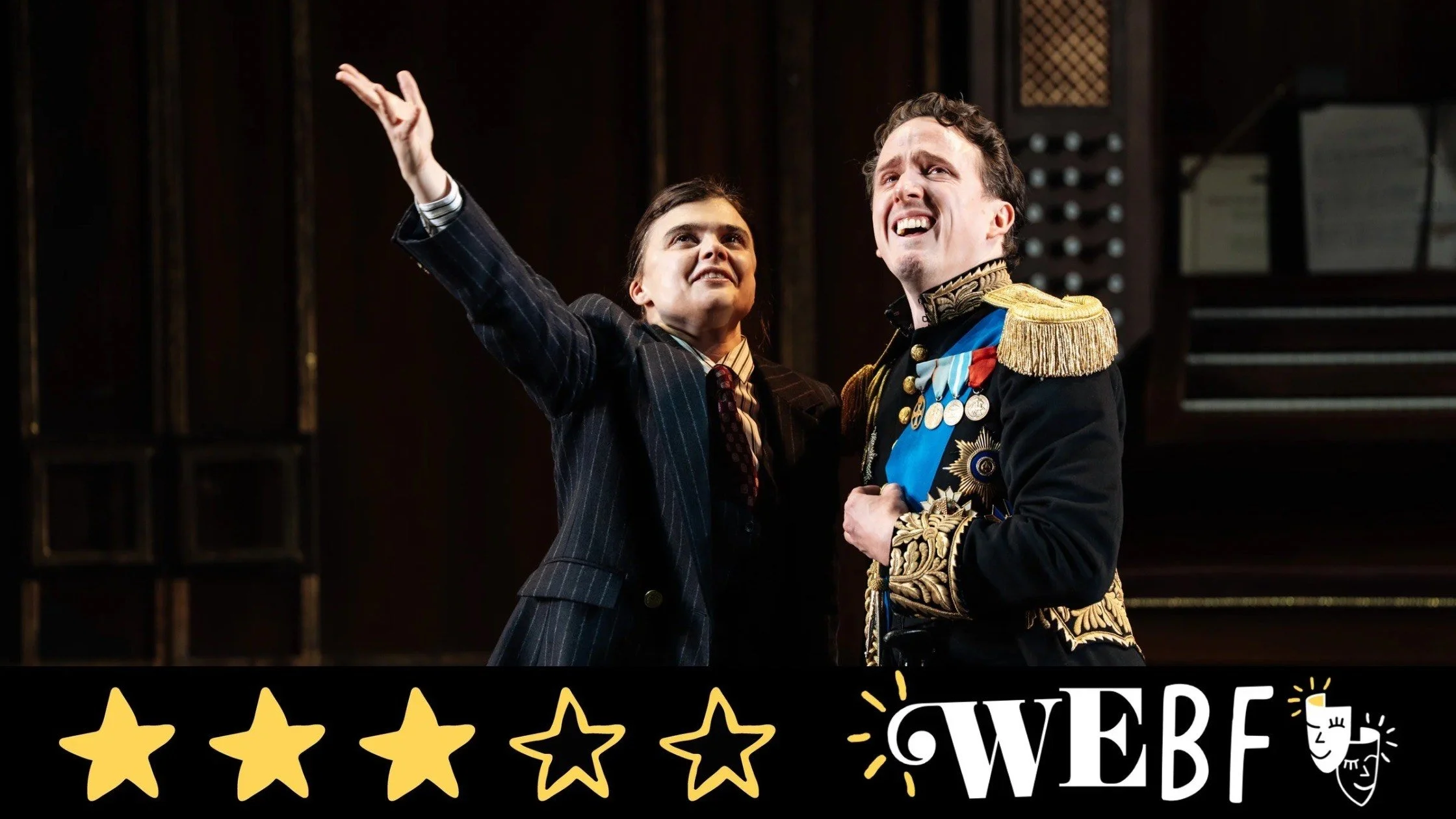
Photo credit: Helen Murray
As directed by Prasanna Puwanarajah, Twelfth Night invites us to ponder on the melancholy that underlies festivities.
Switching the order of the first two scenes, this production of Twelfth Night begins with a sodden shipwrecked Viola clambering through an enormous brutalist letterbox-shaped light-box to find herself in Illyria. Having been saved from a sinking ship by its Captain, and distressed that her twin brother, Sebastian, may have drowned, Viola is not sure what to do. Hearing, from the Captain, of the Countess Olivia, Viola initially thinks of seeking to serve her. Olivia, however, is in mourning for her father and brother and is not admitting anyone, so Viola decides instead to disguise herself as a gentleman, Cesario, and seek employment at the court of Duke Orsino. Thus the central plot of mistaken identities is established.
Just as Viola is a stranger in Illyria, it is soon clear that the place itself is strange. The light box gives way to reveal a meadow bank, soon to literally become Orsino’s “sweet bed of flowers” (set and costumes by James Cotterill). In front is a grand piano with Orsino (Daniel Monks) atop it surrounded by his retinue of male attendants. With the famous “If music be the food of love” monologue underscored by Matt Maltese’s plangent piano piece, the overall melancholic tone of the evening is set. Later, the stage is dominated by an enormous organ, the reverberations from this adding to the soundscape (and providing a great visual gag).
The principal story line revolves around Orsino taking on Cesario and sending them to woo Viola on his behalf. Viola is immediately smitten with Cesario who, in turn, has fallen for the Duke, so a triple case of unrequited love is set up.
Arriving in glamorous mourning attire, Freema Agyeman is splendid as Olivia and there is clearly an instant spark, for her, with Gwyneth Keyworth’s Viola. Once Olivia’s attendants have withdrawn, Agyeman and Keyworth take command of the Barbican’s enormous stage and endear themselves to the audience. While much of the comedy in other parts of the production relies on slapstick, Agyeman finds the humour in Shakespeare’s text: her self-admonition over “what is your parentage?” being such a lousy chat-up line is a case in point. In the final scene when Olivia is told that she might “have been contracted to a maid”, Agyeman’s look to the audience speaks volumes.
Less convincing is the sense of attraction that Viola feels for Orsino. In their scenes together, the Duke’s attendants stay on stage, dancing together and vying for Orsino’s attentions, making it difficult to focus fully on what is happening between Viola and Orsino.
Sea-captain Antonio (Norman Bowman), having rescued Sebastian (Rhys Rusbatch), also makes declarations of love but here again, the implications are under-developed.
Alongside these entanglements is the secondary plot of the humiliation of Olivia’s steward Malvolio (Samuel West). Sir Toby Belch, Olivia’s uncle, and his companion Sir Andrew Aguecheek, piqued by Malvolio’s shutting down their revelries, conspire, with Maria, a waiting-gentlewoman, and Fabian, another member of the household, to convince Malvolio of Olivia’s love for him. Given the excesses of these characters, it is easy for productions to have them played as comic grotesques, but Puwanarajah adopts a subtler approach. Joplin Sibtain’s Sir Toby is a boorish drunk while Demetri Goritsas’ Sir Andrew is an American clearly out of tune with the niceties of courtly life.
As might be expected, Samuel West presents a complex Malvolio. Rather than being a prissy puritan (although he does snatch a Santa hat off a passing attendant), his Malvolio is simply a stickler for order, so when his life becomes so completely dis-ordered, it is genuinely moving. At the end, hissing his desire for revenge to the “whole pack” of the audience makes us complicit in crossing the thin line between laughing with and laughing at.
As a thread running through the evening, Michael Grady-Hall is splendid as the jester Feste. Not only does his clowning delight the audience, his strong singing of the ballads (new melodies by Maltese) add to the evening rather than feeling like interludes to be sat through.
The opening scene has two small tombstones front of stage, and these return for Feste’s poignantly sung epilogue. Bookended in this way, the follies of love that we have witnessed bear witness to Feste’s earlier claim that “Youth’s a stuff will not endure”.
This is a Twelfth Night that goes beyond being simply a great comedy and invites us to question how to live and love.
*** Three stars
Reviewed by: Mike Askew
Twelfth Night plays at London’s Barbican Theatre until 17 January, with tickets available here.
