
Review: THE SPY WHO CAME IN FROM THE COLD, UK Tour
Johan Persson
The Spy Who Came in from the Cold is the first stage adaptation of one of John le Carré's famous spy novels, and with it you can see why it has taken so long to reach the theatre.
The complex story has been condensed into a two-hour, 15-minute production, including the interval, and at times it feels as though certain aspects of the novel have been lost. The key plot points are all there, and the narrative flows well enough to make it easy to follow, but there is little time to build meaningful relationships between the characters or explore them in any real depth.
We are first introduced to Alec Leamas (Ralf Little), a British intelligence officer working in Berlin. After his undercover source, Karl Riemeck, is killed attempting to cross the Berlin Wall from East Germany, Leamas is ready to 'come in from the cold' and retire. However, Control (Nicholas Murchie) has other ideas, offering him one final mission: to bring down Mundt (Peter Losasso), an East German intelligence officer at the Abteilung whose rapid rise through the ranks has raised suspicions.
As with most spy stories, nothing goes according to plan. Leamas makes the one mistake the Circus never expects—he falls in love with Liz Gold (Gráinne Dromgoole). Although he never shares classified information with her, the relationship complicates the mission and sends it in several unexpected directions.
Watching over the operation is George Smiley (Tony Turner), a familiar figure for fans of le Carré's novels.
The first act is largely devoted to setting up the story, but it moves at such a brisk pace that it often feels rushed. Very little time is devoted to developing Leamas and Liz's relationship, making it difficult for the audience to invest emotionally in them. We rarely see Leamas's softer side; instead, we are presented with his constant emotional distance before the romance suddenly develops.
The second act is considerably more engaging, allowing the layers of the plot to unravel and building towards a satisfying conclusion that leaves few loose ends.
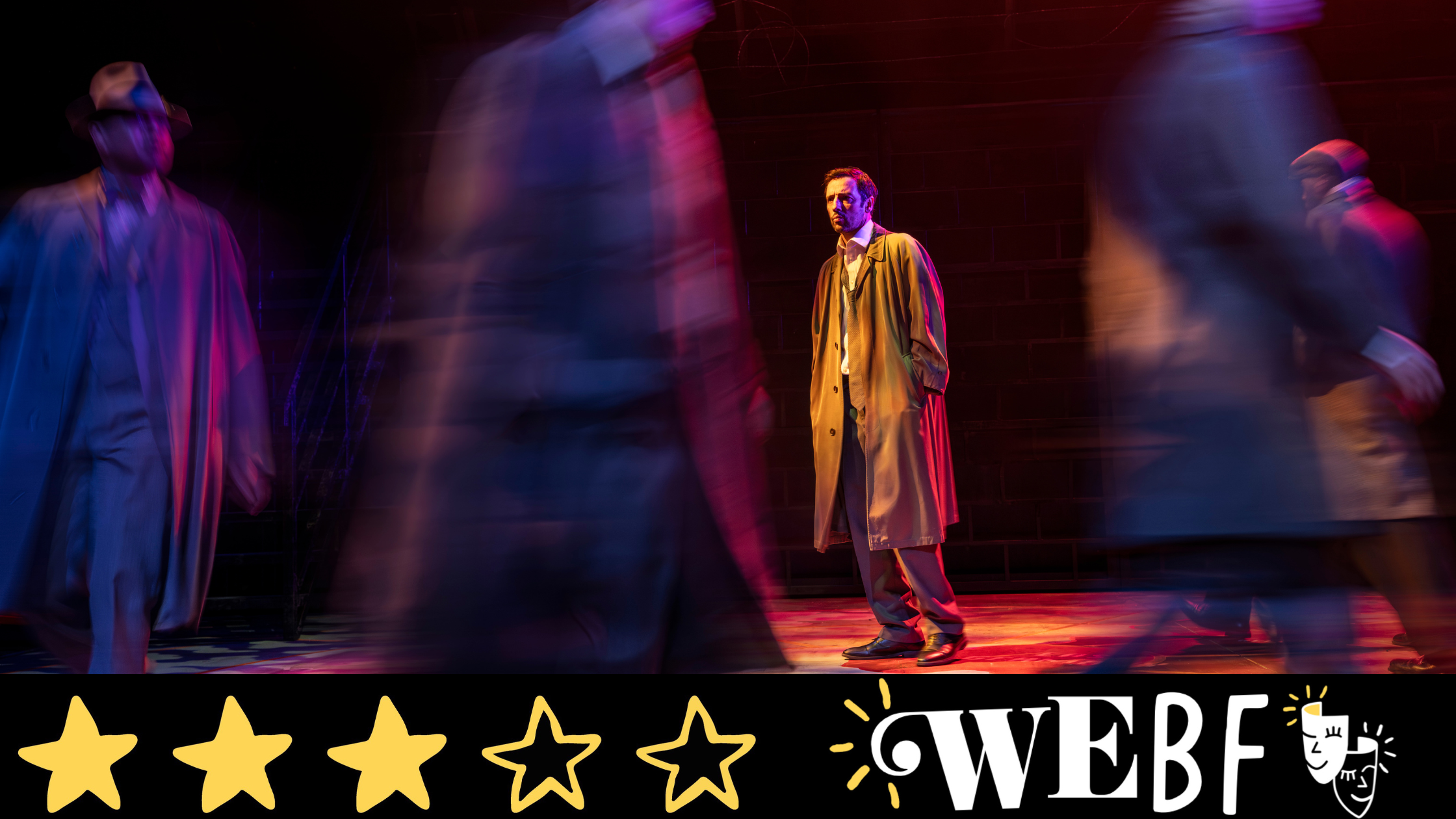
The set design perfectly captures the cold, oppressive atmosphere of the piece. A towering back wall, styled to resemble the Berlin Wall with its concrete brickwork and barbed wire, dominates the stage. Above it sits a gangway where George Smiley spends much of the performance, almost omnipresent, subtly reinforcing his control over events. It is a particularly effective visual touch.
The lighting is equally impressive. Movable overhead lights descend like interrogation lamps, adding to the tension and atmosphere throughout. A striking blue light running through the Berlin Wall is used during moments when Leamas retreats into his own thoughts, creating an effective visual representation of his internal conflict.
The cast, led by Ralf Little, deliver strong performances throughout. Little takes a little while to settle into the role during the first act, but he truly finds his stride after the interval, delivering a far more layered and compelling performance. His chemistry with Gráinne Dromgoole as Liz Gold feels somewhat underdeveloped, although both actors perform well individually.
Dromgoole portrays Gold as warm, likeable and perhaps a little naïve, full of hope that the world can change. She has excellent diction and a commanding stage presence.
Nicholas Murchie is superb as Control, striking the perfect balance between calculated manipulation and dry wit. His performance makes the character both authoritative and quietly intimidating, while still feeling like a faceless figure within the intelligence machine.
Tony Turner gives an understated yet powerful performance as George Smiley. Although he has relatively little dialogue, his constant presence and measured physicality allow him to dominate scenes without saying a word.
Peter Losasso and Eddie Toll, playing Mundt and Fiedler respectively, both maintain convincing German accents throughout. Toll, in particular, brings considerable emotional depth to his performance.
The Spy Who Came in from the Cold doesn't quite hit the mark when it comes to pacing, with the adaptation sacrificing character development in favour of plot. However, strong performances, an atmospheric production and some striking design choices make it an enjoyable evening at the theatre.
***Three Stars
Reviewed by Emma Littler
To book tickets, click here