
Review: THE CHERRY ORCHARD, Harold Pinter Theatre
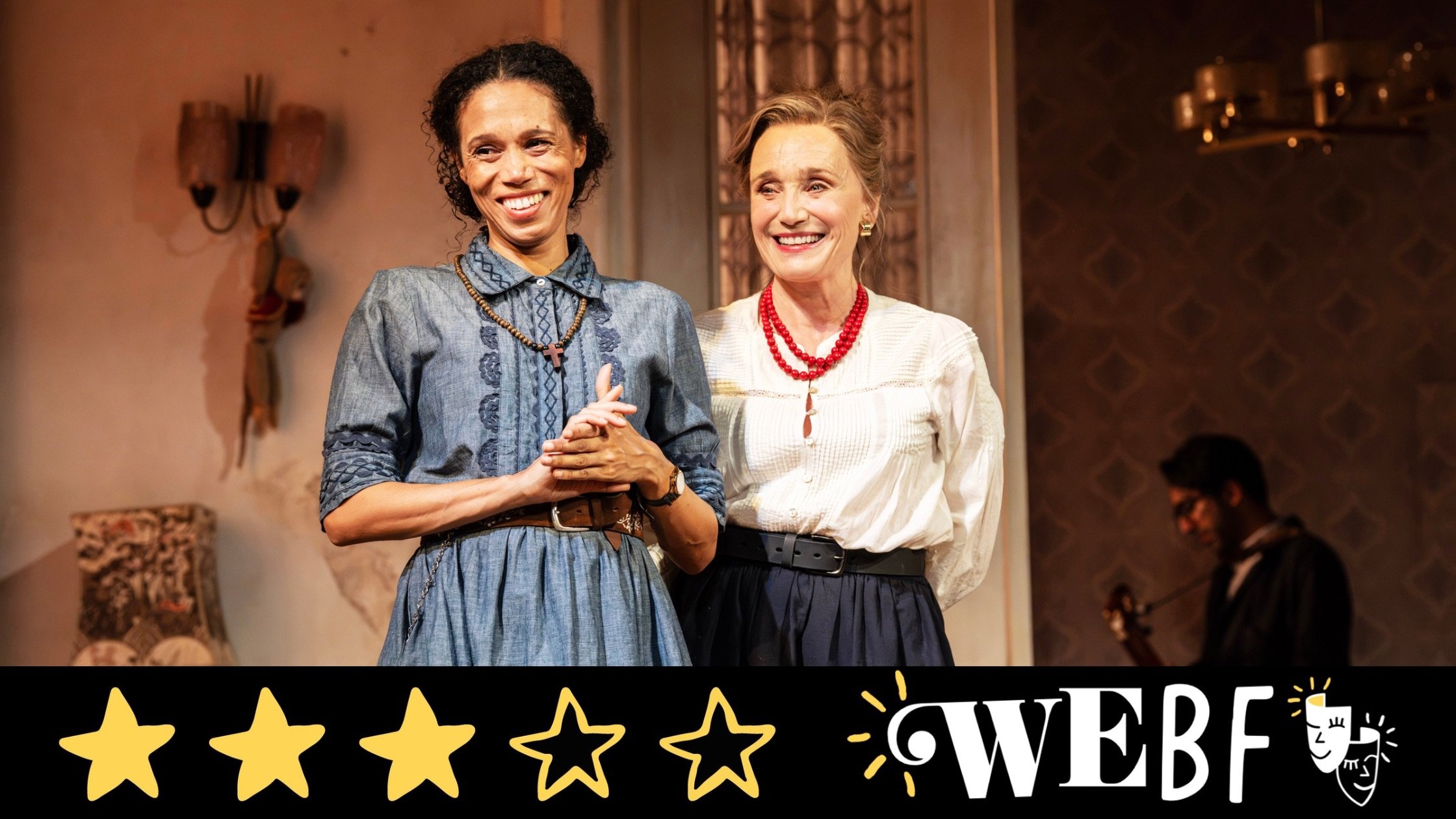
Photo credit: Johan Persson
Whatever your knowledge of this play, the very name The Cherry Orchard carries an air of prestige. Having already had one stage adaptation in Stratford-Upon-Avon earlier this year, on the surface, this is an intimidating prospect for both creatives and audiences. The last of Anton Chekhov's plays, it maintains the classic Chekhov characteristics: a large ensemble cast inhabiting an aristocratic Russian household, relatively out of touch with real-life hardships and entangled in multiple romantic complications. Here, Ranevskaya (Kristin Scott Thomas) is a mother in mourning who returns to her run-down family home, which is under threat of sale due to mounting debts. The most feasible option to save the family estate is to allow the beloved cherry orchard to be felled to make way for summer homes. However, despite constant reminders of impending bankruptcy, they continue to live a high-end lifestyle, unable to accept that society is undergoing seismic changes.
When Anton Chekhov originally published the play in 1903, he described it as a comedy, complete with farcical elements. However, its first director saw it as a straight-up tragedy. Therein lies the dilemma for all future adaptors: in which direction do they lean, and how do they balance the two? Director Ian Rickson and adaptor Conor McPherson reunite after their previous success with Chekhov's Uncle Vanya and quickly lean towards the farcical nature of the setting. As doors swing open and closed, they conduct the stage like a giant chessboard. We are quickly introduced to the large cast, and every character gets their opportunity to step forward to a central square and shine, either when flanked by the formidable ensemble or in a smaller scene, speaking in defence of or in opposition to the proposed destruction of the prized orchard. The various combinations of characters allow the multiple romances and rejections to unfold with pace and clarity, but it is Vinette Robinson's Varya who provides the emotional roots of the household, binding everyone together in a tender and heartbreaking performance.
At the heart of this chessboard sits the queen whom the family are so keen to protect: Kristin Scott Thomas's Ranevskaya, a jittery ball of nervous energy doing her best to mask her grief while remaining unable to accept that the family home is slipping away from her. Scott Thomas is wonderfully visceral and always a joy to watch. Her distant stares, which routinely snap back to the present moment, are mesmeric to watch, but she struggles to convey the depth of emotion required in a play that wrestles with its own tone, never far from a comedic interlude. Special mention should go to Jack Riddiford as Trofimov, Ranevskaya’s daughter’s tutor, whose exchanges with Scott Thomas are magnetic and a particular highlight of the play.
The play does indeed work best when foregrounding its cynical comedic side. Stephen Mangan's sharp-tongued Lopakhin is a former serf who has risen to become a wealthy man but, to his frustration, is still not recognised as an equal in these surroundings. Mangan delivers the comedy with precision through both physical dexterity and verbal wit but is less believable when he must quickly pivot into becoming the piece's outright villain.
Karl Johnson, as the butler Firs, is the real heart of this production. McPherson clearly has a deep affection for this character, who gets all the best laugh-out-loud one-line jibes and steals every scene he appears in. Here, Firs is presented as a human personification of the estate itself: old, declining, but held in great affection by the family. Like the damp-ridden walls of Chloe Lamford's wonderfully dilapidated set, there is a whole life on display within this cynical, foul-mouthed body, and it is his decline that most strongly resonates as a reminder of what is really at stake. This is more than a family estate; it is people's dependency and livelihoods in a fast-changing world for which they are unprepared. The final tragic scene of Johnson alone in the house suddenly feels very far removed from his comedic turn throughout and has quite the impact.
All in all, this is a fun and touching restaging of a classic family drama, but the push and pull of this comedic tragedy never quite settles on either mode and cannot always see the wood for the trees.
*** Three stars
Reviewed by: Phil Meikle