
Review: TAO OF GLASS, @sohoplace
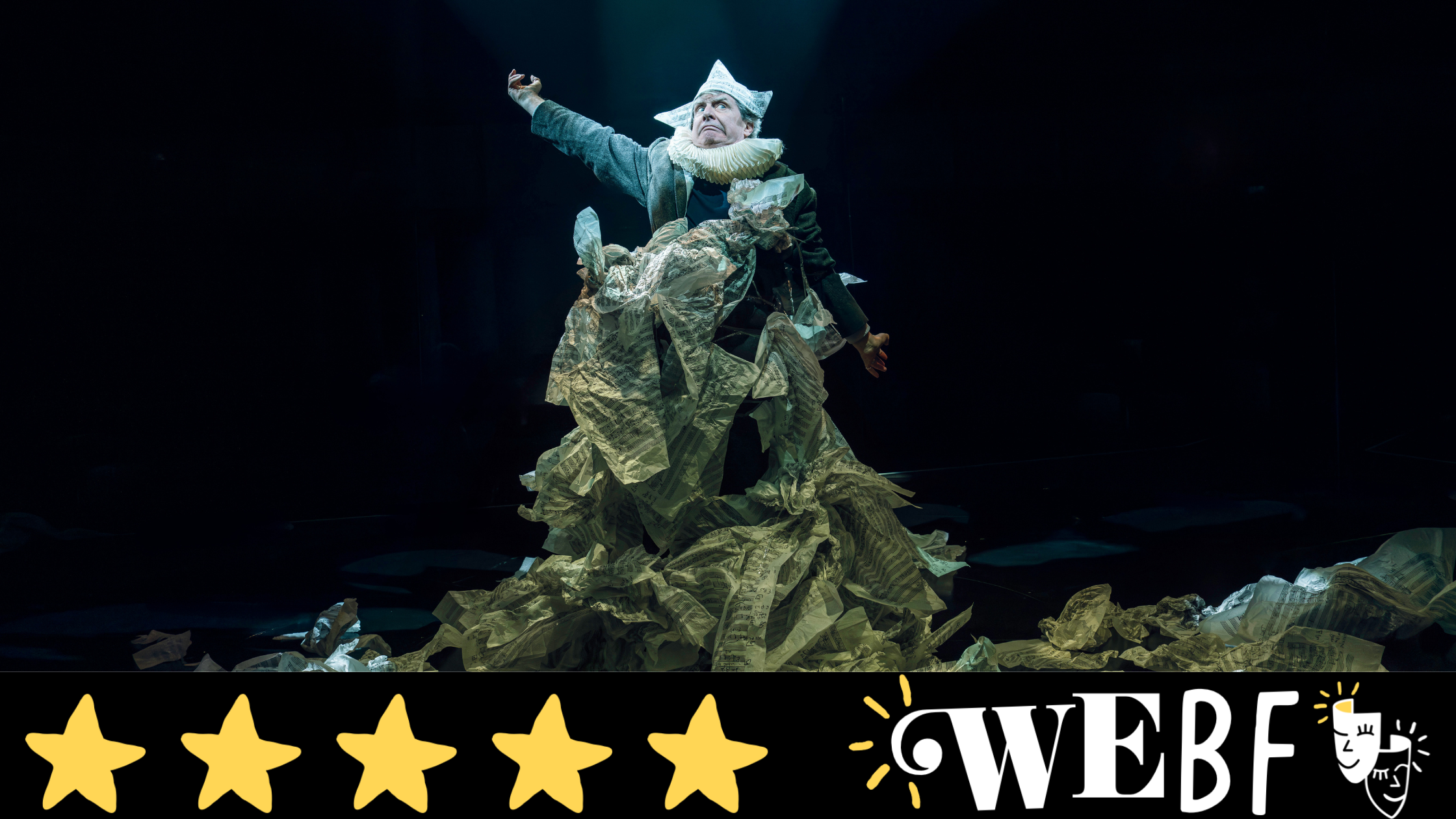
Johan Persson
What makes a West End production? A huge cast? A spectacular dance number? Fancy lighting and an elaborate set? For Olivier Award-winning director and performer Phelim McDermott, the answer lies somewhere else entirely. It sits in what he calls, borrowing from the psychologist Arnold Mindell, essence, dreamland and consensus reality. Tao of Glass quietly manifests that philosophy on stage.
Seven years after its first premiere at Manchester International Festival, McDermott brings his collaboration with one of the world's most celebrated living composers, Philip Glass, to @sohoplace. Part autobiography, part meditation, part love letter to theatre and to music, the piece feels like an invitation into McDermott's mind, and a guided tour of his unconscious.
The story follows McDermott's life and the long, patient process of making a work with his hero, Glass. From Maurice Sendak's In the Night Kitchen to the Tao Te Ching, I Ching and Lao Zi, we are led through his childhood memories, his dreams, and his contemplation of mortality. It is also, simply, the story of how a collaboration comes alive, told by someone who clearly finds that process as miraculous as the result.
As the show begins, McDermott emerges from the auditorium and takes his time to connect with us. He is a wonderful storyteller, warm and unhurried, with a clown-like playfulness sitting just underneath. The curiosity in his eyes is probably the most charming thing on stage. He remains utterly present, responding to the audience with ease, and makes every person in the room feel like they are the whole world for a moment. It feels like being children and adults at once, listening to a father or a friend tell a bedtime story, while he dreams alongside us.
That same warmth and touch of humanity extends to the production itself. Puppetry, shadow play and object manipulation are used through out. Lyndie Wright's puppet design carries tenderness, and Fly Davis' design giving the whole production room to breathe. Colin Grenfell's lighting and Giles Thomas' sound move us between reality and dream. Kirsty Housley's co-direction is the kind of work that is easy to overlook and almost certainly essential. An autobiographical piece needs an outside eye that can see what the performer cannot, and Housley has done this before, co-directing Simon McBurney in Complicité's The Encounter. The shaping here is precise enough to feel invisible. The puppetry techniques are simple, yet each is executed with such precision that they become quietly magical. Puppeteers Sarah Wright, Janet Etuk and Vic Llewellyn handle every one of them with extraordinary care, whether they are casting shadows with a torch, turning a sheet of manuscript paper into a giant, or breathing life into the little boy puppet who carries so much of the show's heart. None of it is technically complex, but all of it done with tenderness and care. Equally refreshing is the visibility given to the musicians and puppeteers, led by music director Chris Vatalaro. Rather than disappearing into the mechanics of the production, as they so often do, they take up space as active storytellers. It is a fitting choice for a work that is ultimately about what people make together.
The second half is where the piece really opens out. As the story deepens and McDermott's emotion escalates, the imagery on stage grows wilder and wilder, building towards something close to chaos. And then, without warning, all of it drops away. We are taken into a deep meditation, and for a long stretch nothing asks for our attention beyond Glass' music. McDermott simply lies on the floor. The rest of us are given permission not to analyse, but to sit with the sound.
Perhaps the production's greatest achievement is this confidence in stillness, and the fact that it earns it. McDermott understands exactly when silence is needed, and he has spent the previous hour building the pressure that makes the silence land. In a theatrical landscape that feels compelled to entertain every second, these moments become surprisingly profound. They are not empty space. They are space for reflection.
There is something distinctly @sohoplace about all of this. The venue continues to programme work that sits outside conventional commercial theatre, and Tao of Glass extends that tradition. It feels close to miraculous that a piece this experimental, this gentle and this patient can exist on a West End stage. One could easily imagine it in a small black box studio, and there is something moving about watching an artist who has made enormous, elaborate productions turn back towards the simplest tools of theatre-making. Here it sits comfortably in one of London's newest commercial venues without losing an ounce of its intimacy.
The piece also leaves behind a question that is hard to resolve. Eastern philosophy forms the backbone of McDermott's worldview here, and it is handled with real care. This does not feel like borrowed exoticism. It reads as a philosophy he has actually lived with, and he understands what sits behind these texts. So the question of whether a work this rooted in Eastern thinking should also have Eastern artists shaping it becomes a difficult one. The instinct is that it probably should. Yet the version of that answer where an Eastern face is added to the room and nothing else changes is not much of an answer either, because understanding the essence of a philosophy matters more than looking like one ought to understand it. It is worth turning over, and perhaps that is the honest place to leave it.
“道可道,非常道” (“The Tao that can be told is not the eternal Tao,”) Lao Zi warns. McDermott does not try to tell it. He simply lets us into the dream, sits down beside us, and lets Glass do the rest. What a gift.
*****Five Stars
Reviewed by Diana Feng
To buy tickets, click here