
Review: SOME WOMAN, National Theatre
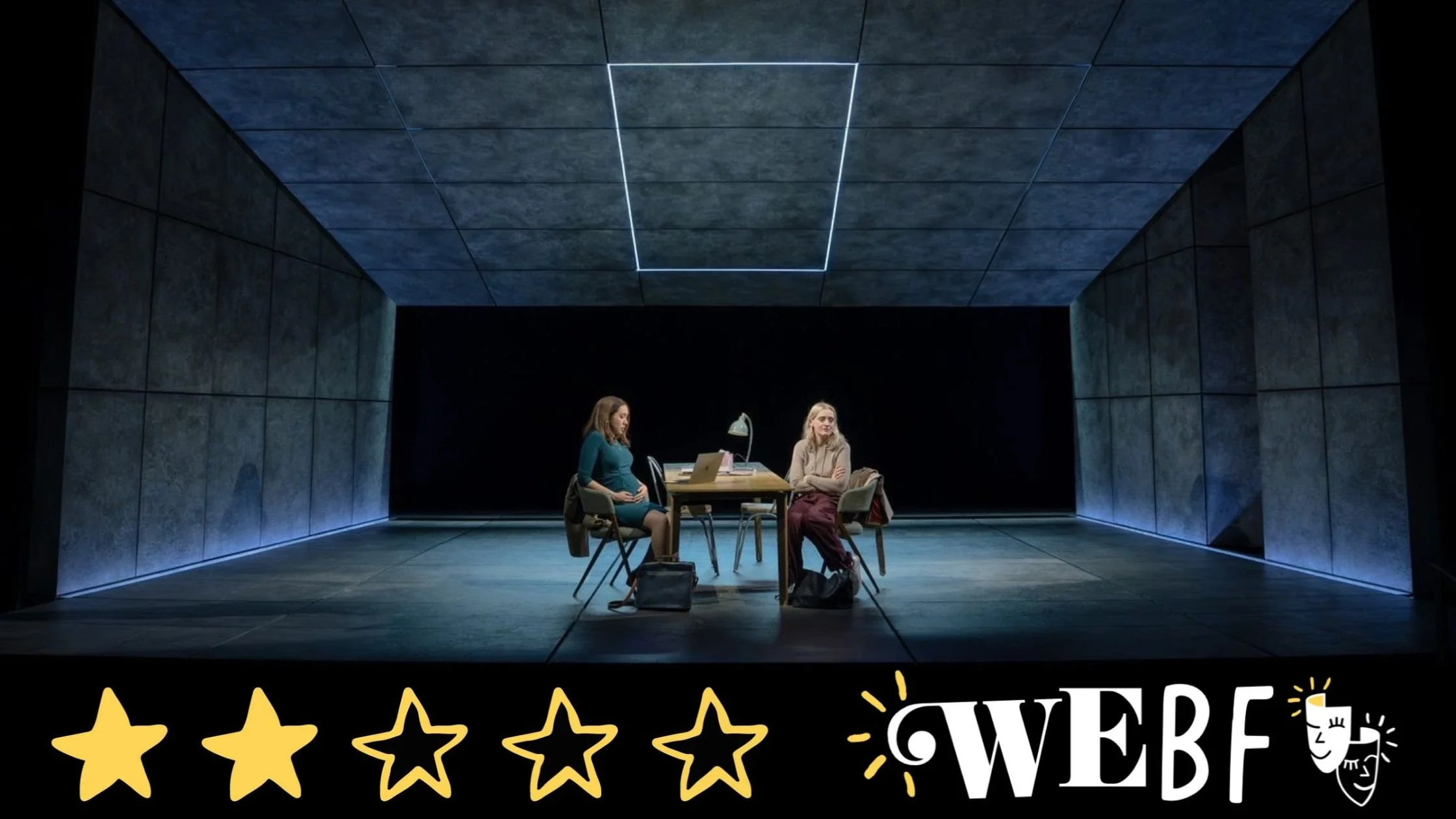
Photo credit: Ellie Kurttz
Helen Edmundson’s Some Woman follows Julie, a divorced mother-of-two, as she negotiates the personal and domestic implications of a seemingly unfounded criminal charge. It’s a domestic drama with bigger world ambitions, taking place over the course of a month or so, and at nearly two hours without an interval, is unrelenting in its insistence that it has something important to say, and is an impressive feat for its main cast whom are engaged throughout.
The story unfolds naturally, through a series of scenes in enclosed spaces, made suffocating by Robert Jones’s set design that often closes the lid on Julie’s (Anne-Marie Duff) increasingly narrowing choices. Julie’s daughters, Hannah Onslow’s assertive and abrasive Kate and Grace Doherty’s ambiguously unwell Ginny, alongside their mother never look comfortable in their setting, lending a tense edge to proceedings that necessitates the plot rather than foreshadows it. There’s a permeating sense that this home isn’t really a home, perhaps attempting to show a family not quite comfortable with one another, or perhaps indicative of a tension that the audience is not supposed to be able to ignore.
Natasha Chivers’s lighting has some wonderful moments of warmth against scrutiny, but perhaps for practical reasons never allows a full blackout, lending the transitions an uncertain atmosphere. No one in the cast of characters has much fun, except Tobi King-Bakare’s Nathan, who brings some much needed charisma to proceedings, even if occasionally dissonant. Onslow is the stand-out in terms of performance, committing to the complex character she is given and believable in her torn loyalties to herself and the mother that made her herself.
The message of the play seems to be allowing mothers the space to be angry, but Julie’s final stand is lessened in impact by the sense that she is angry from the start. In the final act, an overt instance of threatening, overpowering masculinity leaves little satisfaction for an ending that is trying to commit to a stance, but is up against the complicated odds of its own premise, and the downbeat emotions of most of the rest of the play.
Blanche McIntyre directs her cast in successful waves of discord, although there’s a staticity to most scenes, since it is mostly people standing still in a room and talking to one another. The piece suffers overall from an emotional block with the audience, who will feel sympathy for Julie’s plight but don’t get the chance to know and care for her beyond her pain. The aftertaste is that being a mother is a thankless task, and the odds are stacked against women despite their own fortitude. The blandness of the setting lends a realism that, while convincing, doesn’t spark much imagination.
An interesting premise pulled down by its own weight.
** Two stars
Reviewed by: Oli Burgin
Some Woman plays in the National’s Dorfman Theatre until 21 November, with further info here.
