
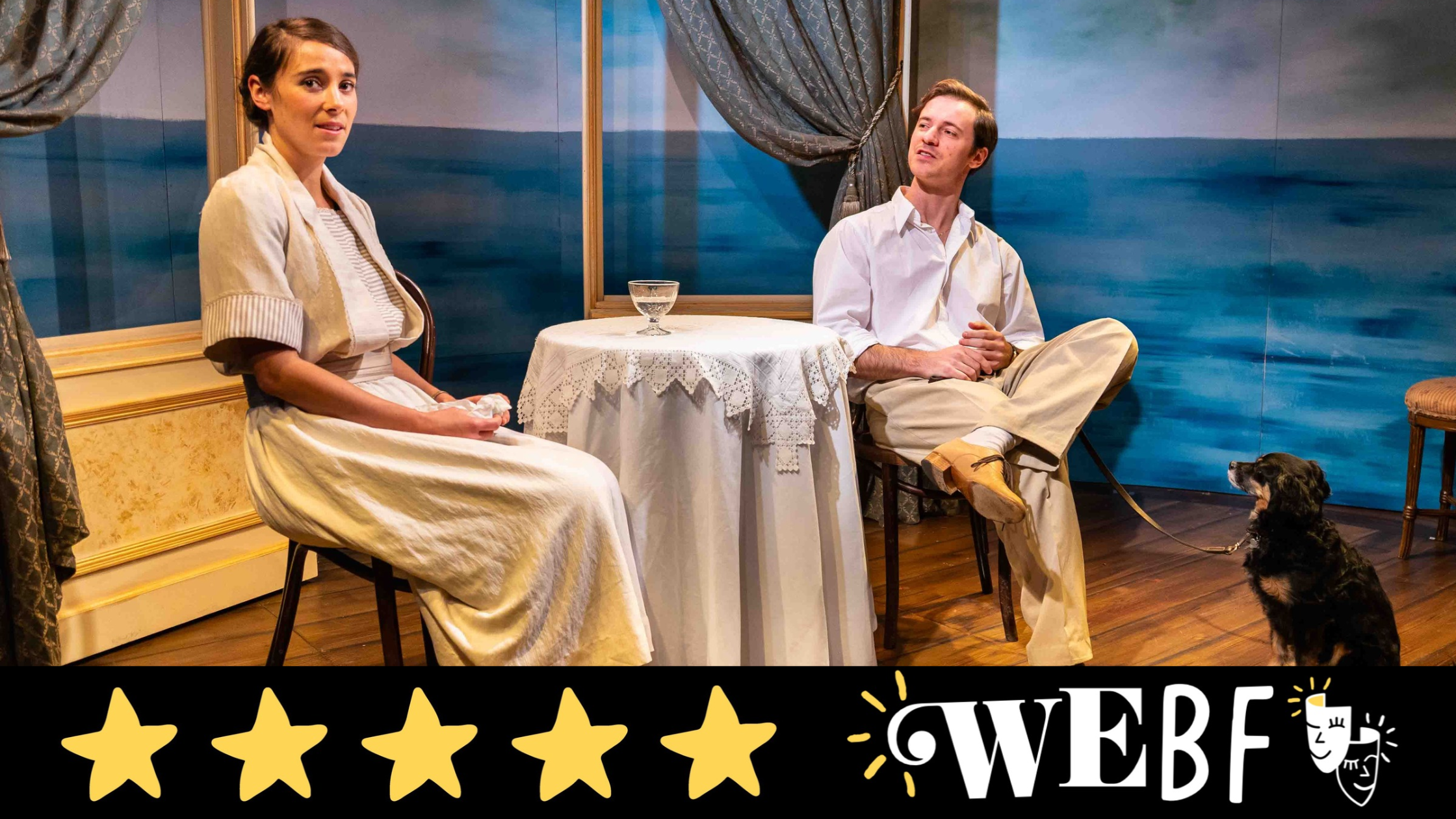
Photo credit: Carla Joy Evans
After a disastrous opening night in 1927, Noel Coward’s play about sex and scandal in 1920s Italy has only had one other production - at the Glasgow Citizen’s Theatre in 1983. Director Brigid Lamour said she “was looking for ‘forgotten gems’ with good roles for women” when she came across the play, and the stars aligned with Neil McPherson at the Finborough Theatre. Coward’s original 1921 version was “wildly different” to the version that was eventually produced in 1927. In order to be deemed acceptable to be licensed, there had to be a heavy suggestion that the protagonist, Lucy, descended into prostitution as a result of her adultery. This is not the ending of Lamour’s version.
We open in Bellegualia, with the hilarious Mrs Griffin (Amanda Bellamy) and Miss Johnson (Julia Watson) discussing Mrs Griffin’s son Stephen (George Kemp) leaving on oil business for six weeks. They vow to try and cheer up his wife Lucy (Grainne Dromgoole), whom Mrs Griffin feels is too dependent on her husband for happiness. They’re interrupted by squeaky Francine Trott (Giorgia Laird), a “bluebottle” as Lucy describes her, declaring her excitement that there is to be a Festa, according to the farcical Reverend Crutch (Miles Richardson). It’s a seemingly happy depiction of upper class British society, living abroad in a beautiful sun-and-sea Italian setting. But something darker lies beneath, specifically within timid and tame Lucy.
The introduction of young artist Sirgio (Guilio Cavazzini), and his sweet dog Mrs Robinson (Evie), changes everything. From their first encounters, we know that Lucy and Sirgio are heading into uncharted territory, thanks to the chemistry between Dromgoole and Cavazzini. After Stephen patronisingly rejects Lucy’s request to join him on his business trip, she is continually swept up in Sirgio’s world, even returning to the Festa for the non-English part of the festivities in secret. This is the climatic scene of the play, and the most active, with a physical fight between the unnamed Italian characters in an impressive display of the actor’s range. After dismissing Sirgio’s declarations of love as naive and premature, Lucy shocks herself by saying it back. She leaves her husband and follows him to Florence, where a week later, Stephen comes armed with Mrs Griffin to give her a second chance. This is all the two leading men seem to have in common: a dependence on their mothers, and no real love for Lucy.
This production of Sirocco is particularly interesting because, although all but half a line are Coward’s, Lamour makes an entirely different comment about the repression and liberation of women. To a 2026 audience, Lucy’s decision to not return to her unhappy marriage and not to stay with Sirio is unsurprising to us, but to 1927 audiences, it would’ve been a scandal that she couldn’t have recovered from. Though Lucy’s final line “I’m free” feels a little heavy-handed, it’s a compelling reminder of how far we’ve come.
One of Noel Coward’s least known and most controversial plays brings female freedom into the spotlight in an evening of thrilling fun.
***** Five stars
Reviewed by: Ruby Skippings
Sirocco plays at London’s Finborough Theatre until 22 Dec, with further info here.
