
Review: SHAKESPEARE AND THE ALCHEMY OF GENDER, York International Shakespeare Festival
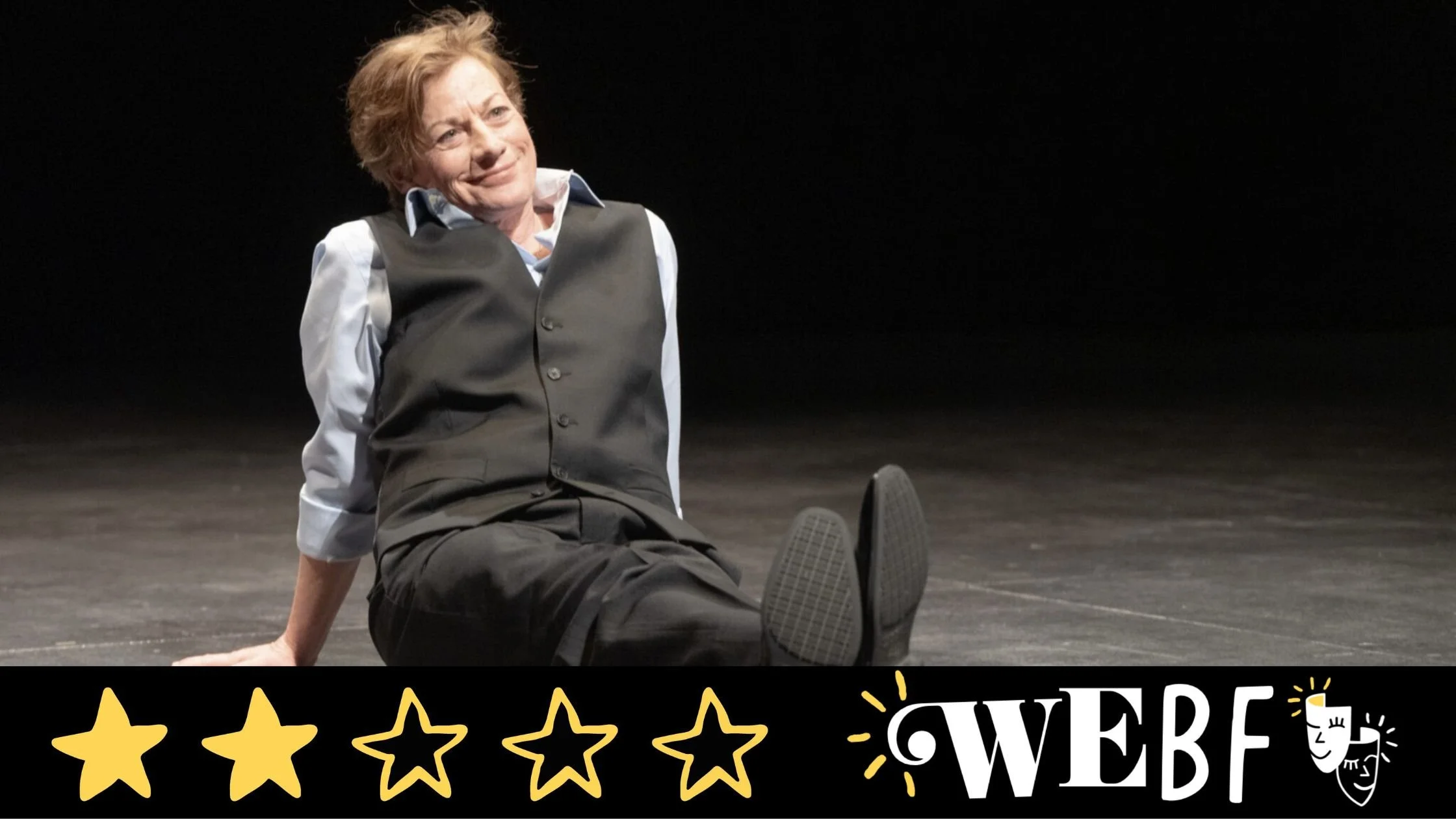
Photo credit: Supplied by the festival
Shakespeare and the Alchemy of Gender is an ambitious one-woman show written and performed by Lisa Wolpe. It explores her experiences with Shakespeare and gender, offering commentary on some of the Bard’s most beloved moments such as Hamlet’s “To be or not to be” soliloquy. These excerpts are examined alongside moments from her father, Hans Wolpe’s fascinating life, providing an example of the transcendent and timeless power of Shakespeare’s work.
This play has very little in the way of technical elements, with no set, a simple costume, and the bold choice to keep the house lights in the auditorium on. This creates a raw, pared-back backdrop for Wolpe to perform against, and allows the audience to fill in the blanks of the worlds she describes.
Lisa Wolpe is a lively performer, and her use of stage space is effective. Her dynamic stagecraft creates visually interesting moments, with her use of levels in particular fostering an intimate relationship between herself and the audience. She transforms into a multitude of different characters, both from Shakespeare’s world and her own, and convincingly distinguishes between them through captivating physicality.
To be or not to be compelling: although Wolpe’s performance certainly is, the script never quite decides. The amalgamation of an autobiographical retelling of Wolpe’s life, a seemingly disjointed collection of Shakespearean extracts, and an offering of interpretation on these extracts, lacks cohesion. As a result, the pace of the show feels as though it lacks drive and momentum.
Some links between Wolpe’s personal experiences and the interwoven Shakespeare feel appropriately placed, such as the comparison between her father’s Jewish heritage and that of Shylock from The Merchant of Venice. However, many of the personal connections feel tenuously drawn, seemingly shoehorned in to allow for the inclusion of particular extracts. This unfortunately has the effect of pulling the audience out of the performance.
Mentions of her own career feel discordant within a narrative that largely follows her father, begging the question of whether Wolpe actually knows what she is trying to achieve with this piece. Although the source material - both Shakespeare and the life of her family - is rich with potential, Wolpe’s writing fails to successfully bring these elements into a meaningful conversation.
Despite a weak script, Wolpe’s stage presence brings merit to the production, and the interweaving of personal narrative with these legendary characters provides an interesting interrogation of Shakespeare’s relevance to a 21st century audience.
** Two stars
Reviewed by: Anna Nichols