
Review: Scottish Ballet’s MARY, QUEEN OF SCOTS, Sadler’s Wells
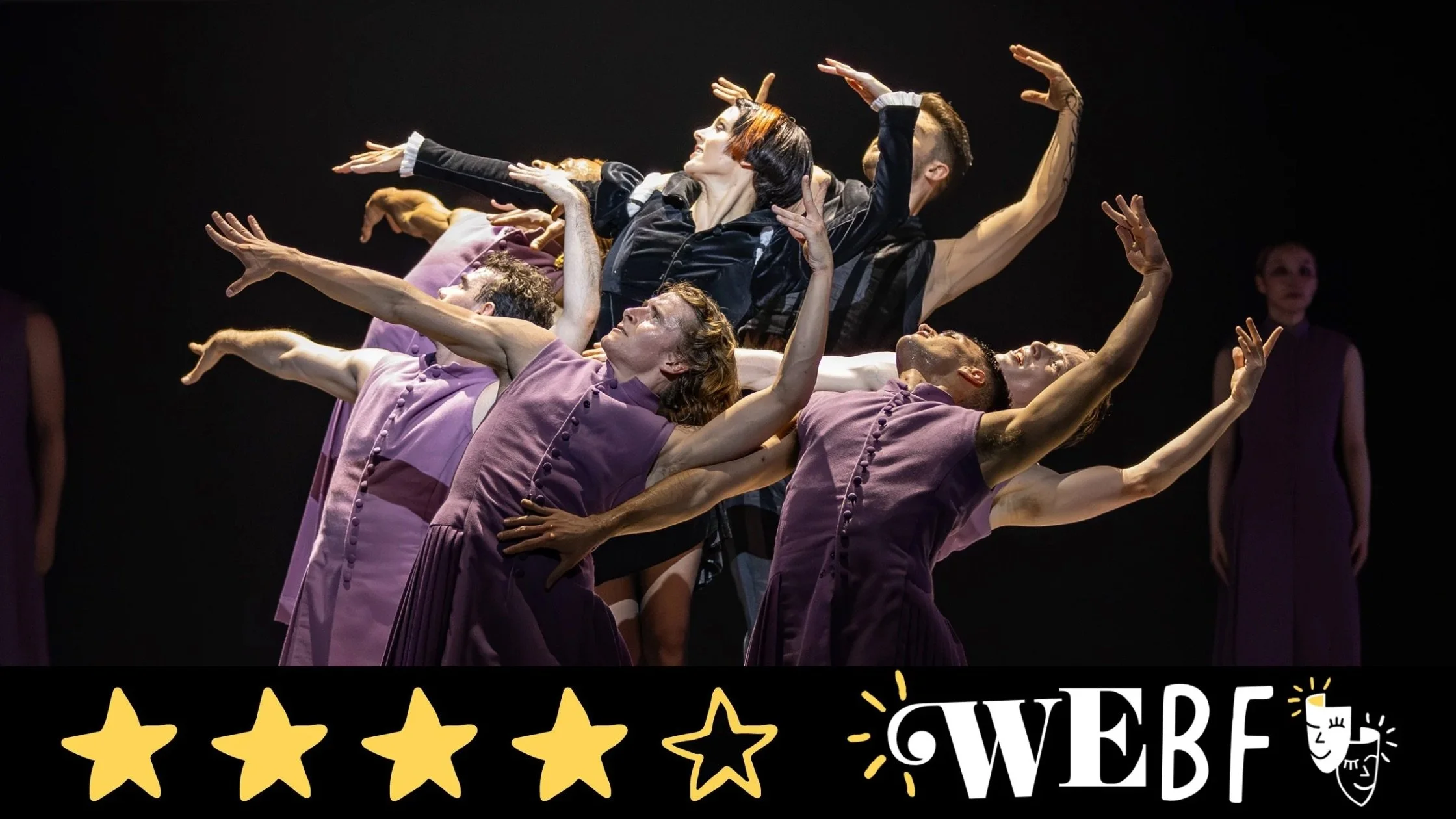
Photo credit: Andy Ross
Scottish Ballet have a reputation for rethinking classics, and productions such as Coppelia and The Crucible have been very successful for them. Now, their production of Mary, Queen of Scots reaches London for the first time at Sadler’s Wells. It’s very different from their previous Peter Darrell ballet with the same subject.
The programme warns that this is not an historical account but is, instead, all taking place in the mind of the aging Elizabeth I on the day she died. As a result, what we see is what she might have believed to have happened, rather than what she observed or knew to be true. It’s an interesting format but also a slightly confusing one for the audience, since many will be aware of the accepted historical version.
Elizabeth is played by two dancers as her younger and older selves. Rizzio, Darnley and the Dauphin appear but Bothwell is omitted. The rumoured liaison between Darnley and Rizzio is made more explicit, presumably because it is suggested that Elizabeth might have believed that it took place.
Choreography is by Scottish Ballet’s Sophie Laplane, and the piece is co-created with her regular working partner James Bonas. The involvement of a director alongside a choreographer here is unusual but explains much of what is seen on stage. This is very much a high-concept director-led take, with designer Soutra Gilmour providing a rising and falling room which serves as a video screen, and some truly outlandish costumes. Also on stage are what look like an array of IKEA wardrobes, serving as exits and entrances.
The younger Elizabeth achieves eminence by teetering around (very confidently it must be said) on stilts; costumes are from all periods or none, and the infant James is born as a balloon with his name written on it with a marker. The rival courts are well demarcated by costume: the Scottish court in heather-coloured androgynous dresses, the English in punk outfits with Mohican hair, and the French in haute couture, although the men all have protruding bellies. Walsingham looks like a 1930s fascist and is accompanied by his spies who all wear falcon hoods. Unfortunately, the key male characters are dressed similarly to one another, and it can be confusing at first to identify each rival suitor (although no problem in the case of the Dauphin). Perhaps that was why, at one point, one of those large foam pointing hands labelled Darnley was carried on stage.
So much, so expected in 2026, where European-style director-led theatre is regularly seen on our stages. What lifts this production above the sometimes over-dominant concept is a combination of a delightful score and expressive, powerful dancing. Mikael Karlsson and Michael P. Atkinson have fused Scottish folk and ceilidh with electronic sounds to create eminently danceable music, vigorously played by the Scottish Ballet Orchestra under Martin Yates.
Evan Loudon and Bruno Micchiardi make their mark as Darnley and Rizzio, with Thomas Edwards as Walsingham a powerful presence, with his flock of falcon spies. Kayla-Maree Taratolo is an engaging – if perplexing – presence as the Jester. Clad in day-glo green and dressed as Pierrot, she seems to have suddenly appeared from a different ballet altogether; perhaps one of those Russian Swan Lake productions which also include the character.
As the younger Elizabeth, Harvey Littlefield is an imposing presence, very much the Queen that Elizabeth would like to have been. As the older Queen, guest artist Charlotta Ofverholm is a magnetic performer, tottering around the stage in her underwear, with a bedraggled wig or bald, and mostly wearing only a vaguely Elizabethan basque and unflattering pants. It’s a remarkably selfless performance, as much acting as dancing, until she transforms when she is finally dressed as the Queen in all her finery.
Well supported by her four Mary’s, Roseanna Leney is a dominating presence in the title role, often in her little black dress (although she does go to her execution in a red bikini). It’s a riveting performance and your eye is drawn to her whenever she is on stage, and whatever strange stage business is happening around her.
The much tighter and action-packed second half makes up for the rather longer first act, and the combination of music and dance rises above, and to some extent works with, the production concept to make this a production well worth seeing despite the occasional directorial over-indulgence. All comes together as the second act progresses to the inevitable execution and a rather sudden blackout.
**** Four stars
Reviewed by: Chris Abbott
