
Review: SAN FRANCISCO BALLET: MERE MORTALS, Sadler’s Wells
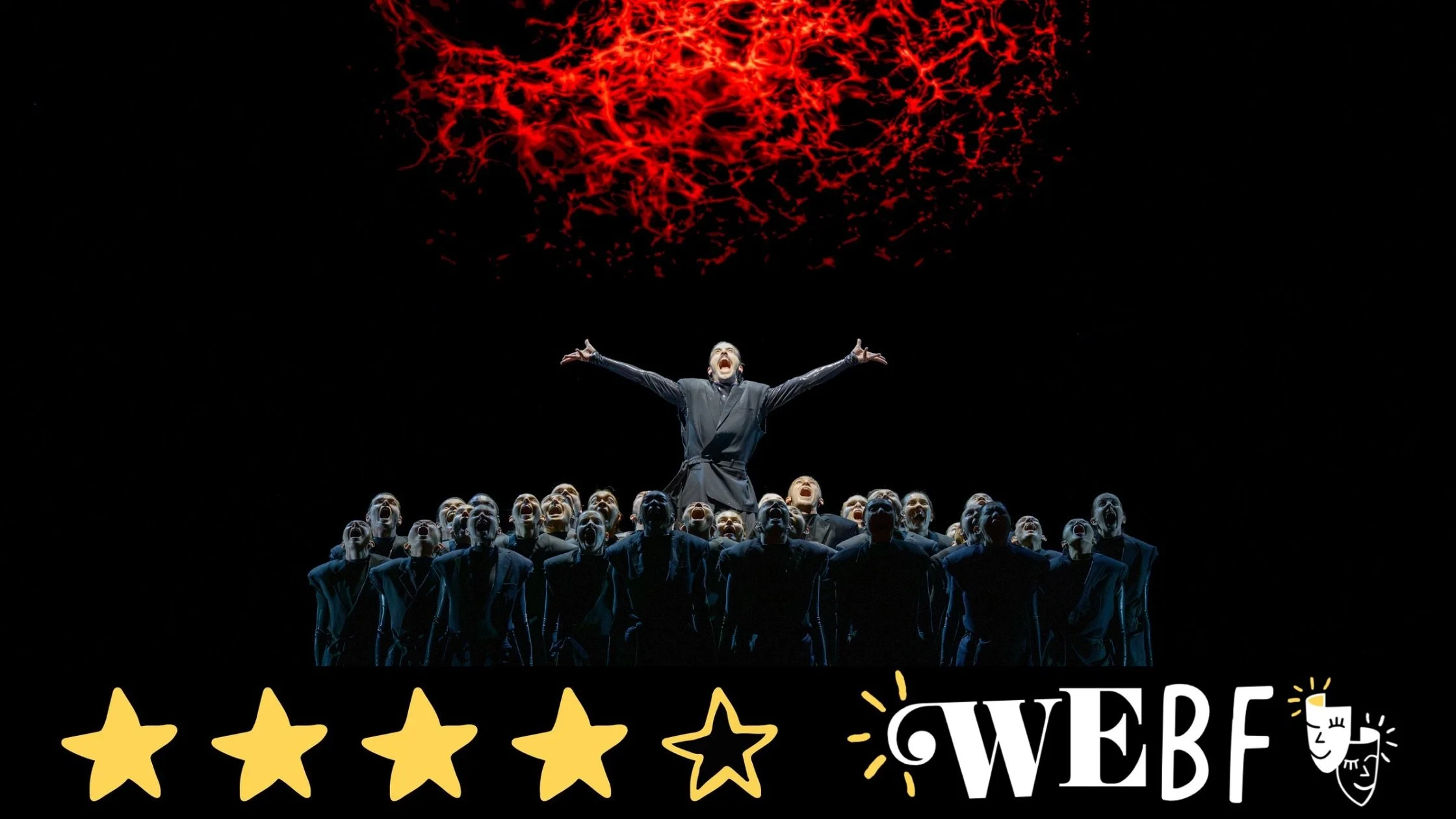
Photo credit: Jane Hobson
There were plenty of luminaries from the dance community in the audience to see Mere Mortals, a return to Sadler’s Wells for San Francisco Ballet. The company were last seen here in 2019 and are now led by Tamara Rojo, who made such a mark during her time running English National Ballet. Mere Mortals was also seen at the Edinburgh Festival before coming to London.
Merging the story of Pandora and her jar (not box, as the programme reminds us) with the concept of AI, it’s a piece with a complex rationale but little in the form of clear narrative. The four main dancers portray named characters from the myth, while the large chorus of more than 40 dancers seems to be presenting the potential and threat of AI through their thrilling encroachments on the central story.
It’s very much a high concept piece with music composed by UK-based electronic specialist Floating Points, which is then performed live on a vintage synthesiser alongside the Royal Ballet Sinfonia, conducted by Martin West. The inclusion of traditional symphonic sections (especially the harp and violin solos) makes the score more audience-friendly than a purely electronic soundtrack might have been, and the two disciplines are united by the ways in which the synthesiser enhances and recreates the sound emanating from the orchestra.
The design from Hamill Industries features large moving video screens which display fascinating animations which endlessly reproduce and grow, on occasions to the detriment of the dancers, who had the difficult task of pulling focus towards the central story. On press night, all four featured dancers were more than up to this task however, although one felt for Jennifer Stahl as Pandora, impossibly supple and a fine dancer, who was required to stand motionless for a very long section while the video screens behind her took over. Joseph Walsh as Prometheus and Harrison James as Epimetheus are similarly costumed but managed to present their different characters clearly to the extent that the limited narrative allowed.
As Hope, all that is left in the jar after Pandora opens it, Wei Wang is remarkable, opening and closing the show with exhilarating dancing and total engagement with the audience, the occasional fourth-wall breaking grin being well received. The costumes by Michelle Jank are stunning, ranging from belted overcoats to unitards, at first as black as oil poured over the dancers’ bodies and then gold towards the end - perhaps to link with Hope, also in gold, or possibly to signify out of control AI. The programme tells us they were sourced from thrift shops in the Bay Area; we can only comment that we have never seen fabric like this in our local charity shop in London.
Perhaps the most impressive part of the ballet was the dancing of the ensemble, all forty of them mostly moving in unison, edging downstage towards the audience, mutating like the images on the screens or seizing a character, and propelling him or her to the heights from the hill they formed with their bodies.
Mere Mortals is an exhilarating, exciting but short piece, coming in at 1 hour 10 minutes. It is presented without any accompaniment, so the press night audience were on their way home by 8.40pm. If ballet is to follow straight theatre and move towards much shorter performances, perhaps starting times also need to be considered. Just over an hour is a good length for an Edinburgh Festival show, when audiences are likely to be rushing on elsewhere, but it works less well within the London context, where audiences will be travelling for an hour at least to get there.
Mere Mortals remains an impressive achievement, a fine example of the work of what is the oldest established ballet company in the United States. The company is clearly in great shape under Tamara Rojo, and London ballet fans will look forward to future visits from the company.
**** Four stars
Reviewed by: Chris Abbott
