
Review: RENT, Tom Stoppard Theatre
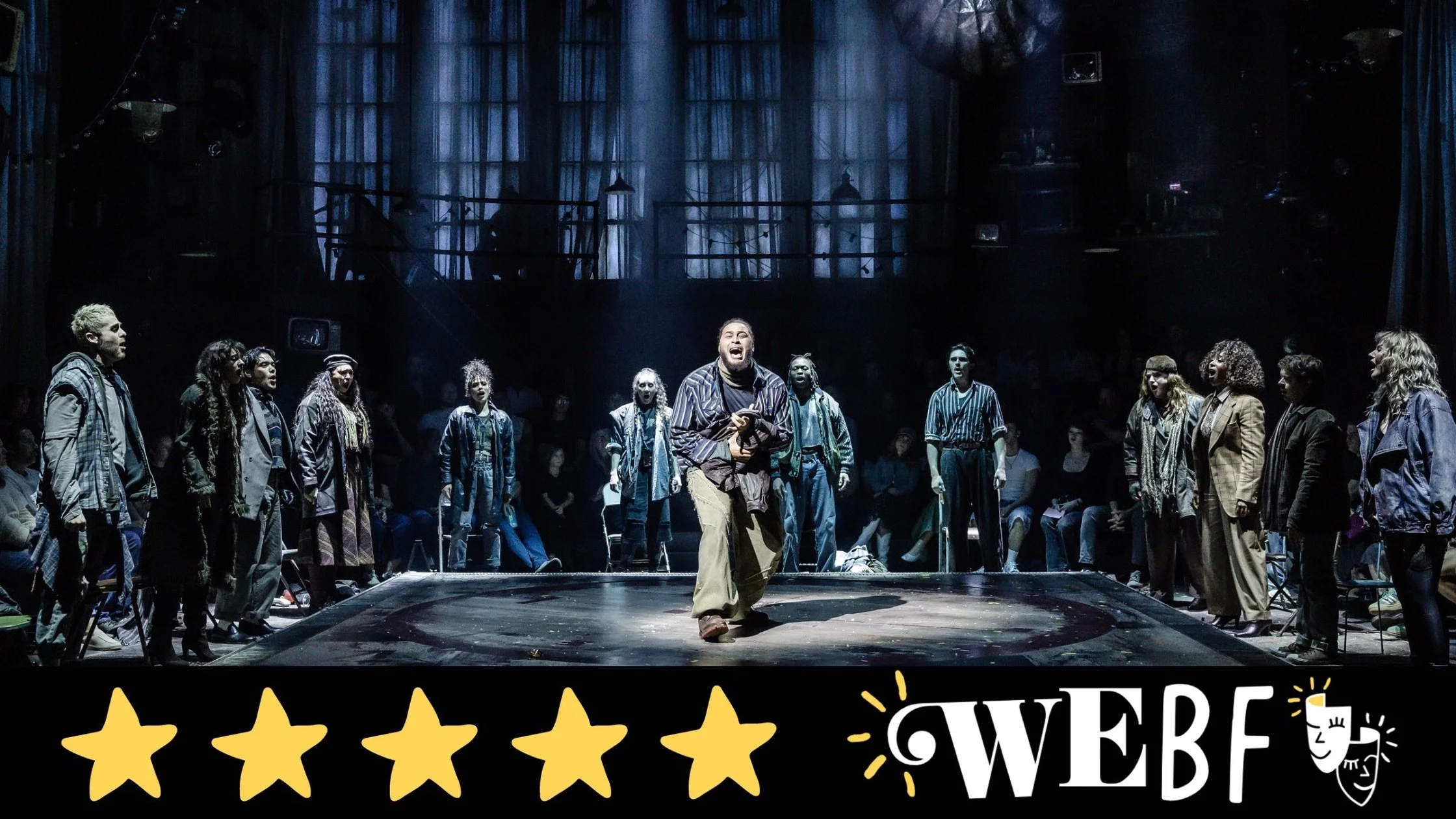
Photo credit: Danny Kaan
During COVID, the Hope Mill Theatre opened a production of RENT, directed by Luke Sheppard. With the world locked down, theatres shuttered and with an industry fighting desperately to survive, the material suddenly felt more relevant than ever. RENT has always been a musical about artists trying to survive, about friendship, love, community, addiction, illness, identity and the terrifying passage of time, but watching it during a period when so many of those very things had been stripped away from us gave the piece an extraordinary new resonance. The production was performed for socially distanced audiences before the pandemic forced the run to close, and it was subsequently filmed and streamed, meaning that for many of us, this particular RENT became intrinsically linked with that strange, frightening period of our lives. At the time, we genuinely thought it might be the best production of RENT we had ever seen, staged, filmed or otherwise.
Fast forward several years and Luke Sheppard has gone from one of the exciting young directors working in musical theatre to arguably one of the defining creative forces in the UK industry. His original RENT company have gone on to extraordinary things too, with Tom Francis, who played Roger in the Hope Mill production, now an Olivier Award winning, Tony nominated Broadway performer with major screen credits to his name. So when the announcement finally came that Sheppard's RENT was transferring to the West End, our excitement was matched by one rather enormous question: would it still work? Would Jonathan Larson's material still feel as urgent? Could a production so perfectly suited to the intimacy of the Hope Mill survive the move into a West End theatre? Could the same lightning possibly strike twice? There was only one way to find out, and Besties, we are delighted to report that it absolutely can.
From the moment we stepped into the Tom Stoppard Theatre, our hopes started getting higher. David Woodhead's design immediately creates a world that feels appropriately grimy, urban and lived in, with a dark industrial environment surrounded by screens and visual fragments that feels like a 1990s East Village, which has somehow been dragged through the digital age without losing its soul. There is a wonderful sense of clutter, decay and life throughout the design, perfectly capturing a group of artists existing on the fringes of society and making a home out of whatever they can find. Then, you notice the audience. They aren't simply watching from the auditorium; they are inside the world. The company occupies the sides and rear of the playing space, surrounding the action and transforming the production into something approaching theatre in-the-round. It is an inspired decision, not only because it preserves the intimacy that made the Hope Mill production so special, but because it means the community at the heart of RENT is literally surrounding the characters throughout the show. And yes, we're sure the producers weren't exactly unhappy about getting a bigger audience capacity for their bottom line. Good thinking!
At the centre of the space is a revolve, and initially we wondered whether it was simply there because, well, they could. Then the show started and we realised exactly what Luke Sheppard was doing. The stage turns almost like the hands of a clock, and suddenly one of RENT's most famous questions, "How do you measure a year?", feels embedded into the very mechanics of the production. Time is constantly moving, the characters are constantly moving, they come together, break apart, circle one another, spiral and return, and the revolve becomes far more than a practical piece of scenery; it becomes a visual metaphor for the passage of time and the cycles that these characters find themselves trapped within. It is bloody clever, and this is what Sheppard does so brilliantly throughout the production. He finds new meaning in material we thought we knew inside out, with moments we have watched countless times suddenly landing in completely different ways. April's ‘Will I?’, Mimi's ‘Without You’, the subtle ways that certain lyrics are redirected or reframed so that their emotional meaning shifts, all make you sit up and think, "How have we never noticed that before?" Nothing feels like reinvention for reinvention's sake. Instead, Sheppard seems to have spent years interrogating this musical and finding the tiny details buried underneath the things we think we already know. Most importantly, on a much bigger stage, nothing gets lost. The scale expands without the production becoming less personal, the levels are used beautifully, the screens add rather than distract, sparks fly, the choreography fills the space and yet, at its heart, this remains a group of people trying desperately to hold onto one another. That is RENT, and that is precisely why this production works.
For anyone somehow unfamiliar with RENT, Jonathan Larson's musical follows a group of young artists and outsiders living in New York's East Village as they attempt to make art, find love and survive in a world where money, illness, addiction and the pressures of adulthood are constantly threatening to pull them apart. At the centre is Mark, a filmmaker documenting the lives of those around him, and his former roommate Roger, a musician struggling to create again after the death of his girlfriend. Their lives become increasingly intertwined with Mimi, a young dancer living downstairs, Maureen, Mark's outspoken and unpredictable ex-girlfriend, her new partner Joanne, and the charismatic Angel and Collins, whose relationship becomes one of the emotional hearts of the piece. Hovering over much of the story is the AIDS crisis, which profoundly affects this community and forces the characters to confront mortality while simultaneously trying to embrace every moment of life they have. There are arguments over rent, questions of artistic integrity, complicated relationships, addiction, grief and loss, but underneath all of it is Larson's central idea that time is finite and that the way we choose to spend it matters. It is a story about a group of people who may not have much money or security, but who have one another, and who refuse to stop creating, loving and living simply because the world keeps telling them that they should.
A huge shout out has to go the UK casting team (Pearson Casting) for assembling a company that feels completely and unwaveringly committed to the world of this show. What we particularly love is that the company isn't simply built around recognisable names. There are established performers alongside artists making some of their first major professional steps, and every single person feels like they belong in this community. It is exactly what casting should be, finding performers who understand the material, who can inhabit the world and who collectively create something bigger than any individual performance. Nobody feels like they have been placed into the production simply because their name will sell a ticket, and that ensemble mentality becomes one of its greatest strengths.
Gaten Matarazzo is wonderful as Mark. There is an emotional maturity to his performance that we really appreciated, with his Mark being likeable without becoming bland, vulnerable without becoming self pitying and constantly searching for his place within this chaotic little family. Matarazzo also understands that Mark is, in many ways, the observer of the story. He is the person with the camera, the person standing slightly outside the circle and the person desperately trying to document everyone else's lives while simultaneously struggling to work out what he is doing with his own. That distance becomes an important part of his performance and we completely bought him as the friend who is simultaneously at the centre of this group and slightly separated from it. Vocally, he is also incredibly strong, and there is a real sense that this Mark is growing emotionally throughout the show rather than simply observing everyone else's development.
Alexa Lopez is heartbreaking as Mimi. There is an infectious youthful charm to her performance but underneath, it is a fragility that gradually becomes harder and harder to ignore. Her ‘Out Tonight’ is particularly fascinating because it is a number that can very easily become all swagger, sexuality and adrenaline. Here, there is something darker underneath it. You watch Mimi slowly unravel and suddenly the song becomes less about simply wanting to go out and more about the compulsive need to chase the next high, the next thrill and the next escape. It made us think differently about Mimi's addiction and her desperate need to keep moving, and Lopez manages to make Mimi incredibly likeable while never allowing us to forget that there is something deeply vulnerable beneath the bravado.
Travis Ross is vocally phenomenal as Roger. He plays the brooding rocker with almost clinical precision, with the isolation, bitterness and emotional barricades all firmly in place. There is a real sense that Roger is permanently living inside his own head, which makes complete sense for a character who has experienced immense loss and is terrified of allowing himself to feel it again. We would, however, love to see a few more glimpses of those walls coming down around Mimi. Their relationship would benefit from a few more moments where Roger lets her in properly because, at present, we think the slight lack of chemistry comes partly from how successfully Ross has built Roger's emotional isolation. It is a very good portrayal of Roger, but we need to see a little more of that isolation crack so that we can really understand why these two people become so important to one another. When that wall does come down, there is the potential for this pairing to be devastating once we reach 'Your Eyes' territory.
Lazy Violet and Danielle Fiamanya are an explosively entertaining Maureen and Joanne, respectively. Their dynamic is deliciously messy, complicated and completely believable, while vocally, they are both absolute powerhouses. There is a wonderful sense that these two characters genuinely drive one another completely insane while simultaneously being incapable of letting one another go, and that tension gives their scenes a brilliant energy. ‘Take Me or Leave Me’ is one of the show's standout moments, combining huge vocals with the comedy, frustration and genuine emotional connection between the two characters. It is exactly the sort of scene where the production manages to be enormous while still feeling completely truthful.
Then there is Jeevan Braich and Billy Nevers. Goodness, where do we even begin? This may be our favourite Angel and Collins dynamic we have ever seen. Braich is effortless as Angel, bringing such warmth, generosity and joy to the character that their presence seems to brighten the entire theatre. Nevers plays Collins as a gentle giant, someone whose presence feels like the emotional glue holding this strange little family together. Their relationship feels completely organic and there is no sense of two actors simply performing a "great musical theatre couple". They feel like two people who have genuinely found one another, and when their voices come together in ‘I'll Cover You’, everyone's heart melts. The connection is immediate, authentic and beautifully played.
Then comes the moment that everyone has been waiting for, ‘I'll Cover You (Reprise)’. We have heard this song many times, we have seen many performers sing it and we knew what was coming, but we were still absolutely not prepared. Billy Nevers quite literally brought the roof down. WHAT. A. VOICE. Besties, we ugly cried. Not tasteful theatre tears, not a single elegant little tear rolling down the cheek, but full on, proper, shoulders shaking, face screwed up, UGLY CRIED. We genuinely hope this production gets filmed, if only so we can watch that performance again, because when Nevers lets that voice loose and the ensemble joins him, the sound becomes almost overwhelming. It feels less like a group of people singing and more like an entire community mourning together, with the voices building into something resembling a collective musical keening. It takes your breath away, and it is one of those moments where the audience becomes completely united by what is happening on stage.
The staging of ‘Contact’ is another highlight. Rather than treating the number simply as a spectacular dance sequence, the production allows the eroticism, danger and physicality of the scene to sit alongside the terrifying reality of the AIDS crisis that hangs over these characters. The sequence has an intentionally seductive quality, but there is something deeply unsettling underneath it too. It captures the freedom and exhilaration of physical connection while simultaneously reminding us of the fear and consequences surrounding sex during the height of the AIDS epidemic. The contrast makes the number far more thematically significant than simply being a spectacular dance break, and once again Sheppard and choreographer Tom Jackson Greaves find a way of making something we thought we understood feel newly provocative.
Finally, there is Joaquin Pedro Valdes as Benny. Suave, cool, collected and almost painfully pristine, Valdes plays Benny beautifully as the man who has moved beyond the bohemian chaos of his old friends and into a very different world. We would, however, love to see a little more of the turmoil underneath that exterior. Benny is arguably one of the show's most underwritten characters, so there isn't an enormous amount in the text to work with, but we'd love to see a few more flashes of the person who once belonged with the bohemian bunch. A look, a hesitation, a tiny crack in the façade, anything that hints at the bohemian underneath the polished exterior would make the character even more fascinating. These would have to be found by the actor rather than handed to him by the script, but Valdes is more than capable of finding those moments.
The ensemble are absolute stars. Ryan Nixon, Baylie Carson, Laura Delany, Shem Omari James, Leah Vassell and James Wilkinson-Jones bring character, comedy, grit and total commitment to every moment. Nobody is phoning it in, nobody is trying to steal the show and nobody feels like they are waiting for their big moment. That is one of the greatest strengths of this production because RENT isn't supposed to be about one person. It is about a community, and this company functions as one.
Which brings us to Tom Jackson Greaves. The choreography is outstanding; feeling painful, jagged and almost uncontrolled while somehow remaining completely free. Bodies collide, fracture, pull away and reconnect, creating an almost animalistic quality to the movement as though the choreography is constantly fighting against the characters' attempts to control their own lives. There is a rawness to the physical language that fits this production perfectly, particularly because the movement never feels decorative. It always feels connected to character, emotion and circumstance. Greaves once again proves why he is one of the most exciting choreographers working in the industry.
But ultimately, the greatest achievement of this production is that the company operates as one organism. Nobody is desperately trying to be the star and nobody feels like they are waiting for their individual moment to shine. They are a community of friends, lovers, artists and outsiders who have created their own little family because the world outside it doesn't always make room for them. That is exactly what RENT needs to be, and it is why the production feels so alive.
Jonathan Larson's musical is often described as a landmark, and it is. But perhaps what makes it so extraordinary is that it was never polished into something safe. Larson died on the morning of RENT's first preview, before he ever got to see the full impact of the piece he had created. There is something incredibly moving about watching this production now because RENT remains imperfect. It is messy, occasionally chaotic and sometimes rough around the edges. Some characters are more fully drawn than others and some ideas are deliberately left complicated, but perhaps that is exactly why it continues to work. It feels alive. It feels unfinished. It feels like a piece of art that is still desperately trying to tell us something, and that sense of imperfection is part of what makes it so beautiful.
In that sense, this production feels like the ultimate tribute to Larson. Luke Sheppard hasn't attempted to turn RENT into a museum piece or recreate some perfect version of the past. He has allowed it to breathe, evolve, hurt, laugh, rage, love and, most importantly, live. We went into the Tom Stoppard Theatre wondering whether the Hope Mill magic could possibly survive the journey to the West End. It didn't just survive - it evolved. Sheppard has created what we believe may well be the definitive production of RENT, a complete triumph from beginning to end, an extraordinary ensemble piece and a beautiful, bruising, joyful and heartbreaking tribute to Jonathan Larson.
Besties, you MUST see this show. After all, RENT has spent decades asking us how we measure a year, and this production gives us a pretty good answer: in moments like these, with people like this, you measure it in love, loss, friendship, art and the memories you carry with you afterwards.
When? No day but today.
The definitive production of RENT. The ultimate honour to the memory of Jonathan Larson. A musical monument.
***** Five stars
Reviewed by: James Edge