
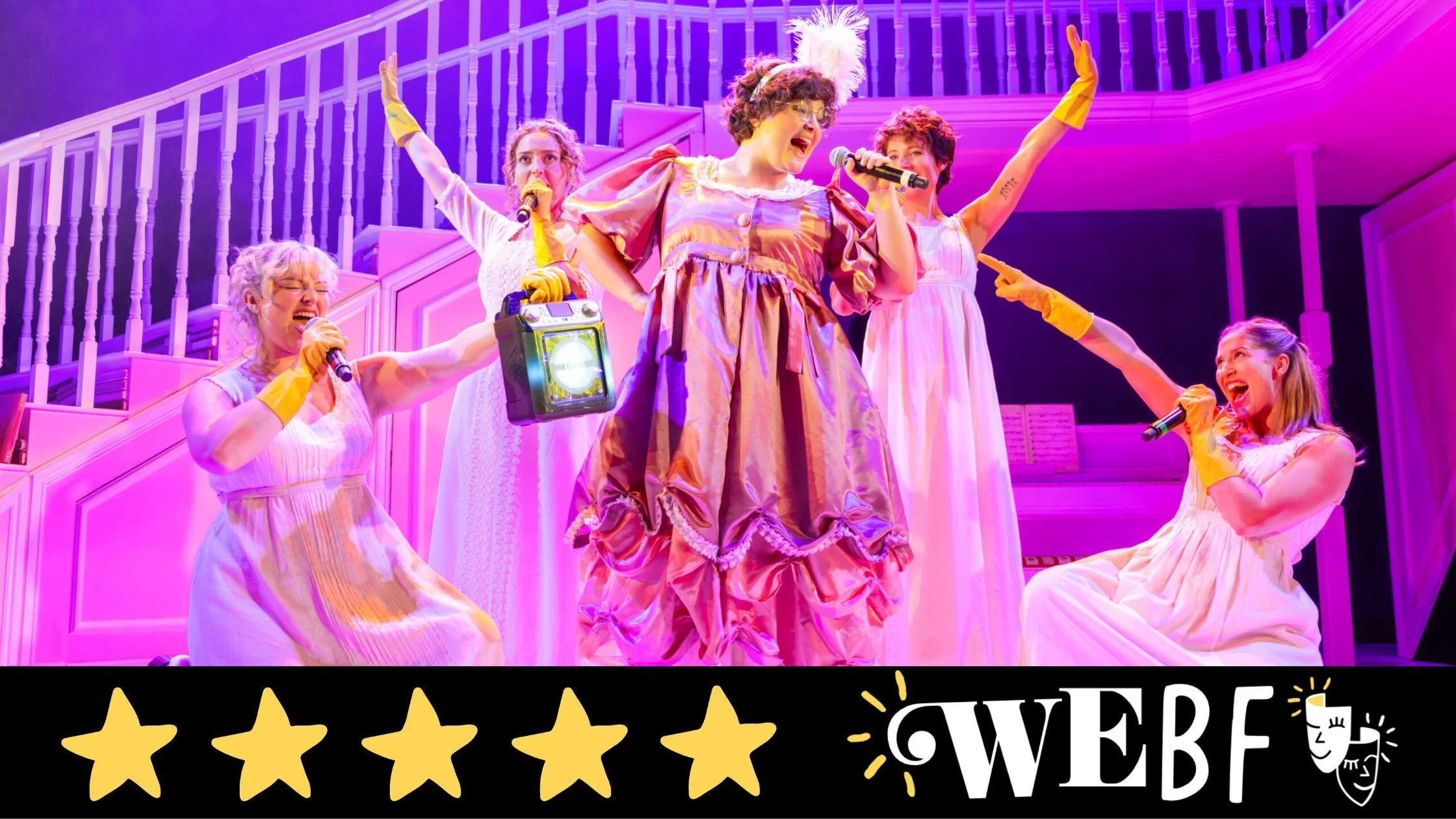
Photo credit: Mihaela Bodlovic
A tale as old as time, and one open to countless remakes (including those featuring zombies!), Pride and Prejudice is universally known and loved. Written in the early 1800s and centred around the Bennet family in Regency England, Austen's novel explores wealth, class and social standing. With no male heir to inherit the family estate, the Bennets have five daughters to marry off, preferably into good society.
Adapted and written by Isobel McArthur, who was once told, "If you can do Austen for Glasgow audiences, you can do anything", Pride and Prejudice* (*Sort Of) was born. McArthur set about creating a version of the story that would be more accessible to audiences, deciding that the "posh-ness" needed to be removed and the characters made more relatable.
And so, we end up with a version of Pride and Prejudice told entirely by the five servants who work in the Bennet family household. What an inspired idea it turns out to be, because this play is a wonderful piece of theatre.
Our five actresses – Georgia May Firth, Eva Hope, Phoebe Marshall, Julia Murray and Grace Farrell – retell the story through a series of incredibly quick costume changes, playing ALL the characters! All, that is, apart from poor Kitty, who is frequently mentioned but never seen, and Mr Bennet, who is rather humorously represented by a chair facing the back of the set, complete with a newspaper and the occasional cigarette.
A special commendation must go to the costume department and designer Ana Inés Jabares-Pita, who have put together a fantastic collection of quick-change Regency outfits that fit over the actresses' simple dresses. The use of colour, with a different shade for each Bennet sister, makes it easy to distinguish between characters, while the fabrics and materials cleverly reflect each character's social standing. The speed and ease with which the actresses transform from one character to another is a testament to the fantastic work of the costume department.
The set is very pink. We have a staircase that would certainly befit Elle Woods, complete with cubby holes underneath that are cleverly used by the cast for character changes. There's also a bookshelf that doubles as a door, with a hidden opening through which a head can occasionally poke. Alongside these, we have a sofa, which is moved on and off by the cast, a chaise longue and a piano. Everything is moved around by the actresses themselves. It's functional, playful and perfectly suited to a production told from the women's perspective, with plenty of feminist humour woven throughout.
The play is absolutely hilarious. The actresses' comic timing is impeccable, and the humour comes in all forms: tongue-in-cheek moments, physical comedy, intellectual humour, a little slapstick and even some singing. It has a real Bridget Jones feel to it, or perhaps one of those much-loved 90s/00s comfort films. Calling this piece simply "funny" really doesn't do it the justice it deserves.
Part of the comedy comes from things being exactly where they shouldn't be. Take the Regency Ball, for example, where we are presented with red plastic cups, bottles of vodka and pots of Pringles! The production leans into these anachronisms, too. One of the servants even comes on to clean up after the interval, complete with ice cream tubs on stage (sold at the theatre), just to get a laugh from the audience. And it works!
All five actresses deliver impeccable performances, each bringing something different to the characters they portray.
Phoebe Marshall's Caroline Bingley is a scene-stealer on several occasions, but perhaps none more so than when she breaks out the worm (yes, the dance move!) across the stage in an attempt to entice Mr Darcy. Marshall also feels like a little bit of glue holding some of the scenes together, doing so effortlessly.
Grace Farrell, who is presumably an understudy judging by the programme photographs, arguably has the most roles to play. Her Reverend Collins, complete with Brummie accent, is spot on. The scene in which "he" proposes to Elizabeth Bennet is another highlight. Farrell's Lydia is wonderfully extravagant, while her portrayal of Mary is absolutely spot on. She seems to appear from nowhere, but makes every moment count.
Eva Hope plays Jane, described by her mother as the "pretty one", as well as Wickham and Catherine de Bourgh. Jane is incredibly likeable, but Hope's transformation into Catherine de Bourgh is particularly impressive. Much of the character's age is conveyed through costume, but Hope's facial expressions are absolutely hilarious, capturing every ounce of disgust. The scene in which Catherine suddenly appears from nowhere to scare Elizabeth is another comic highlight.
Elizabeth Bennet is played by Georgia May Firth, while Julia Murray takes on the role of Mr Darcy, as well as Mrs Bennet. The pair have some wonderful comic timing together, which is displayed to perfection when Darcy attempts to propose to Elizabeth, accompanied by The Partridge Family's ‘I Think I Love You’, delivered in an incredibly muted, monotone fashion. Comedic gold!
Firth plays a wonderfully witty Elizabeth, perhaps allowing herself to explore the character's sarcastic and blunt nature more freely than Austen originally intended, or was able to portray at the time. She feels very much like a modern woman trapped in the 1800s.
The tour de force of the piece, however, is Julia Murray. What a performance! Her facial expressions are absolutely on cue throughout, from the fake laughing to the effortless dropping in and out of a Scottish accent. The way she throws her body around physically, and the contrast in the way she holds herself as Mrs Bennet and Mr Darcy, is fabulous. It is a masterclass in physical comedy and characterisation.
The production is littered with so many brilliant comedic moments, and music is used to illustrate many of them. We have Elizabeth singing ‘You're So Vain’ to Mr Darcy, ‘Lady in Red’ being sung to Catherine de Bourgh to prove that Elizabeth can, in fact, sing (the song from her other nephew, Chris!), and ‘Holding Out For a Hero’ making an appearance to highlight exactly what each of the Bennet girls needs.
This really is a five-star production. It combines modern dialogue with relationships full of genuine chemistry, supported by five wonderful performances. It manages to take a story that has been adapted countless times and breathe some fresh life into it. The result is a brilliantly entertaining and hilariously funny night at the theatre.
A must-see, Besties!
***** Five stars
Reviewed by: Emma Littler