
Review: NINA, Battersea Arts Centre
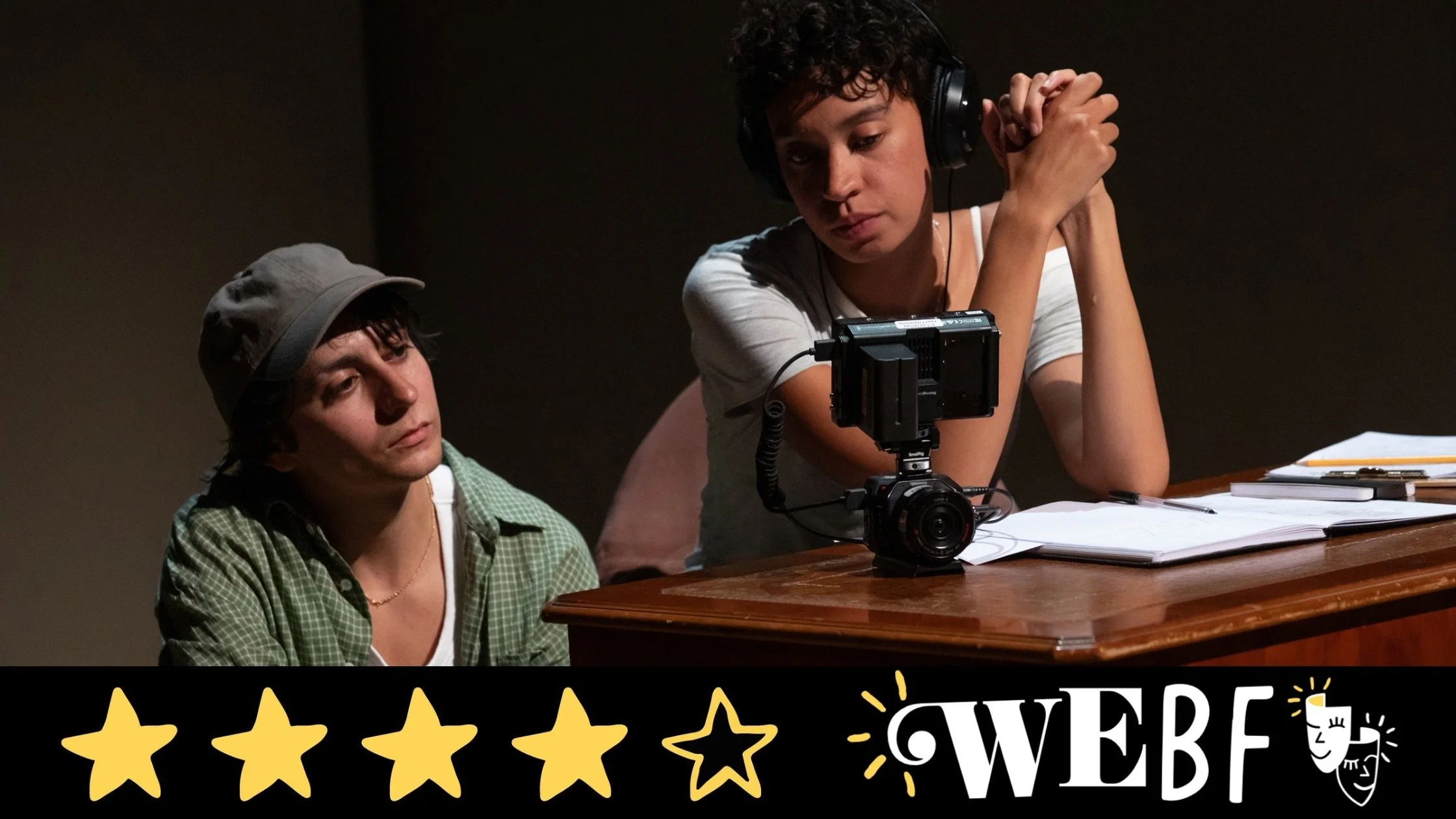
Photo credit: Ali Wright
Borrowing its central premise from Chekhov’s The Seagull, NINA sees one actress after another audition for the role of Nina, under the direction of a Russian director whose unconventional practices, charm and fame give him the notoriety to run the auditions however he pleases. His methods are ruthless, but they get awards and reviews, setting the stage for a production that is as playful and irreverent as it is unsettling.
Written by Caroline Williams and co-directed by Williams alongside Deborah Pearson, the production is an exercise in bold collaboration. Four performers share the title role: Maya Bartley O’Dea as Nina 01, Samantha Begeman as Nina 02, Nina Bowers as Nina 03 and Gemma Barnett as Nina 04, with Joseph Payne as Tim, and Rowan Polonski as Goran.
Samantha Begeman, who previously impressed with another experimental piece of theatre at the Omnibus Theatre, once again delivers an outstanding performance. Nina Bowers is equally compelling, with both performers bringing a raw emotional intensity to the role. Across its four Ninas, the production examines the relationship between an actress and her director, exposing the uncomfortable power dynamics that shape their interactions. Questions of gender, artistic ambition and control emerge through the very process of performance, making the theatre itself part of the conversation.
The staging and direction are brave, impulsive and irreverent, and the risks largely pay off. The meta-theatrical elements strengthen the immersive nature of the experience, continually playing with the relationship between the performers, the roles they inhabit and the world being constructed around them. The result is a production that can be as funny as it is disturbing, shifting between absurdity and emotional devastation with little warning.
The writing is equally bold in its willingness to take risks. Some moments leave room for subtlety to emerge, while others lean into more traditional theatrical exposition. This constant shift makes the narrative difficult to predict. Just as the production appears to be leading us in one direction, it finds a way to prove us wrong, employing classic misdirection to keep the audience uncertain of what might happen next. Occasionally, however, the more absurd flourishes make the story harder to follow, and the production's appetite for unpredictability can come at the expense of clarity.
There is something particularly cathartic about the way the Ninas eventually approach their revenge, drawing on a recognisably Chekhovian tradition while remaining within the production’s own unconventional theatrical language. It is a fitting culmination for a piece so interested in the power dynamics between an actress and her director, and in what happens when the balance between them begins to shift. The final moments do attempt to draw together some of the threads that have been left deliberately loose.
Ultimately, NINA is less concerned with offering a comfortable or straightforward theatrical experience than with provoking a response. Its shifts in tone can be disorientating, but its strongest moments are deeply affecting, and the emotional force of its performances lingers beyond the absurdity and uncertainty. Bold, playful and deliberately unpredictable, it embraces the possibilities of experimental theatre while confronting the uneasy relationship between performance, power and control.
**** Four stars
Reviewed by: Beatriz Ferreira
NINA plays at Battersea Arts Centre until 24 October, with further info here.
