
Review: MURDER, SHE DIDN’T WRITE, Bristol Old Vic - Tour
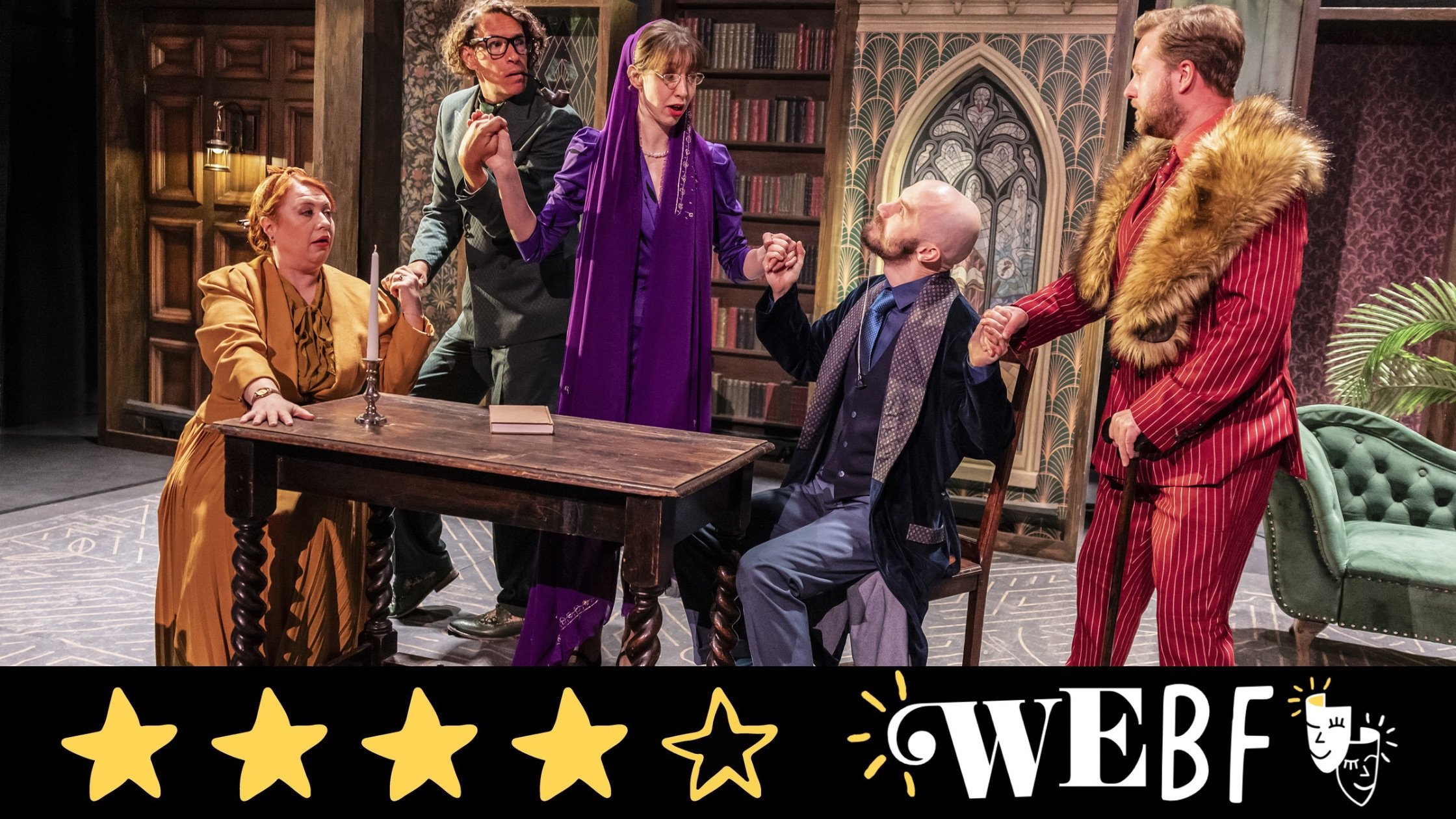
Photo credit: Pamela Raith
“There’s been a murrrrder!” A classic line, pronounced comedically with an exaggerated rolled ‘r’ that murder mystery/Taggart fans will surely be familiar with. Murder, She Didn’t Write, created by improvisation specialists Degrees of Error, brought to the stage by producer Wildpark Entertainment and co-producers Eleanor Lloyd Productions and Fiery Dragons, brings a new representation of this iconic line to every single performance.
A firm Fringe favourite and a piece that is no stranger to touring, it certainly seems to be building a strong following and was received well by the audience in the ornate setting of the Bristol Old Vic where we donned our ‘fingers of suspicion’ to crack the case.
Upon entering the auditorium, audiences are met with a 1930’s period style of music, which instantly sets the scene. This is also played during the interval and upon exit, which holds the vibe and supports the flow of the piece well. A great creative choice from sound designer Lucy Baker-Swinburn.
The stage is preset in what could be described as a classic country house type representation. Again in keeping with 1930’s period style with the decor, bookshelves, candelabras, table and chairs and a chaise longue. To the front of the stage, there is a piano to one side and an armchair to the other. Both the pianist and the detective are seen in character on stage pre-show. This is a cleverly designed set by Justin Williams as it is a fixed set throughout with only minimal movement of furniture, but this singular set needs to represent multiple different locations, heavily reliant on interpretation, due to the diversity of the improvised material that is yet unknown. During last night’s performance, the chaise longue simply changed direction to differentiate between scene settings, simple but effective. This is an entirely improvised piece, even down to the pianist input and sound effects; there is no script and a lot of audience participation, so the scenes could in fact end up set anywhere!
The cast on stage also changes from performance to performance by a clearly talented company of performers. Their characters are named only in terms of colour, much like featured in the game of Cluedo. Costume design by Lu Herbert dresses them to reflect their names, for example: George Green, Vincent Violet, Doctor Gloria Gold. This again leaves their character open to the unknown direction of the performance, each time introducing a unique character role, who will become the victim? And who was responsible for their murder? The audience decide!
As the play begins, we are introduced to the structure of the performance, which is quintessentially your classic whodunnit crossed with the most random game of Cluedo, by the detective, who for this performance was played by Peter Baker. Think Sherlock Holmes meets Poirot, with a comedic flare! The random comes due to it being the audience's suggestions that instigate the action - who, where and with what. Audience members are invited to shout out ideas which are then consolidated and a selection are then offered to ‘the sidekick’, a previously randomly selected audience member, to make the final decision. A card is then anonymously selected by the sidekick and placed into a wallet to select the victim. This is then shown to the actors who spontaneously launch into a fully fledged performance, weaving in the features selected and somehow produce a coherent, internally consistent fully fledged murder mystery that, at the same time, is completely absurd, which elevates the comedic value of the piece greatly. Later, the same thing is done to select the murder.
There is little point in detailing the specific plot of last night’s performance as 'the case of the ‘plastic banana’ is not one that will ever be reciprocated, but the skill of the actors must be recognised to be able to improvise on the spot, produce a plot and motive with clues and twists, all whilst live in front of an audience. This does not feel like an unpolished rehearsal, the pacing is fast, the dialogue flows, quick witted and humorous, with suggested innuendo, implied references to relevant events/politics and is an engaging joy to watch.
The performers, whilst delivering a high calibre performance, truly look like they are having fun and the audience are taken along with that, comedy is enhanced by the quick wit of the cast as they intertwine features into the plot as they arise. It is a particular joy to watch the receiving performers' faces as they realise they have been totally stitched up in a feature they are required to then run with. Harry Allmark and Stephen Clements were particularly amusing to watch with Clements being villainously endearing throughout. Little details, jokes and subtle mentions are remembered and incorporated back into the events as things evolve.
Incorporated here are multiple reflections of classic murder mystery aspects, for example Sherlock Holmes and his trusty sidekick, alongside the tendency to frequently recount his deductions, the way Poirot commonly gathers his suspects to explain the case, and the basic accusatory structure of setting, weapon and perpetrator. Aside this loose structure, the performers fully improvise. All of these structures allow its audience to quickly identify its characters and consistently memory jogs the plot so far, for both the audience and the cast alike!
A gloriously silly murder mystery that provides pure lighthearted escapism, delivered by a creatively talented cast of improvisers. Well worth a watch.
‘….and that is how we solved the case’
**** Four stars
Reviewed by: Claire Baker