
Review: MURDER IN THE CATHEDRAL, St John the Divine Richmond
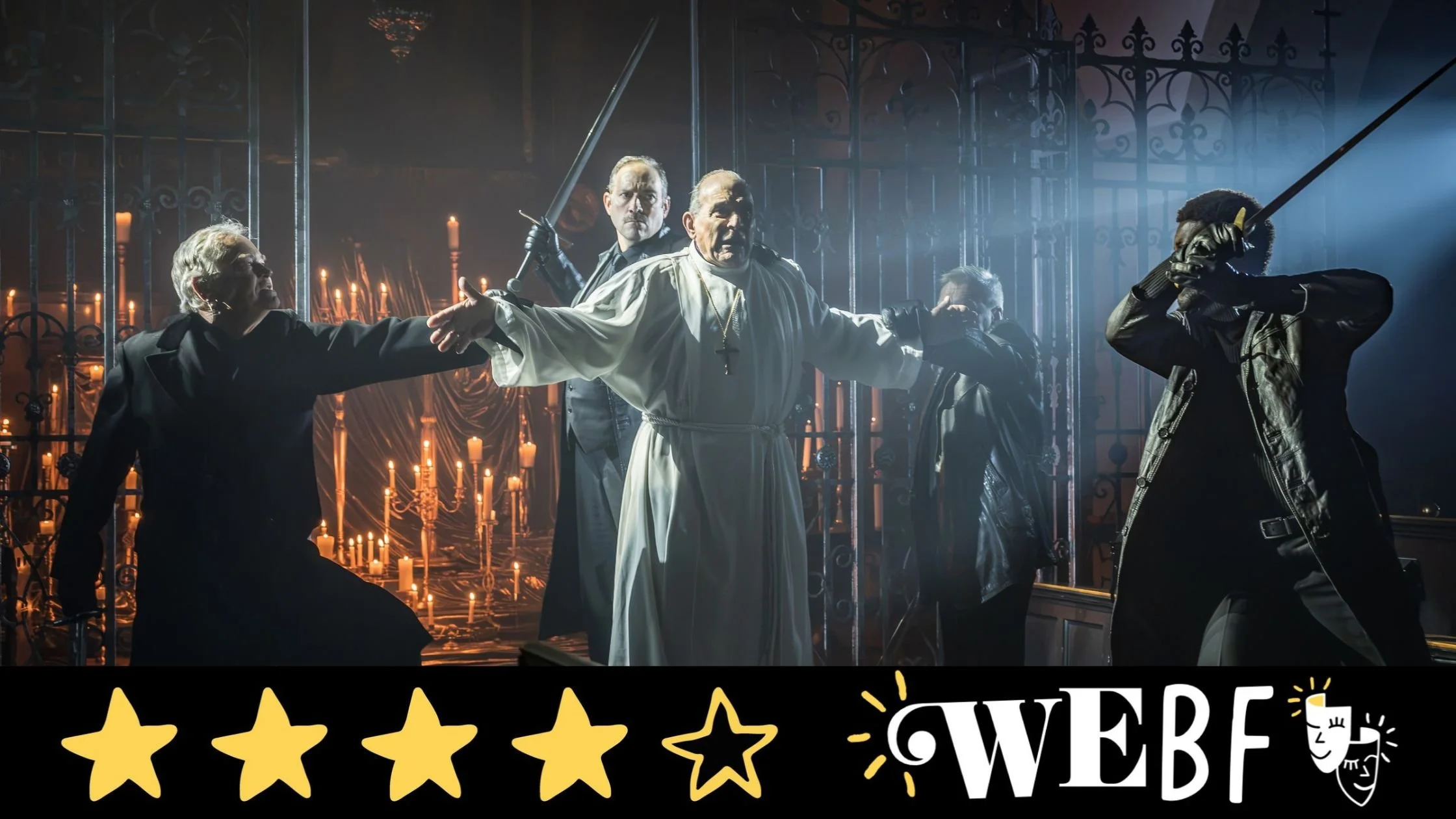
Photo credit: Marc Brenner
There can hardly be a better place to stage Murder in the Cathedral than an actual church. St John the Divine in Richmond, with its enormous crucifix hanging above the performance area, feels just right for T. S. Eliot's play about the murder of Thomas Becket. A runway stretches down the central aisle, suggesting that the action won't be confined to the space beneath the altar. It's a wonderful setting, and one that the production makes full use of.
The acoustics give the voices a lovely resonance, but there's no struggling to hear the words, thanks to speakers fitted to the backs of the chairs. This is especially welcome with Eliot's verse, which isn't always the easiest to follow. The sound of the voices echoing around the church adds to the atmosphere, as does the music, with the Women of Canterbury singing some of the lines.
David Suchet plays Becket, returning to Canterbury after seven years in exile, knowing that he may well be walking towards his death. He's a joy to watch, making Eliot's language sound so natural that it's easy to forget just how difficult it must be to perform. Verse can sometimes sound forced, as though the actor is following a rhythm rather than having a conversation, but Suchet never seems to have that problem. There's a lovely twinkle in his eye, too, giving Becket a warmth that might not be expected.
The Women of Canterbury, for example, don't really feel like ordinary women caught up in events. They're more like the Fates, watching Becket and perhaps even guiding him towards an ending that can't be changed. Their singing and movement give the production an almost supernatural feeling, which is strengthened by the decision to have the same actors play both the Tempters and the Knights. It makes everything feel a little dreamlike, as though Becket was always going to meet these people, whatever he decided to do.
The cast are excellent, with Ben Caplan standing out for the ease with which he handles the verse. He makes some very difficult lines sound like ordinary speech, without losing their meaning or impact.
Tom Littler's direction uses the church beautifully, but it's Peter Mumford's lighting that really deserves attention. Shadows become part of the action, sometimes doing as much storytelling as the actors themselves. In one striking moment, Becket stands with his arms raised while the chorus backs away, his enormous shadow slowly spreading over them. It's a remarkable image, and one that says a great deal about the influence this one man has over everyone around him.
The music and sound are just as effective. A drum, which also doubles as a font or altar, is used to startling effect, and there are even a couple of genuine jump scares. Not necessarily something to expect in a church, but they work wonderfully here. Max Pappenheim's sound design and Orlando Gough's music make excellent use of the building, creating an atmosphere that can change from beautiful to unsettling in an instant.
The costumes are interesting, too. With the clergy in their robes and the traditional church setting, it's easy to assume the play is taking place in the twelfth century. Then someone who isn't a member of the clergy appears, and suddenly it's clear that this is the 1930s, when Eliot wrote the play. That brings a different perspective to the story, especially when considering what was happening in Germany at the time.
The play takes a little while to get going, and the first act is certainly slower than the second. Eliot's writing demands concentration, and this isn't the sort of production where it's easy to sit back and let everything wash over you. But once the pace picks up, it becomes increasingly absorbing.
Murder in the Cathedral isn't an easy play, but this production gives it plenty of life. Suchet makes Becket feel like a real, flawed man, the ensemble adds a strange sense of fate closing in, and the church is so much more than somewhere convenient to perform.
**** Four stars
Reviewed by: Lisamarie Lamb