
Review: MONICA, Battersea Arts Centre
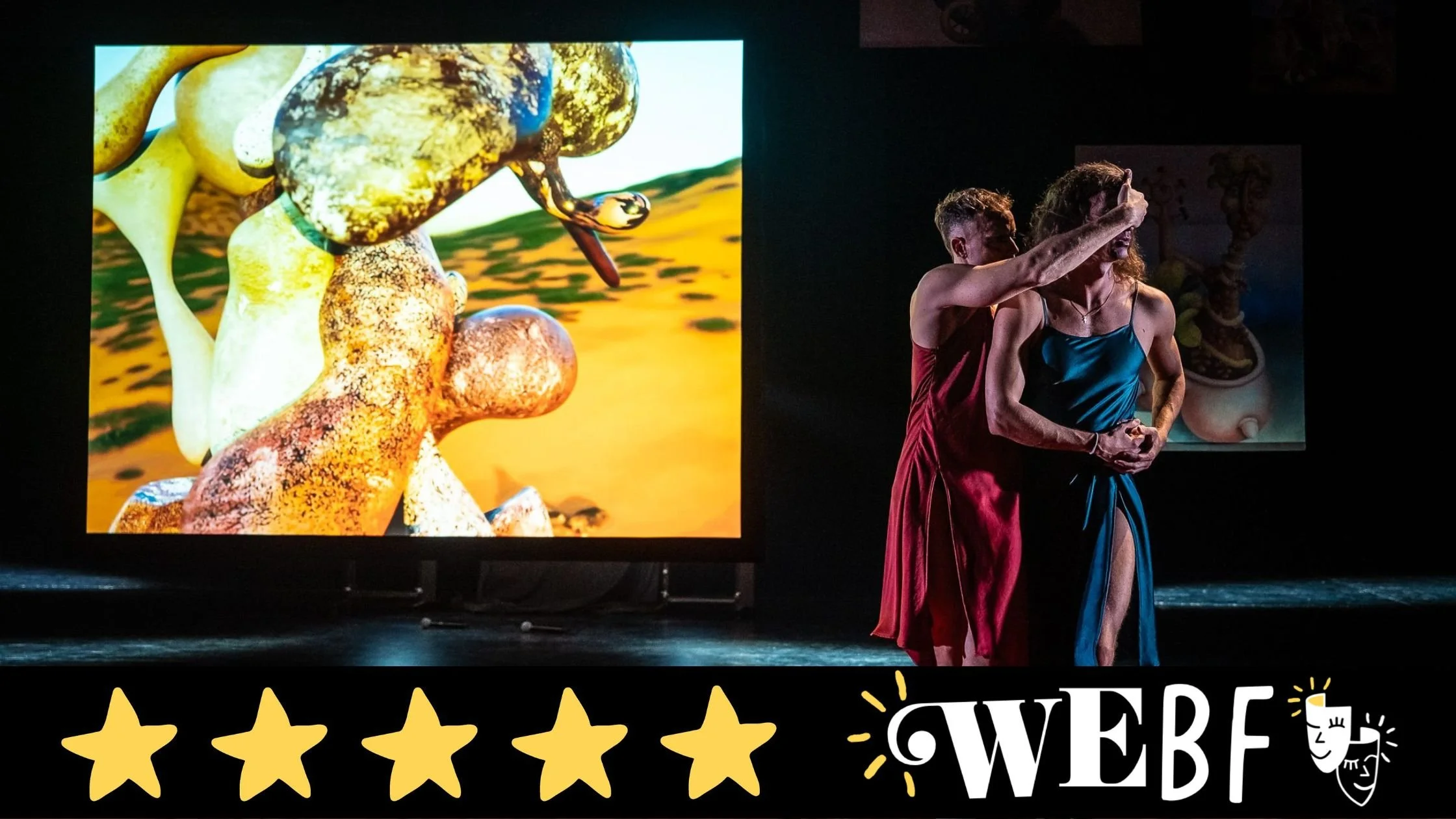
Photo credit: Tom Leentjes
There are works that tell us a story, and there are works that ask us to sit inside memory, image and feeling. Monica is very much the latter, a moving piece of theatre art in which two performers explore the interconnected heritage of two women through disparate but strangely parallel experiences.
Created by artists Pablo Lilienfeld and Federico Vladimir, who are also married, the performance builds a theatrical language around memory, maternal legacy and the many selves a person leaves behind. Both their mothers were born in Argentina in the 1950s, daughters of European war refugees. Both later emigrated to Spain. Both shared a love for American folk musician Janis Ian. Both were named Monica.
What’s in a name? These two Monicas gave birth to two people who found each other later in life; these children then gave birth to a piece of theatre named Monica. From this uncanny coincidence, the evening unfolds into a reflection on inheritance, identity and the way a person gathers meaning through the eyes that remember them. Performed at Battersea Arts Centre, it was a rich and quietly affecting experience.
The subject is the subject, but also how we see the subject. One Monica, Lilienfeld’s mother, was a painter who died young at 36 from skin cancer; in the performance, we encounter her only through the surreal paintings she left behind. Federico’s mother, still present, has her own artistic legacy: she was repeatedly photographed nude by her husband over the course of their fifty-year marriage, preserving a visual timeline of a woman. These paintings and photographs become the emotional backbone of the work, asking how a woman is represented and how we come to know someone through what remains.
The layering of the two performers’ stories of their mothers gives space for our own stories to be projected into the work. Our own Monicas. Though deeply specific in anecdote, the performance opens itself generously, allowing the audience’s personal family histories, absences and inheritances to sit quietly alongside what is unfolding on stage.
An interdisciplinary approach incorporating video, music, verbatim, sound, dance and live performance is used to express this inheritance. Despite the number of elements at play, it remains inviting, placing the audience in a receiving space that feels accessible and caring rather than provocative for the sake of it. Nudity and intimacy feature substantially, but always poetically and playfully.
Video plays a large part in this language. The performers interact with projected paintings and photographs of their mothers, these visual archives cleverly becoming a catalyst for choreography and play. At points, in a short film, they are joined by children related to them in similar costuming, creating a playful continuity between generations. There is a strong sense of play and innocence embedded into the identities of the Monicas through this.
There is also a European cabaret quality running through the evening. One surreal highlight arrives in the character of a grandmother styled inside a pink cardboard-box construction, clownish and heightened yet familiar, part drawn from Lilienfeld’s mother’s paintings, part from an old European grandmother caricature. A play within a play, she MCs on screen before making an appearance live on stage. It gestures toward an older theatrical tradition of wartime avant-garde cabaret while never detaching from the emotional core of the work. It is camp and affecting.
The recurring nude photographs of Federico’s mother are striking not because of their eroticism, but because of their intimacy. They feel self-assured rather than exhibited. Likewise, Monica Lilienfeld’s surreal paintings, often made after the children had gone to sleep, become another private record of a woman. Both mothers are constantly interpreted through visual record yet, refuse to be reduced by it.
There is a great deal contained within the evening and, at times, the themes repeat enough that the mind briefly trails away. Yet a simple enough structure holds the abstraction together, preventing the piece from ever losing its audience.
Most importantly, the emotional connection Lilienfeld and Vladimir have to their material is unmistakable, yet never indulgent. Their handling of a deeply personal archive remains generous rather than self-serving. The wider creative team support this with equal care. Music, created by Pablo and Fede in collaboration with Sophie Taylor, Janet Novas, Cris Blanco, Adriana Reyes, Anaël Snoek and Bunny Cadag, is beautiful and evocative, while movement advice from Mario Barrantes keeps the evening physically alive and emotionally connected.
Monica is never patronising in its treatment of women, nor niche in its queerness. The homage to both mothers is rich with sadness, humour and love, and through these two singular women, the performance opens onto something much broader about how identity survives.
***** Five stars
Reviewed by: Stephanie Osztreicher