
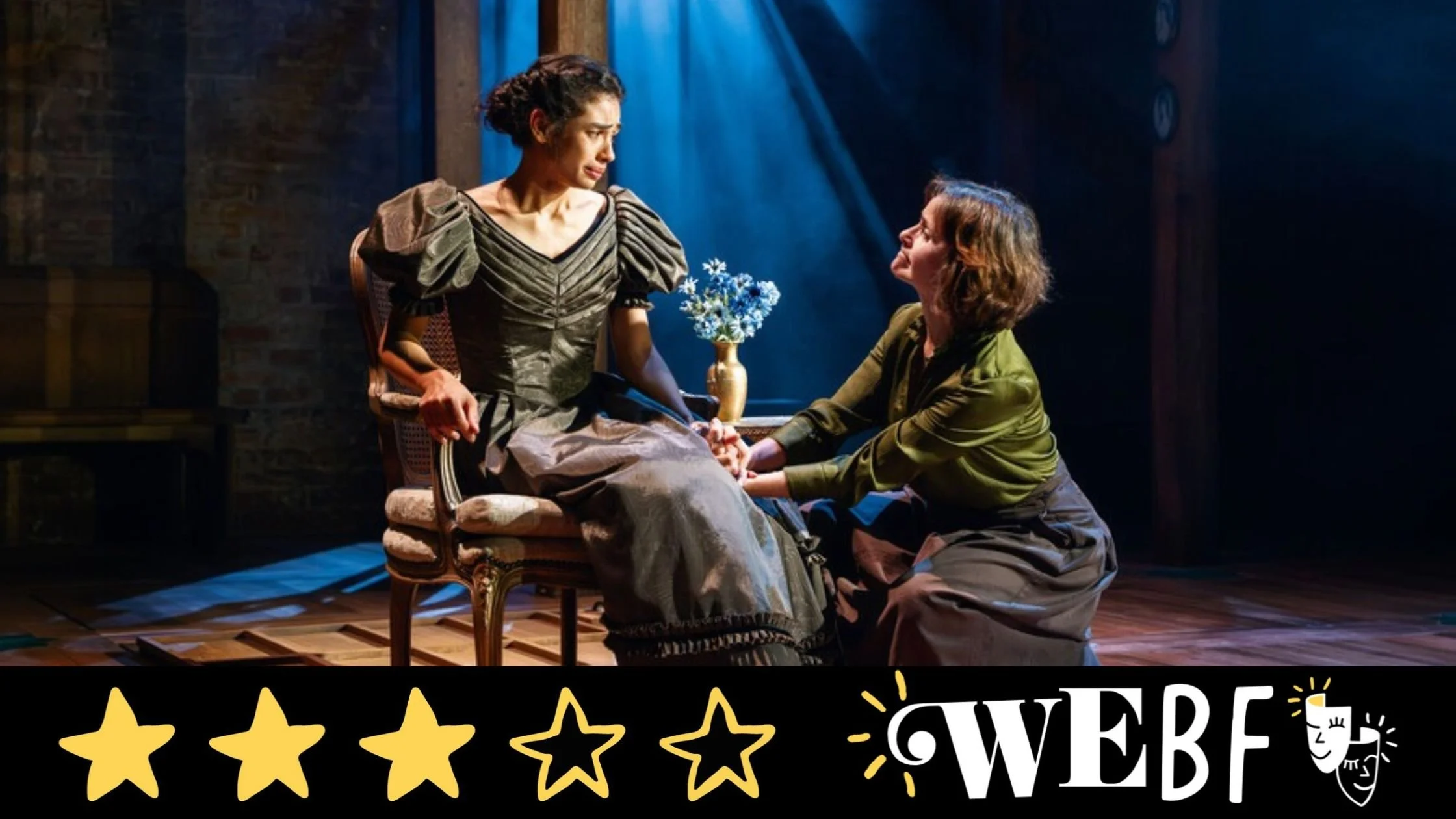
Photo credit: Johan Persson
Middlemarch, A study of provincial life was written in 1871/72 by George Elliot, the pen name of Mary Ann Evans, and was originally published in eight instalments. In 2026, The Guardian ranked it as “the best English-Language novel of all time” so you can see why the RSC thought it might be interesting to adapt it for the stage. The challenge for adapter Nina Raine was how to translate it for stage with some twenty-five characters woven together in a soap opera-like tale, covering the status of women in society at the time, religion and charity, hypocrisy and social conscience, political reform and the democratisation of the vote, and medical advances covering a relatively short period from September 1829 - May 1832. Her answer was to divide it into two parts, seen sequentially and places the author Elliot at the centre of the storytelling.
The RSC had enormous success with Charles Dickens’ The Life and Adventures of Nicholas Nickleby in 1980, an eight and half hour marathon in two parts with an all-star cast that ran in the West End and, of course, Wolf Hall was staged as a two parter, nearly six hours in length in 2013, directed by Jeremy Herrin, who also directs Middlemarch. The two-part version, nearly six hours long, of Harry Potter and the Cursed Child has just closed after a ten-year run at the Palace, with producer Sonia Friedman explaining that the economics of a two parter no longer worked in the West End. All three have a strong linking narrative led by Nickleby, Thomas Cromwell and Albus Potter respectively with pivotal moments of great drama.
Middlemarch is a gentler meandering tale of provincial folk and the adaption uses George Elliot (beautifully played by Amanda Root in an impressive feat of memory) as the narrator to the audience, the conscience of the characters, a mentor and a guide to their actions, as well as creating a sense of the author shaping her own storytelling. It resonates on the conversations on TV at the moment between Susan Ryeland, a literary editor, and Atticus Pund, a fictional detective, in the Marble Hall murders. As a theatrical devise to propel the storytelling and engage the audience, it works and opens up the breaking of the fourth wall for other characters which creates most of the best moments in the plays.
Sisters Celia (Lizzie Annis) and Dorothea (Nia Towle) live with their Uncle (Peter Forbes) until Dorothea agrees to marry the elderly intense, Arthur Casaubon (Ian Drysdale) while Celia marries Sir James Chettam (Gunnar Cauthery in a magnificent wig) who Dodo rejected. In parallel, we meet the Vincy Family; Mayor Vincy (Dave Fishley), his wife (Anita Reynolds), their beautiful daughter Rosamund (Emma Macdonald), drifting son Fred (Ebenezar Gyau) and their relative, the bed bound miser Featherstone (Peter Forbes) and his grasping family, Caleb Garth (Ian Drysdale), his wife (Penny Layden) and their daughter Mary (Lizzie Annis). None of this is a spoiler as it is spelt out in the programme’s family tree. They represent life in the Midlands town before forces for change come into their lives, creating tension, and disrupting their way of life.
The arrival of talented Dr Tertius Lydgate (Andrew Richardson) with his new medical ideas is a force for change and attracts the attention of the financier with a hidden past, Mr Bulstrode (John Hodgkinson), while the dashing Will Ladislaw (Rory Alexander) is a man of energy and ideas pushing for reform. These two young men disrupt the tranquillity of the town, attracting the attention of the young generation of Dorothea, Fred and Rosamund while arousing suspicion and tension amongst the older generation. Two deaths add to the tension and disruption, with Featherstone leaving his wealth to a virtually unseen character Joseph Rigg (Mackenzie Heynes) and Mr Casaubon, leaving Dorothea with a dilemma to solve. The appearance of Raffles (Peter Forbes) casts a dark shadow of the town.
The moments of delight for the audience arise when we become part of the action as an additional member of the cast. The Featherstone Will reading, where we are potential cousin beneficiaries, the auction of property by an ebullient Mr Trumbull (John Hodgkinson) where we are bidders, the election of the Chaplain where we are in the electoral college, and the rowdy public speech by Mr Brooke in his parliamentary campaign. Other moments are less effective with the frequent use of a drably dressed chorus carrying candles singing or providing recaps or round ups of the story we have missed are moments in a long show where you are inclined to tune out.
There is no denying that the acting is first class, the direction and staging slick and efficient keeping the action flowing, if not at pace, and at least seamlessly helped by the excellent stage floor of traps and risers. The beamed and vaulted ceiling that hangs over the stage is said to symbolise the expectation of characters and used to create a “literal lid we can pour light through”. However, to this reviewer, it symbolises the excess, self-indulgent expenditure of the large ACE funded NPO’s on settings. The atmospheric Swan Theatre does not need such a roof and when the rain pours through it at the end the symbolism was completely lost on me. It may be a budget enhancement of the co-producer Second Half Production to recreate the Swan atmospherics in a West End proscenium arch transfer.
This is a worthy literary exercise, a faultlessly delivered production from an acting and direction point of view, and is sure to be enjoyed by students of 19th century literature. But it is not engaging enough to justify a 14 hour round trip to Stratford upon Avon including travel time and the three hours between each part. You are left with a sense of “so what?” or “is that it?”, just as many commentators have reflected on the budget presented at the same time as the press performance. Perhaps both events reflect the desire for political and social change in the respective societies, for honesty and transparency missing from political and religious classes of their time. As Elliot says at the end, it is about “hidden lives, unhistoric acts, and the unvisited tombs” of unsung heroines, like Dorothea, who do good and care about their community and that need is as great today as when she wrote the book.
*** Three stars
Reviewed by: Nick Wayne
Middlemarch Parts 1 & 2 plays at the RSC’s Swan Theatre until 16 Jan, with further info here.