
Review: I’M SORRY, PRIME MINISTER, Apollo Theatre
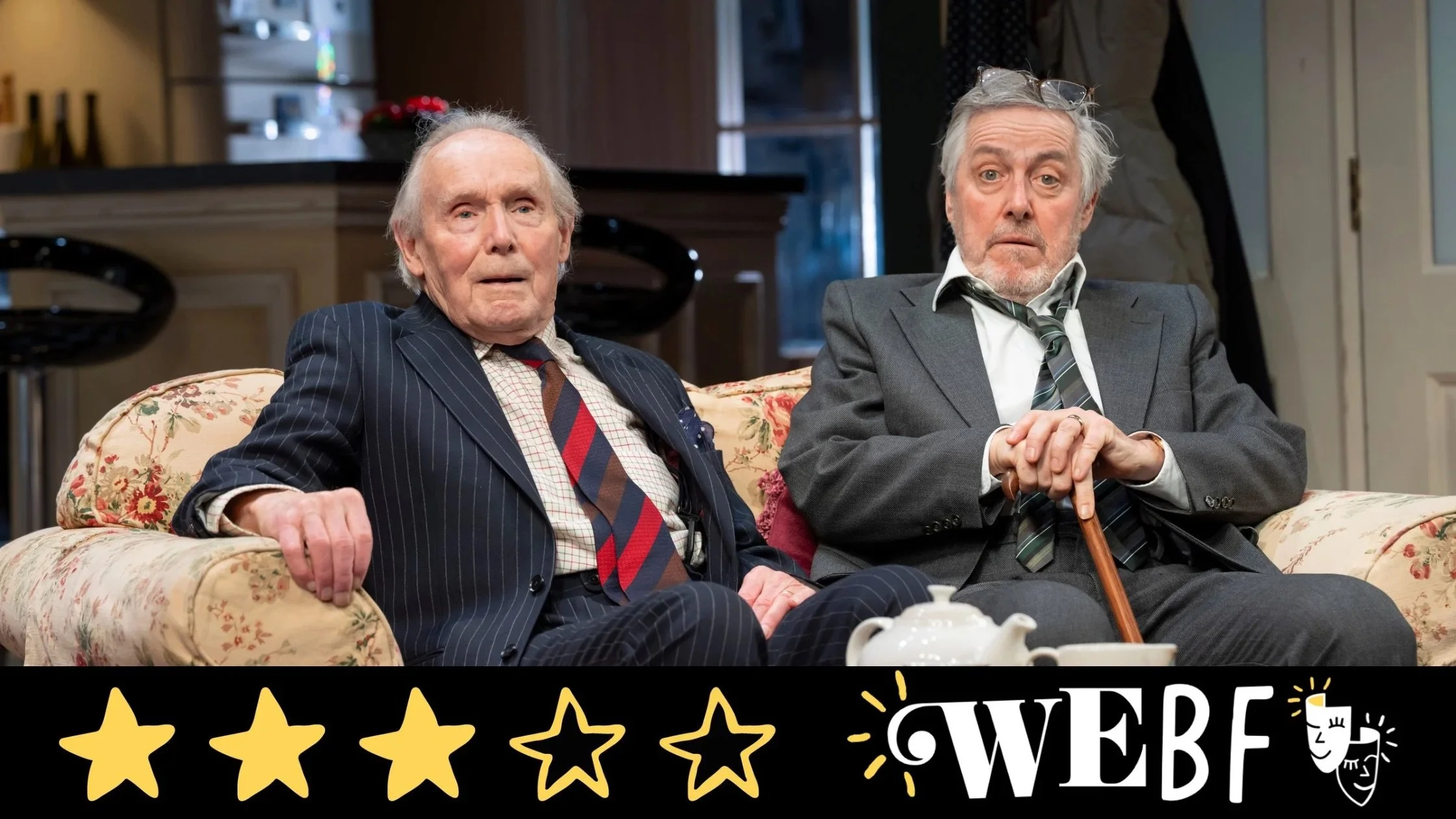
Photo credit: Johan Persson
Transferring situation comedies of the past to the stage has become a regular if risky process, sometimes working and sometimes not. Inevitably, familiar figures from the past have to be played by different actors, not always convincingly. It is to writer Jonathan Lynn’s credit that I’m Sorry, Prime Minister is not a recreation of classic episodes but an attempt to meet these characters now and find out what they are doing.
Jim Hacker and Sir Humphrey are in their eighties and no longer regularly in touch. Jim has settled in to his role as Master of a college which also bears his name, as a result of his attempts to get the funding to set it up. Unfortunately, it is time for him to give up the role, a move he does not welcome. Meanwhile, Sir Humphrey has been persuaded by his daughter-in-law to pass on his savings now in order to minimise inheritance tax, and to move into a care home.
The basic setting convinces and there is much gentle fun to be had from the travails of aging. Writer Lynn (also co-director with Michael Gyngell) has introduced two new characters: Jim’s new care worker Sophie and a college luminary, Sir David. Well played though they are by Stephanie Levi-John and William Chubb, neither has been written convincingly. Sophie is young, black and gay, and her role in the plot is to stand as a cipher for all that Jim Hacker fails to understand. Sir David advances the cancel culture element of the plot, although university machinations and power play happen mostly during lengthy board meetings rather than by sending emissaries; his real role here seems to be as a substitute Bernard bouncing off both main characters. Both actors make the most of the roles they have been given, but one feels for them.
In a small cast of four (with five understudies) that leaves the central couple: as Jim Hacker, Griff Rhys Jones is appropriately crotchety and irascible, frustrated by his growing physical limitations and inability to understand the modern world. We can believe that this could be what Jim Hacker has turned into, and Rhys Jones blusters his way effectively through what has always been the straight man role in this partnership.
Opposite him is the only actor seen in the earlier version of this play: as Sir Humphrey, Clive Francis is an absolute delight. Whether leaping up and down alarmingly when his phone rings in his pocket, or getting at least three good laughs from descending in a stair-lift, this is an actor at the top of his game playing a part that fits him like a glove. He absolutely convinces as the older version of the familiar character, and handles well his disappointment at his current situation.
When the play enters the realm of cancel culture and race, it is often cringeworthy and poorly written. Where once laughs came from general situations, with even Hacker’s political party not identified, here we get specific named statues, lists of supposed forbidden words and other cringe-making and dated dialogue that feels like it was written some years ago. Political satire is best left to the likes of The Thick of It, with writers who can deal with more serious topics. Only once the discussion returns to the difficulties of putting on socks or dealing with grown-up children does the audience relax and enjoy the gentle humour, which has always been the hallmark of this series. The play is unlikely to attract those who have not met these characters before, but will be enjoyed by fans of the series, with a central performance by Clive Francis to cherish.
*** Three stars
Reviewed by: Chris Abbott
