
Review: I’M NOT BEING FUNNY, Bristol Old Vic
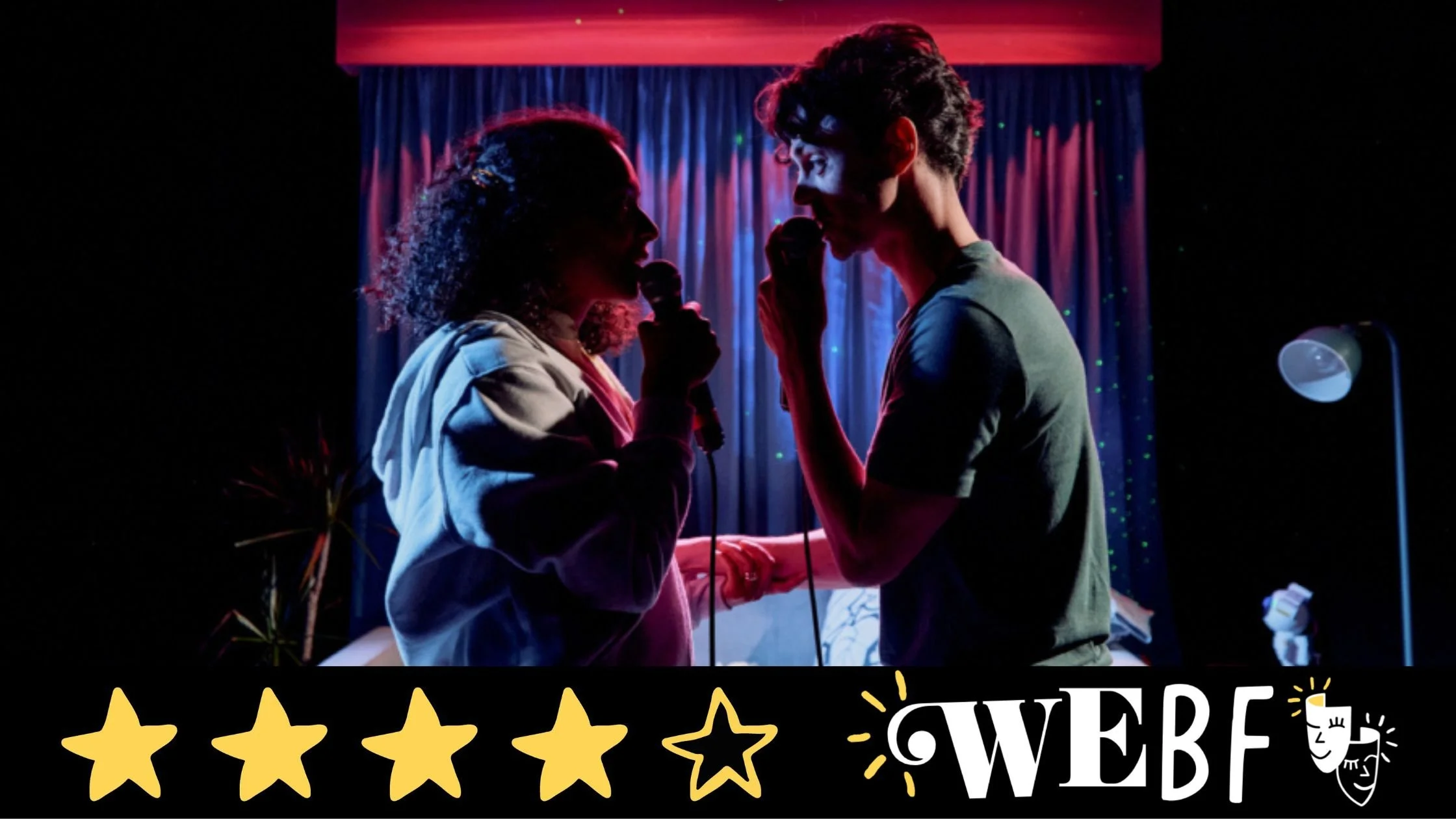
Photo credit: Rich Lakos
I’m Not Being Funny is a poignant piece of new theatre with profound heart. This two-hander from Prentice Productions, in association with the Bush Theatre, recently premiered in London; an initial run that was later extended. It has now transferred and is currently playing for a limited run at Bristol Old Vic.
The narrative follows young couple Billie and Peter, who first come together as childhood sweethearts with references to all the nostalgia of the 90’s, from categorical school dance memoirs, the impending slow dance to the titanic theme tune, Britney Spears, and the rise of the internet. With many twists and turns, we see them make plans and live out their future together with a much deeper context.
Set in the couple’s intimate living room, featuring little more than a sofa, coffee table, light and karaoke machine as set, backdropped by a pair of curtains; clearly a family space where a baby monitor, soft toys and sippy cup can be seen as props. Although Ruby (the couple’s young child) is not seen, with writing and direction by Piers Black and Bryony Shanaham, it is believable that she is there and the poignance of her existence is communicated strongly enough to initiate the required emotional impact.
Cleverly backlit to highlight the centre of the set, ensuring everything is visible but with softer, more centralised lighting over the performance space, giving a cosy, evening feel. Delivered in the Weston Studio at Bristol Old Vic, in front of a smaller audience seated in closer proximity to the action, this iss a fitting location to bring this couple’s story to the floor and Amelia Jane Hankin’s perception as set and costume designer works well. The lighting also plays a key part in intermittently setting the scene as a series of flashbacks interject with the main storyline. These are clearly represented by a sound effect and sudden lighting change, the contrast and softer tones depicting a dreamlike state, whilst delivering key information that drip feeds the wider narrative. As the audience begin to connect to the piece, we are drawn more deeply into the couple’s emotional carousel.
As the play begins, Peter (played by Jerome Yates) is instantly likeable and dives straight into delivering an intentionally substandard stand up routine, full of what do you call... jokes, puns that don’t hit and categorical mediocre dad jokes. It is unclear at first whether this address is a break in the fourth wall and the audience are expected to reciprocate - or not - or whether this is a direct address to which the audience are more of an invisible auditor. This uncertainty adds to the routine not quite taking off but also serves to begin building an empathy with Peter’s character.
The piece is fairly slow to build at first. The opening routine could potentially be a little more concise but beyond this the piece seems to pick up the pace. There are multiple moments as it progresses where the piece lingers on certain moments, where the action is still and the audience are silent, however these moments combined with elements of writing, direction and cast delivery land successfully and allow you to sit just long enough to absorb the poignance and feel.
As Peter’s opening stand up routine turns to frustration and emotional outburst, it is soon made clear that there is more riding on this than meets the eye, and that the heart of the core narrative runs much deeper here than the pressure of preparing for a stand up performance that Billie (his wife) has entered them both into.
The two actors remain onstage throughout the 90 minutes with only brief individual exits. Casting from Fran Cattaneo is strong; there is a clear trust and chemistry between the pair, exemplified by little gestures and body language that support the narrative well. As the couple attempt to prepare their ‘tight five’, we develop a deeper insight into Billie’s character (played by Tia Bannon). Tia delivers strong characterisation and sensitivity as identifiable and challenging themes are explored. Each character has their own arc, delivered in a very real manner as we follow the couple navigating life in all its highs and lows.
Juxtaposing opinions are raised in terms of parenting boundaries, life management and creative choices. We see their approach to the intended goal of the comedy performance begin to create a divide at times, in terms of the material that each are willing to publicise and their differing comfort zones. With Peter often struggling to communicate his emotions, but Billie appearing more confident and open but very reactive to particular subjects that are simply too painful to process.
As tensions heighten and we learn more about these knee jerk moments. Writing by Piers Black has cleverly interwoven the threads and we are drip fed through the flashbacks the reasons for each others personal boundaries and the deeper circumstances surrounding them.
Laughter is the best medicine is a popular saying and children’s laughter specifically has a particularly powerful reputation. This performance lends into the notion of using comedy as a way to open up difficult conversations, sharing information, release things that you lock inside, a way to share ‘uncomfortable’ topics with people that you otherwise can't find the words for. Undoubtedly a method not a cure, but laughing things off here transposes to unlocking lines of communications and mixed emotions that lead to the crux of the stark reality finally being able to be addressed and moments that are otherwise too painful to explore drawing the couple together.
Ending on a cyclical full circle moment, returning to the slow dance to the same tune, however more poignant and sentimental this time. There is a slight element of the unknown to the play’s ending in terms of completing the characters’ story, however it feels finished. As it ends, it leaves an audience satisfied by the journey and feels a natural place to stop. We finish on not a certain ending but a notion of hope and possibility.
A piece of theatre that understands ‘real life’ and offers a space to open up conversations, a place to feel, a place to lose or find yourself, to smile, to be held, to feel seen and heard. It combines ‘normal’ reality whilst posing the question of what happens if the laughter runs out and all that is left is grey, when that pendulum swings between being ok, functioning and swinging beyond manageable realms.
**** Four stars
Reviewed by: Claire Baker
I’m Not Being Funny plays at Bristol Old Vic until 27 June, with further info here.