
Review: HOLY FOOL, Park Theatre London
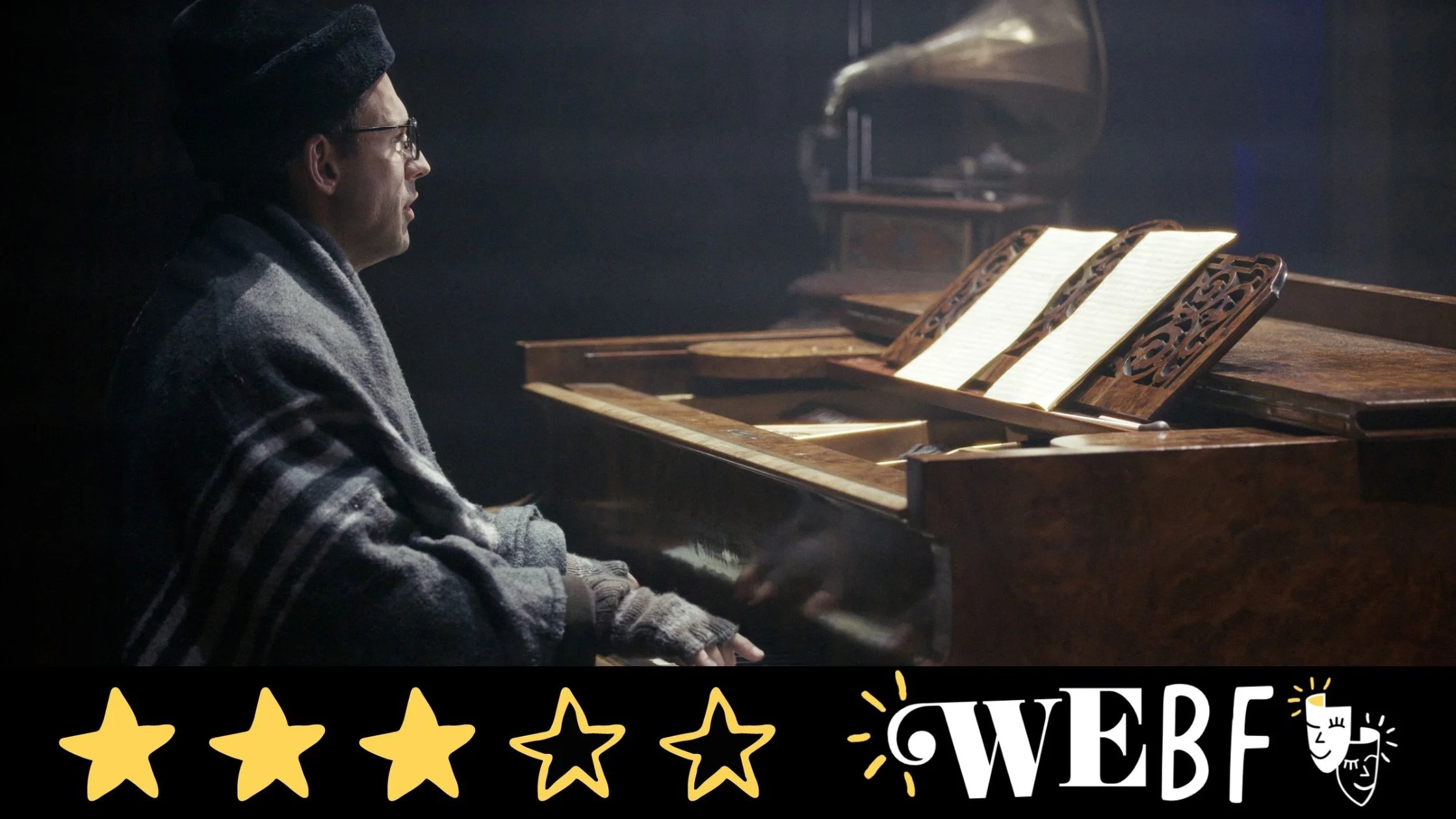
Photo credit: Mark Douet
Holy Fool, a new play about composer Dmitri Shostakovich, offers a pointed perspective of Stalinist Russia through an artist caught inside it, a man whose music could both save him and put him in danger. Written by Rosalind Adler and Lea Sellers and directed by Kate Fahy, the play traces Shostakovich's life from 1936 through to the 1970s, as he navigates censorship, war, political pressure, and artistic compromise.
Shostakovich is a complex figure: a man with a genuine love for his country, while living under a regime that oppresses his artistic freedom and challenges his morals. The question is posed: how much of yourself can be compromised to survive, and whether survival itself can become an act of resistance? He is constantly caught between his deepest calling as an artist and the demands of a collective ideology. It is here that the fascination the writers have with Shostakovich is most apparent. There is something compelling about seeing the world so pointedly through the lens of an artist: his ego and his downfalls remain visible, but so does the human being trying to navigate an extraordinary level of collective trauma.
Music becomes a means of expression when words are dangerous, although still not without risk. The Party favoured music that aligned with Socialist Realism, accessible and comprehensible, with clear emotional and ideological purpose, while Shostakovich's more experimental work could be condemned as “formalism”. When Stalin attended a performance of Lady Macbeth in 1936, the opera was publicly denounced, and Shostakovich was placed under intense political pressure. In this narrative, his Fourth Symphony becomes a symbol of this conflict. Begun in the 1930s and withdrawn before its planned premiere, it was not performed in its original orchestral form until 1961. Its inclusion in Holy Fool gives a clear representation of the tension between Shostakovich's artistic voice and the demands of the state.
Benjamin O’Mahony as Shostakovich gives the appropriate level of ego while still allowing us to sympathise with his plight. His performance keeps the composer from becoming simply a historical figure.
Nina, his wife, played by Jenna Augen, his biggest supporter and anchor, does a wonderful job with a curiosity and passion that feels closely connected to the music of her husband. Around them, Fergus O'Donnell and Phoebe Pryce shift between characters with ease, moving from loyalists to rebels, they hold the changing world around the central figure.
Music naturally plays a key role, and we are treated to samples of compositions that form the legacy of a great artist. The piano on stage creates an intimacy in the moments where we hear music being conceived, yet this is also where the production feels like it misses an opportunity. The music is often used as a convention for scene changes, filling the space between moments rather than becoming fully interwoven with the storytelling. The transitions can feel clunky and abrupt, meaning that the significance of the music becomes convention rather than narrative.
There is enormous potential in Shostakovich's music to carry the dramatic world of the play. His compositions contain the kind of extremes that could deepen what is happening on stage. Occasionally touching this possibility, Holy Fool does not always trust it enough.
The design is minimal creating a bleak world without attempting to overstate it, although the simplicity feels more functional than expressive. The use of voiceovers to add narrative information and internal thoughts also feels more conventional than fully theatrical.
As the story progresses across such a long period of Shostakovich's life, the production does begin to lose steam. Later stages lean increasingly towards exposition, rather than allowing the complexity of the story to remain embodied through the performance.
There is much to admire here: a strong ensemble and a story that places artistic freedom, morality and survival under uncomfortable scrutiny. It also takes a complicated history and gives it clarity through its choices. But there are moments where the production could be braver.
*** Three stars
Reviewed by: Stephanie Osztreicher
Holy Fool plays at London’s Park Theatre until 10 Oct, with further info here.