
Review: HOLMES AND WATSON: THE CURIOUS CASE OF THE MASKED MAGICIAN, Wilton’s Music Hall - Tour
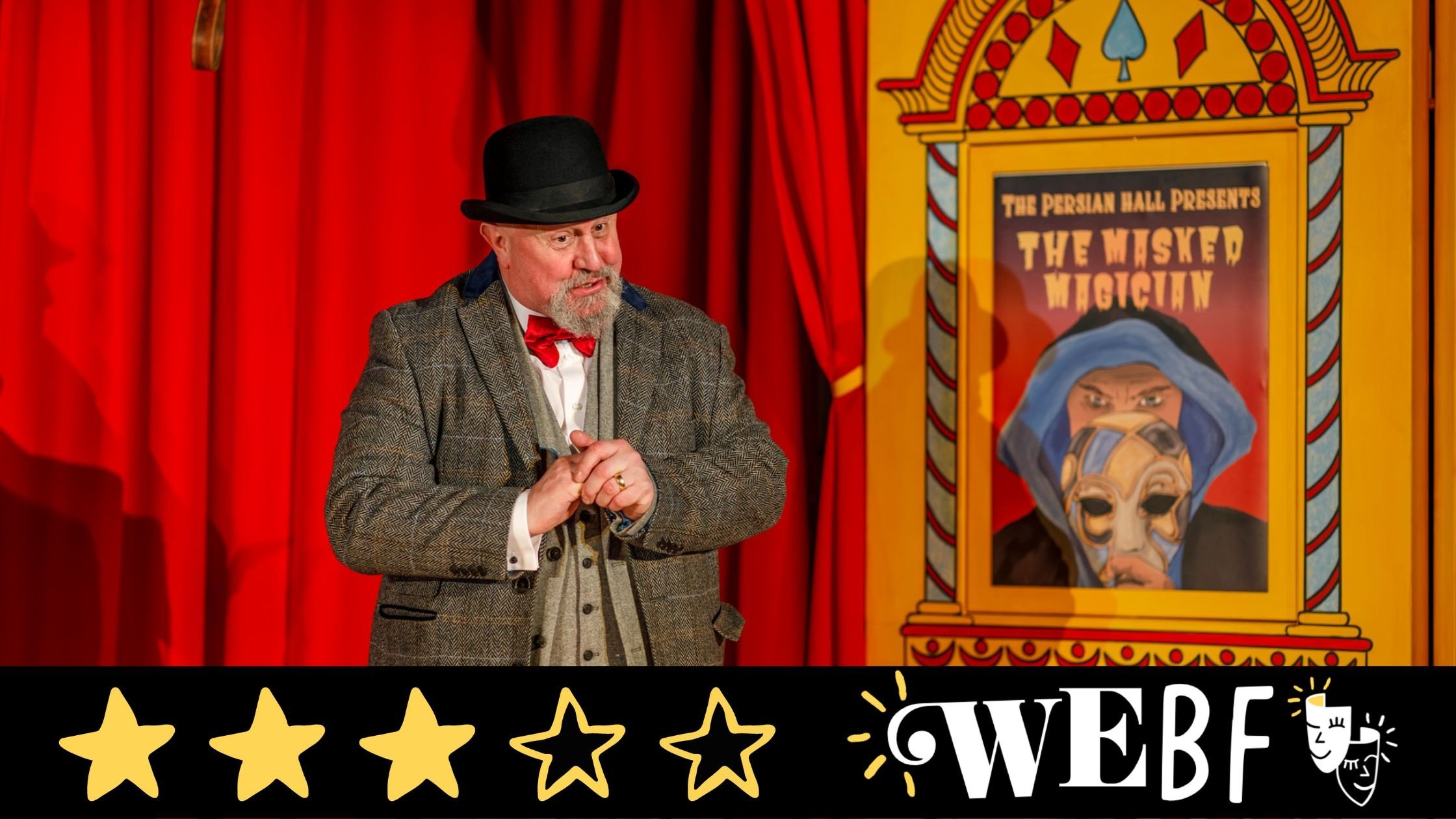
Photo credit: Ed Felton
Wilton's Music Hall already feels like part of the show before Holmes and Watson: The Curious Case of the Masked Magician even starts. With its peeling paint, dark wood, balconies and creaky Victorian atmosphere, it’s exactly the sort of place where you half expect a magician to vanish in a puff of smoke, or Holmes himself to appear in the corner muttering about clues; the venue feels tailor-made for this sort of theatrical nonsense, and the production knows it.
Fi Russell’s set design works brilliantly with the fun of it all – bright, playful and constantly moving, the spinning set pieces work their own kind of magic while keeping the audience firmly aware that we’re in 1906 London, right alongside the newly built Bakerloo Line. There’s even a recurring joke involving station signage that somehow never stops being funny, partly because the production commits so completely to the silliness of it all.
Peter Clifford gives us a Sherlock Holmes exactly as you’d hope for visually – deerstalker, Inverness cape, the whole lot, and minus the violin and pipe, it’s basically the version everyone pictures in their heads already. His Holmes is absolutely the cleverest man in the room and he knows it too, but Clifford plays the smugness with enough charm that it becomes endearing rather than irritating.
Meanwhile, The Great Baldini turns Watson into a wonderfully chaotic sidekick, the sort of enthusiastic Victorian puppy who’s amazed by absolutely everything Holmes says or does whether it’s remotely impressive or not. He bumbles about the stage causing low-level mayhem while trying desperately to keep up, and the audience warmed to him instantly.
Although the magic is really the main attraction here, there’s still a proper mystery underneath it all; the famous Masked Magician vanished during a performance and has never been seen since. Did he disappear voluntarily? Was he murdered? Four gloriously suspicious suspects appear along the way, giving Holmes and Watson plenty to untangle. We didn’t solve it ourselves, sadly, although to be fair we almost never do, but the eventual reveal is satisfying enough, helped enormously by a wonderfully overcomplicated map at the end that pulls all the clues together.
And yes, the magic itself is good fun. Some tricks genuinely baffled the audience, particularly Holmes somehow identifying people’s professions and a playing card that refused to stay where it should, while others felt slightly more familiar and perhaps could have pushed further. But what matters most is how well integrated the illusions are within the story itself – this never feels like a play awkwardly pausing for a magic act; the tricks are the story.
The audience absolutely loved it too. There is constant laughter, loads of participation, plenty of groaning at the terrible puns, and a sort of shared willingness to completely buy into the silliness for a couple of hours. It feels a bit like adults being allowed to become children again for a while, which is probably something most people need more often. And the bad jokes really are part of the charm.
Most importantly though, the show understands something quite clever underneath all the smoke and nonsense: magic and theatre are basically the same thing. Both rely on misdirection, timing, performance, and an audience desperately wanting to believe what they’re seeing, even when they know they probably shouldn’t, and in a venue like Wilton’s, with all its old-world theatrical ghosts hanging around the walls, that feels magical in itself.
*** Three stars
Reviewed by: Lisamarie Lamb