
Review: HENRY V, RSC
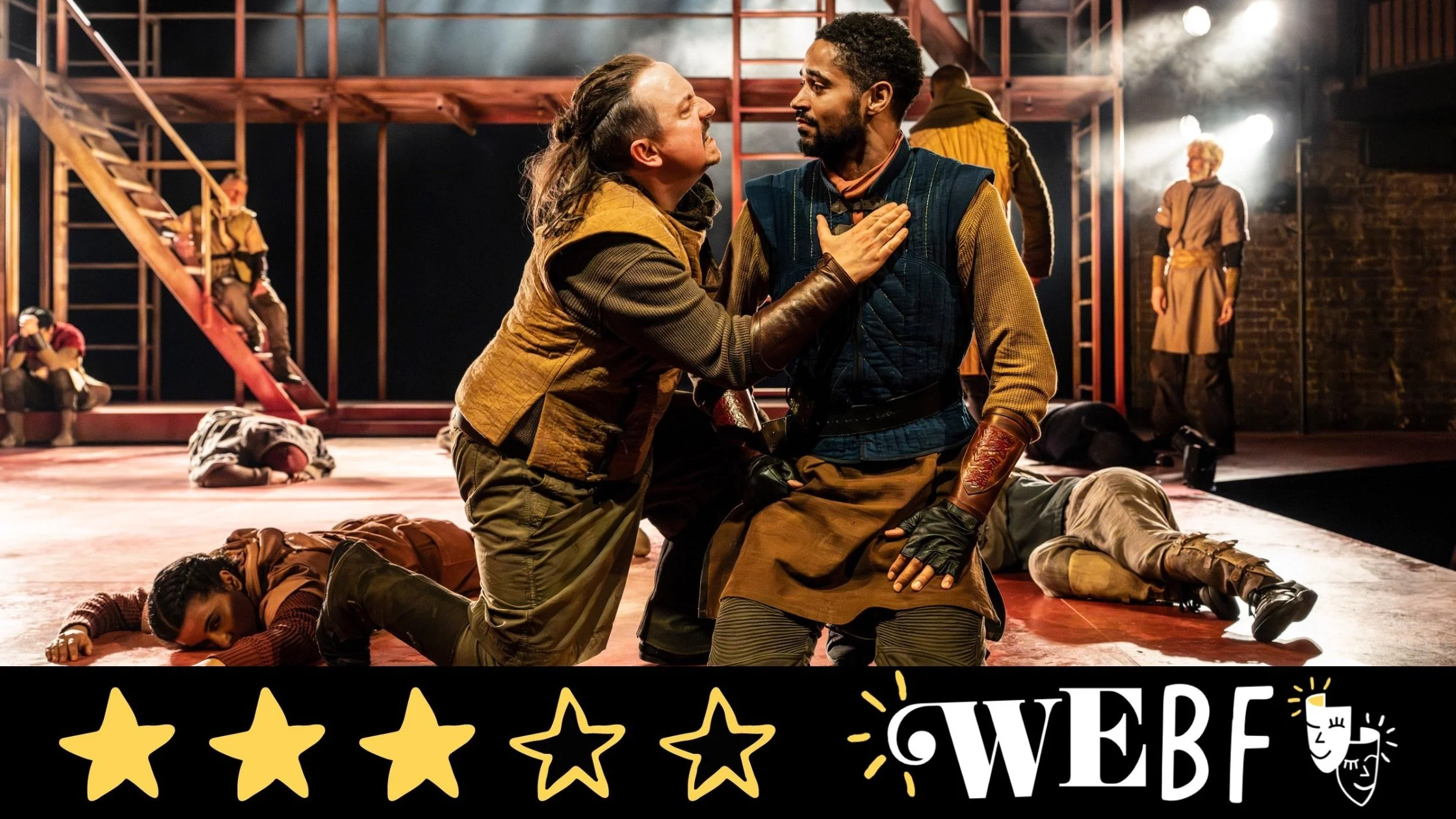
Photo credit: Johan Persson
Henry V, as portrayed in film and previous productions, is a heroic, patriotic inspiring leader who rallies his heavily outnumbered troops at their lowest point to defeat the French at Agincourt. It’s stirring stuff with its cries for “God for Harry, England and Saint George” before the siege Harfleur and rousing the men with ”we few, we happy few, we band of brothers” before the famous 1415 decisive battle. Yet in the RSC’s latest production, it is reimagined as a sprawling confusion with an animated mass of courtiers, soldiers and villagers filling the stage. Together with Movement Director Annie-Lunnette Deakin-Foster and Fight Director Kate Waters, Director Tamara Harvey creates a complex three-dimensional picture of activity, which detracts from the famous Shakespeare lines.
The images created remind us of a medieval Bruegel peasant painting with the muted colours and an array of hats and groups engaged in their own distinct activity, while ignoring all the others. Too often, your eye is caught by action on the three-storey wooden scaffold frame that dominates the thrust stage, and you puzzle at the meaning of the director’s intention rather than focus on the spoken word. At one point, sheets and ropes are passed through the scaffold in a complex choreography of movement, were they hanging out the washing or rigging a ship? It adds nothing to our understanding. In another scene, we see the parallel action of the Court of France and back in Southampton, we see the preparation for the hanging of the Earl of Cambridge, Sir Thomas Grey and Scroop (reimagined as a female), which is gruesomely re-enacted. When the siege of Harfleur and battle of Agincourt take place, the scaffold tower revolves as the performers dance in slow motion around the stage like a medieval rave rather than a ferocious decisive battle. There is a clear directorial vision for the staging to be different from what has gone before but surely it should enhance our understanding or draw relevance to today’s leaders’ Global ambitions.
There are moments when the lighting by Ryan Day helps clarify the confusion but at other times, it jars anachronistically. The French court is symbolised by a single electric light bulb, and the scene where Princess Katherine (Natalie Kimmerling) learns some English words is transported to a hospital under fluorescent lights while she sounds like Inspector Clouseau on a ward visit. When she finally engages with Henry as he proposes marriage, it feels like a Shakespeare version of Kiss me Kate.
Through all of this, Alfred Enoch is left to make some sense of the historical tale and demonstrates his command of the language with clear and purposeful delivery as we see him grow in stature and authority. There are moments of real joy when the focus is on him. The delightful scene on the eve of Agincourt when he first engages Pistol (a very amusing prancing performance throughout by Paul Hunter as the counterfeit rascal) and then challenges Williams (Jamie Ballard) provides insight into his character. While during the Feast of Saint Crispin Day speech, he brilliantly engages the front row of the audience as if we are all in his band of brothers. As he did in last year’s RSC production of Pericles, he proves himself a very good Shakespearean actor with good stage presence, which helps him rise above the masses of cast around him.
Indeed, the eighteen other actors, many of them doubling up in both courts and without distinctive costumes to distinguish the French from the English, are supplemented by fifteen supernumeraries (18–20-year-olds from Belgrade Theatre, Warwick University, Stratford Youth Theatre and Strafford College) as villagers and soldiers. This opportunity to appear on stage for young aspiring performers is to be applauded and we wanted them to be better used apart from traipsing across the stage or filling the upstage space behind the scaffold. We could see the pleasure they derived from being part of the show.
The rebalancing of the gender mix in the cast largely works with the Duke of Gloucester becoming the King’s sister (Sophie McIntosh), the French Herald becoming a female Mountjoy (Sarah Slimani) and the young boy who follows Pistol becoming a young girl (Tanvi Virmani). All three young actresses take the opportunity to quietly make a favourable impression in these important cameo roles.
Henry V is a straightforward linear retelling of the King’s desire to rule France and a familiar story with several famous speeches and characters. Enoch conveys the King’s ambition and quieter, more caring side convincingly but is not served well by the rest of staging around him, which is more intent on being different and visual rather than enhancing the storytelling in what is, after all, a rather long play for a modern audience.
*** Three stars
Reviewed by: Nick Wayne
Henry V plays in the RSC’s Royal Shakespeare Theatre until 25 April, with further info here.