
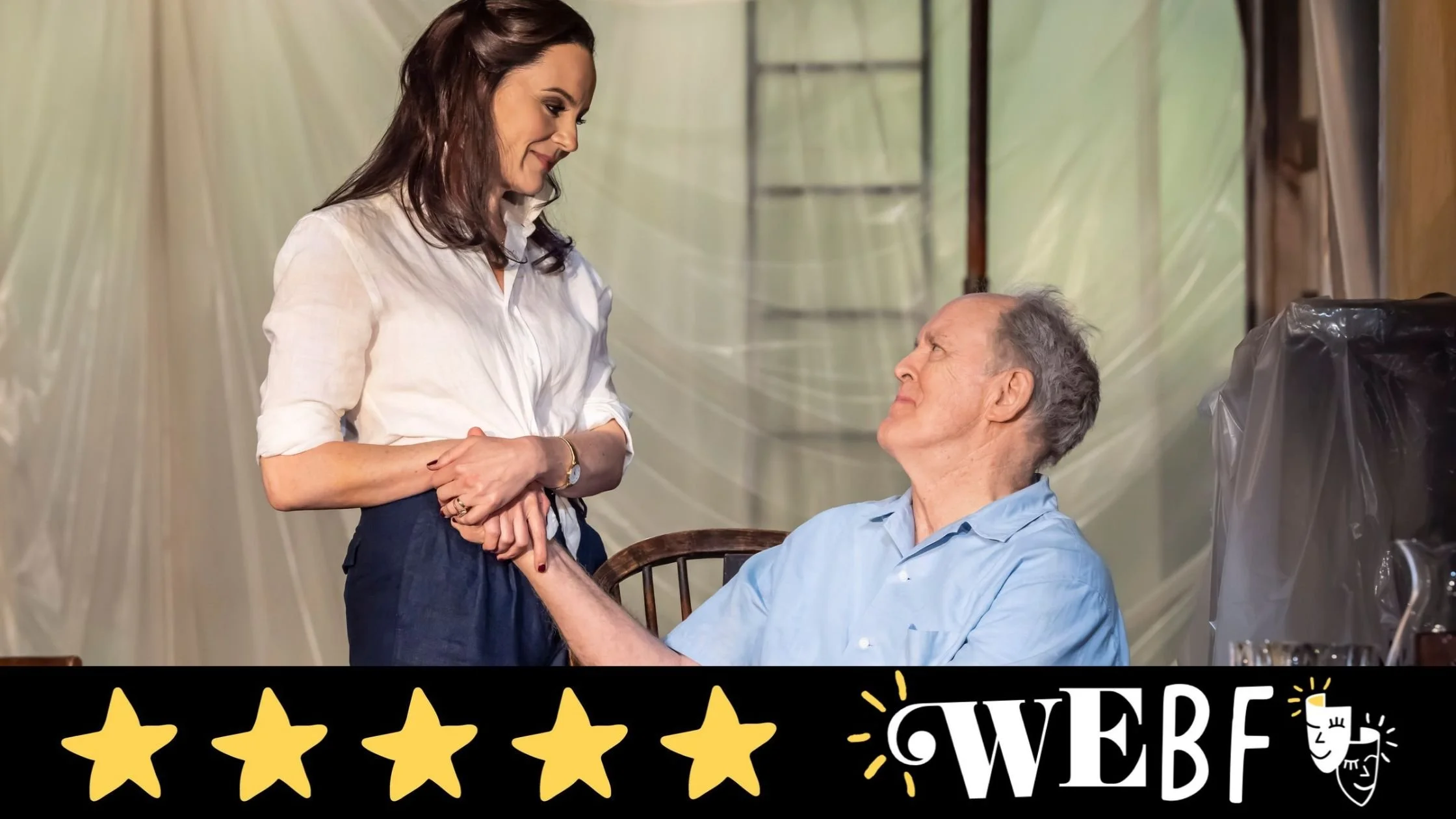
Photo credit: Johan Persson
Filmed at the Harold Pinter Theatre, this recording of Giant really captures the feeling of a live experience. The audience is shown entering and applauding, and the occasional discreet rustle and cough are left in for authenticity. There’s also an interval built into the recording, which adds to the feeling of being in a theatre. The picture and sound quality are excellent, although the speakerphone section is unusually loud. The camera is not confined to a static viewpoint but instead follows the action, capturing finer facial expressions and details of the set, adding another layer to the theatrical experience.
Giant focuses on the real events of 1983, when Dahl wrote a public book review of God Cried, which prompted accusations of antisemitism. While the situation depicted in the play is fictional, Dahl’s comments and views were real and the play uses Dahl’s actual words, from the review and subsequent interviews.
The play takes place in the aftermath of his review, when two representatives of Dahl’s UK and US publishers (one entirely fictional, one based on a real person), both Jewish, visit the author at home. With Dahl on the cusp of publishing The Witches, they seek to persuade him to consider the impact of his review and apologise.
It is as heavy as it sounds. Although it starts slowly, there is no light touch here. The issues are not skirted around but are confronted head-on. Some of the language can be jarring and the cast do an excellent job of conveying the frustration arising from their individual and collective viewpoints. Alongside the discussions of politics and antisemitism, Giant explores a number of questions, many of which remain pertinent today: can a body of work be separated from an author’s opinion, and are inappropriate behaviour or controversial views overlooked simply due to celebrity status? Is there a higher tolerance for poor behaviour or offensive opinions due to the financial implications of the alternative?
The writing is impressive and, on the whole, Giant manages to present a balanced picture, rather than simply portraying Dahl as a one-sided villain. It also explores other facets of Dahl’s character, including his fondness for children, both his own and those who read his books. We learn that Dahl refuses to use a PO Box address as he wants children to be able to write to him directly.
Nicholas Hytner’s direction is particularly effective, allowing the nuanced writing and characters to breathe. There are moments of levity and humour amid the tense, often impassioned discussions. The play offers no neat conclusions, and the direction encourages the audience to consider the arguments throughout the performance and long afterwards.
John Lithgow is outstanding as the objectionable, opinionated Dahl. He strikes such an impressive balance of playful, aggressive, delicate and rude. It would have been very easy for any actor playing Dahl to adopt a one-dimensional approach to the character, particularly given his many seemingly irredeemable characteristics, but Lithgow invites the audience to consider all sides of Dahl rather than just those at the centre of the controversy. It certainly helps that he bears a striking resemblance to Roald Dahl himself, but it’s Lithgow’s ability to make both sides of Dahl’s complex character believable that gives the performance its authenticity.
Aya Cash is outstanding as the impassioned Jessie Stone, whose character provides the moral driving force of the play, as she ultimately refuses to be intimidated by Dahl. Rachael Stirling is equally impressive as Dahl’s fiancée, inviting us to ask: at which point does support become complicity? Elliot Levey is convincing as Tom Maschler, conveying both his dedication to the author and his growing sense of disappointment.
There’s no sugar coating here. It’s frank, relevant and incredibly important. As well as inviting audiences to question their own relationship with Dahl and his work, Giant explores several complex subjects: power, accountability, grief, relationships, identity, friendship and cowardice. All feature prominently, as we are asked to consider the risk of someone becoming so powerful that they become incredibly difficult to challenge.
***** Five stars
Reviewed by: Cara Brazier
GIANT will be screened in more than 900 cinemas across 18 countries from 19 November, including the UK, USA, Canada, Australia and select international territories.