
Review: DEBATE: BALDWIN VS BUCKLEY, Wilton’s Music Hall
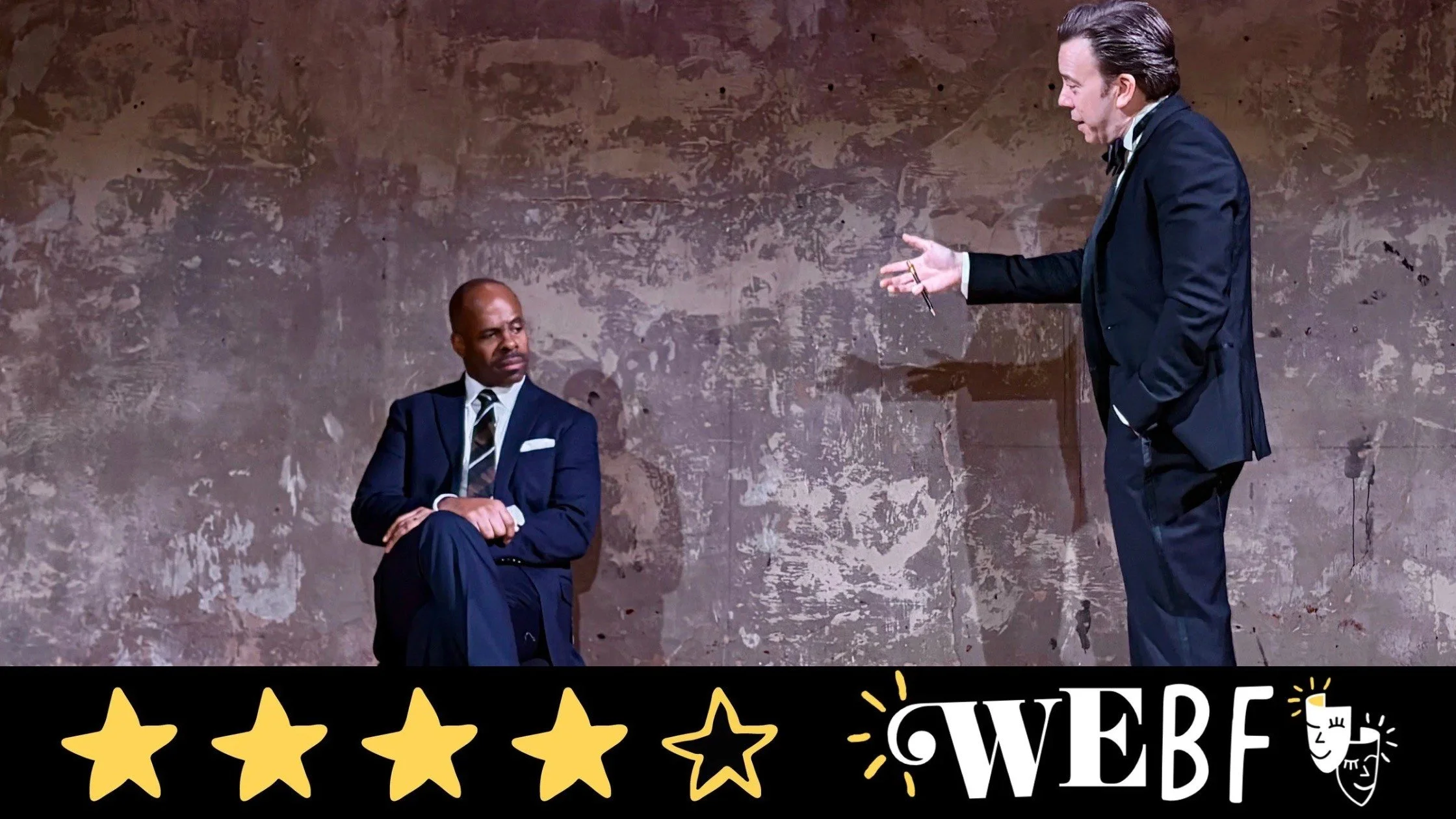
Photo credit: the american vicarious
There is a particular alchemy that occurs when the ghosts of history are summoned into the well-loved confines of Wilton’s Music Hall, the world’s oldest surviving Grand Victorian music hall. The dense history, both in venue and the staged dramatisation of the 1965 Cambridge Union debate between James Baldwin and William Buckley (Debate: Baldwin vs. Buckley) leaves an unsettling profundity in the air long after the verbatim play finishes.
The setting is lean, with four chairs situated downstage from the occasional projections of the original 1965 debate. There is gladly no artifice here, with the verbatim script carrying with it a heft that needs no alteration to remain startlingly urgent today.
As James Baldwin, Arnell Powell contains the might of Baldwin’s thinkings well. He inhabits the role with a poised dignity and yet his performance vibrates subcutaneously. He captures the specific exhaustion of a black man carrying centuries of systemic trauma. It is a performance of immense poignancy; one sees the sadness seeping through the cracks of his eloquent armour as he recounts the indignities of a country that builds its wealth upon the very bodies it rejects.
Opposite him, Eric T. Miller offers a chillingly precise foil as William Buckley. Cloaked in the sartorial arrogance of a dinner suit, Miller captures Buckley’s performative elitism with piercing accuracy. He treats the stage and the audience as his natural domain, utilising a well-timed interjection or a condescending tilt of the head to seem beyond at ease. He teaches, as Buckley did originally, a masterclass in the rhetoric of the ‘Establishment’, arguing for a poisonous status quo under the guise of ‘intellectual’ civility.
The brilliance of the production lies in its restraint. By stripping away everything but the oratory, it forces us to confront the terrifying stagnation of progress. Baldwin’s observations on systemic racism are just as tactile today as they were six decades ago.
While Buckley's victim-blaming and exclusionary tactics eventually collapse under the weight of their own hollow logic, the production reminds us of the importance of debate. It is crucial people speak to one another, while also realising that intellectual pontification will not help move the dial for those stuck outside the racial, societal, and economic ‘room’.
This is more than a historical reenactment; it is an alarm to conscience. The simplicity of Christopher McElroen’s direction and adaptation demonstrates that while we may differ in identity, the path toward a shared world requires the courage to truly hear others’ concerns.
**** Four stars
Reviewed by: Jeff Mostyn
