
Review: DEATH NOTE THE MUSICAL, Barbican Theatre
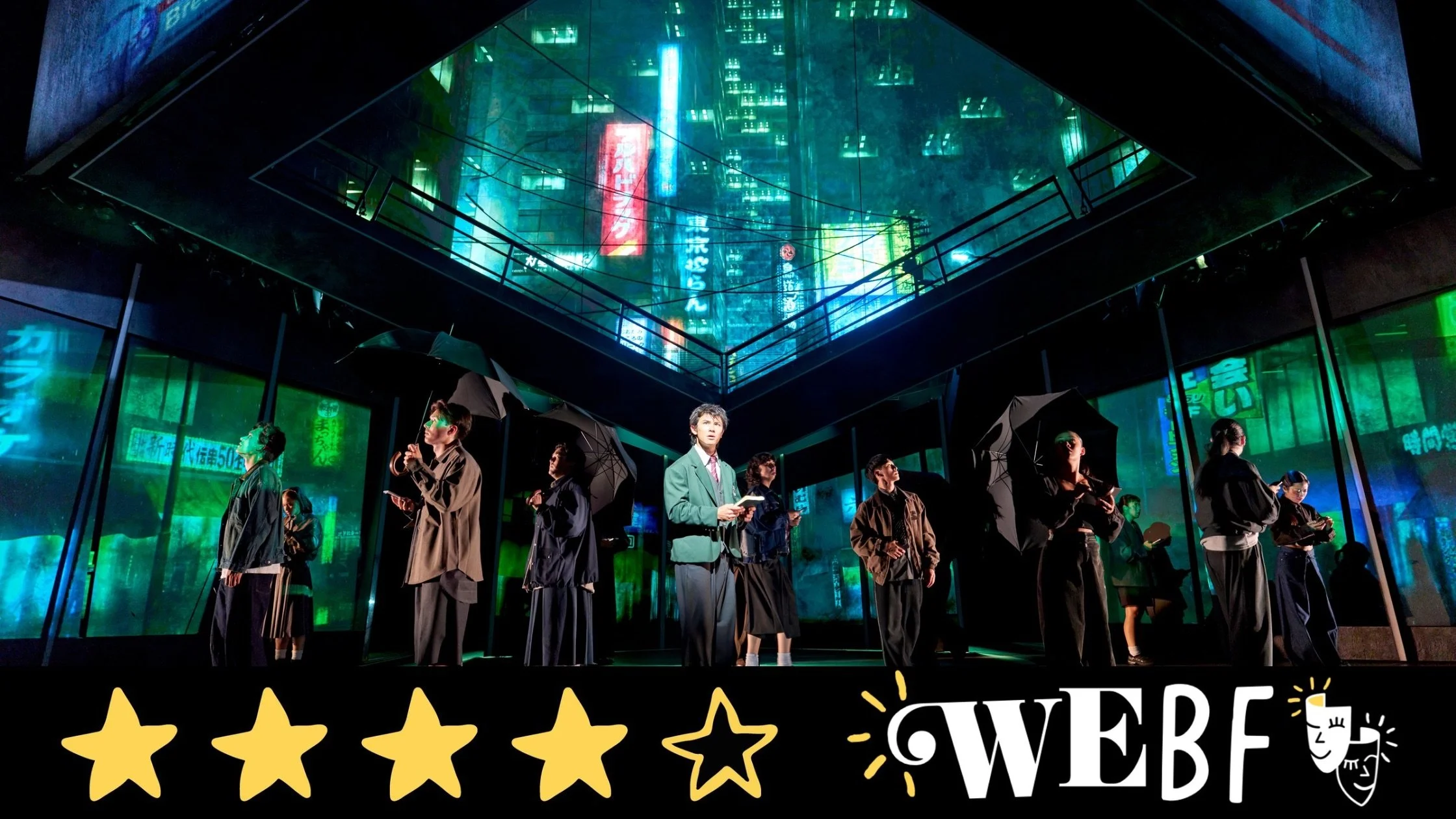
Photo credit: Manuel Harlan
Death Note is a name familiar to many. The manga, by Tsugumi Ohba and Takeshi Obata, and its anime adaptation is up there with the giants of the genre, and has achieved worldwide acclaim. The single-line premise of a high school student finding a book that allows him to kill whoever he likes by writing their name in it is the starting pistol for a complex political crime thriller that spans 37 episodes and 108 chapters. Ivan Menchell (writer), Jack Murphy (lyricist) and Frank Wildhorn (composer) have since undertaken the mammoth task of condensing the sprawling narrative into a two-act musical. It has never had a full staging in the UK, and the Barbican’s production succeeds in conveying the scope and stakes of both the story and its real-life reach.
Designed strikingly by Jon Bausor, the set uses angled lines to skew perspective, allowing main character Light (Xander Pang) to expound his radical beliefs on justice in an environment that is both hostile and built for him to manipulate. The shinigami (death gods) look down from their own moving platform, separate but omniscient, and the use of projection to show a rainy Tokyo background, or the social media flurry that follows Light’s seemingly-impossible killing spree, adds the extra scope the production needs. Jen Schriever’s lighting is impossible to ignore: Matrix-style greens for the detective’s computer-like intellect, warmth and colour for popstar Misa Misa’s in-universe performances, and scenes of soft, poignant darkness as gods and teenagers meet over their Death Notes. The production looks fantastic, the set constantly moving to allow the ensemble to mimic the infamous Tokyo crowds, and making the world feel both huge and focused.
Fabian Aloise’s vivacious choreography means the stage never feels flat or empty, with the ensemble twitching and flailing like puppets for Light to control, or swinging in on the revolve to portray the public’s reaction to Light’s vigilante killings and Misa Misa’s viral stardom. The cast work best as parts of a writhing whole, with each inter-dynamic given its own pocket of breathing space so every member of the multi-rolling ensemble feels important. A performance stand-out is Colin Ryan’s “L”: a brilliant if bemusing young detective, who Ryan captures perfectly, his head at a strange angle, eyes wide and off-putting, teaspoon dangling between his fingers. Stephanie Zaharis’s zany numbers are thoroughly convincing of her star power, but she is also intensely vulnerable as a grieving orphan. Pang gives main character Light room to evolve from a dissatisfied youth to power-mad demi-god, and watching his descent into machiavellian mania is insidiously engrossing.
The pace required to cram enough plot from the original manga to be complete while also limiting it to a 2-hour stage show causes the musical in places to feel rushed, and sometimes a little confusing, so that by the final confrontation the audience may get a sense that they’ve missed something, especially since the stakes are life-and-death high. L and Light’s rivalry and Light and Misa’s relationship emotionally must take a backseat to plot detail. However it sticks a slightly-wobbly landing and ultimately satisfies, and you leave feeling like you’ve witnessed (most of) an epic, on a stage befitting a modern classic, all to the tune of some incredibly catchy songs, sung by a cast that knows they’re pitch-perfect.
Mass murder never looked (or sounded) so good!
**** Four stars
Reviewed by: Oli Burgin
