
Review: COPENHAGEN, Hampstead Theatre
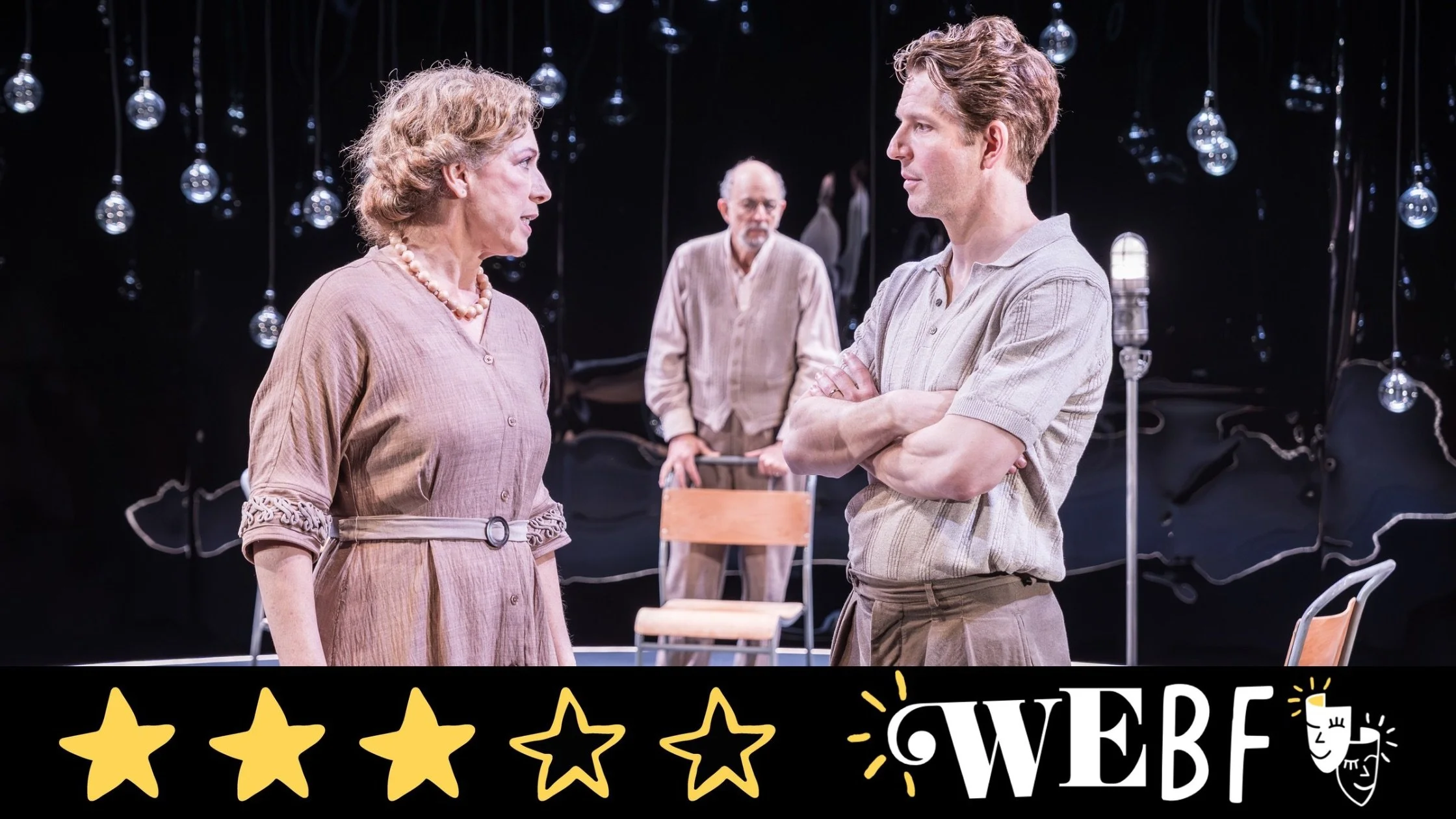
Photo credit: Marc Brenner
Michael Frayn, still active in his nineties, is a remarkable author and playwright. There are few other writers whose greatest successes could be as varied as glorious theatrical farce Noises Off and a very serious play like Copenhagen, dealing with complex physics and World War II atomic research. It is Copenhagen, first seen at the National Theatre in 1998, that has now been revived at Hampstead Theatre.
The abstract setting (Joanna Scotcher) consists of a black double revolve encircled by a band of light, underlining the circularity of much of the discussion on stage. Each side of this area is a black void, later shown to be filled with water, echoing the fate of a child of one of the characters. Above the stage hang lanterns that glow or fade and underline concepts when they are mentioned, with a shadowy mirrored curtain behind which hides a final effect for the end of the play. Costumes are in muted greys and beiges, befitting characters that are mostly not alive but are looking back at their younger selves.
Michael Longhurst’s production makes good use of the revolve, sometimes having the two male characters travelling round it together and at other times having them going in opposite directions, physically and ideologically. A suitably ethereal soundscape (Richard Hammarton) is particularly successful at underpinning key moments, as is, for the most part, the constantly changing lighting (Neil Austin).
One of the many challenges for actors approaching this play (not to mention learning such a complex and deliberately repetitive text) is to make sense of difficult scientific concepts for a general theatre audience. To do so, they need to sound as though they understand what they are talking about and it is second nature to them, so that we can get past the science to the key conundrum: what was said between the protagonists at a meeting in Copenhagen in 1941.
Those protagonists are researchers Heisenberg (German) and Bohr (Danish), who had worked together before WWII. We know that Heisenberg visited Bohr (who had Jewish heritage) in German-occupied Denmark and the suggestion is that this may have been linked to efforts by one or both men to limit the efforts of the Germans and the Allies in their research into nuclear weapons. The third character, Margrethe, is Bohr’s wife, also present for at least part of the meeting and serving as a vital dramatic device in the play. A topical play, perhaps, in view of current world events.
Alex Kingston is commanding as Margrethe, as powerful and important to the action when she is sitting and listening as when she is taking part. It’s a remarkable performance, as is that by Damien Molony as Heisenberg, totally believable as an absorbed scientist who lives for his next research results but also hankering for his younger days when he lived in Copenhagen.
In this production, Bohr seems to have been cast as much older although in real life there was only sixteen years between the two men. Richard Schiff seems less than convincing at times; he plays the character falteringly and is also very softly-voiced and sometimes not completely audible. The hesitancy of his performance seems to unsettle the cohesion of the trio at times and interrupts the pacing of the piece as a whole.
Copenhagen is a complex and unusual play and this production does much to recreate its power and grip, though without perhaps quite reaching the required clarity regarding its subject matter.
*** Three stars
Reviewed by: Chris Abbott
Copenhagen plays at London’s Hampstead Theatre until 2 May, with further info here.
