
Review: BITTER VISIONS: BY ORDER OF HILDEGARD, Arcola Theatre
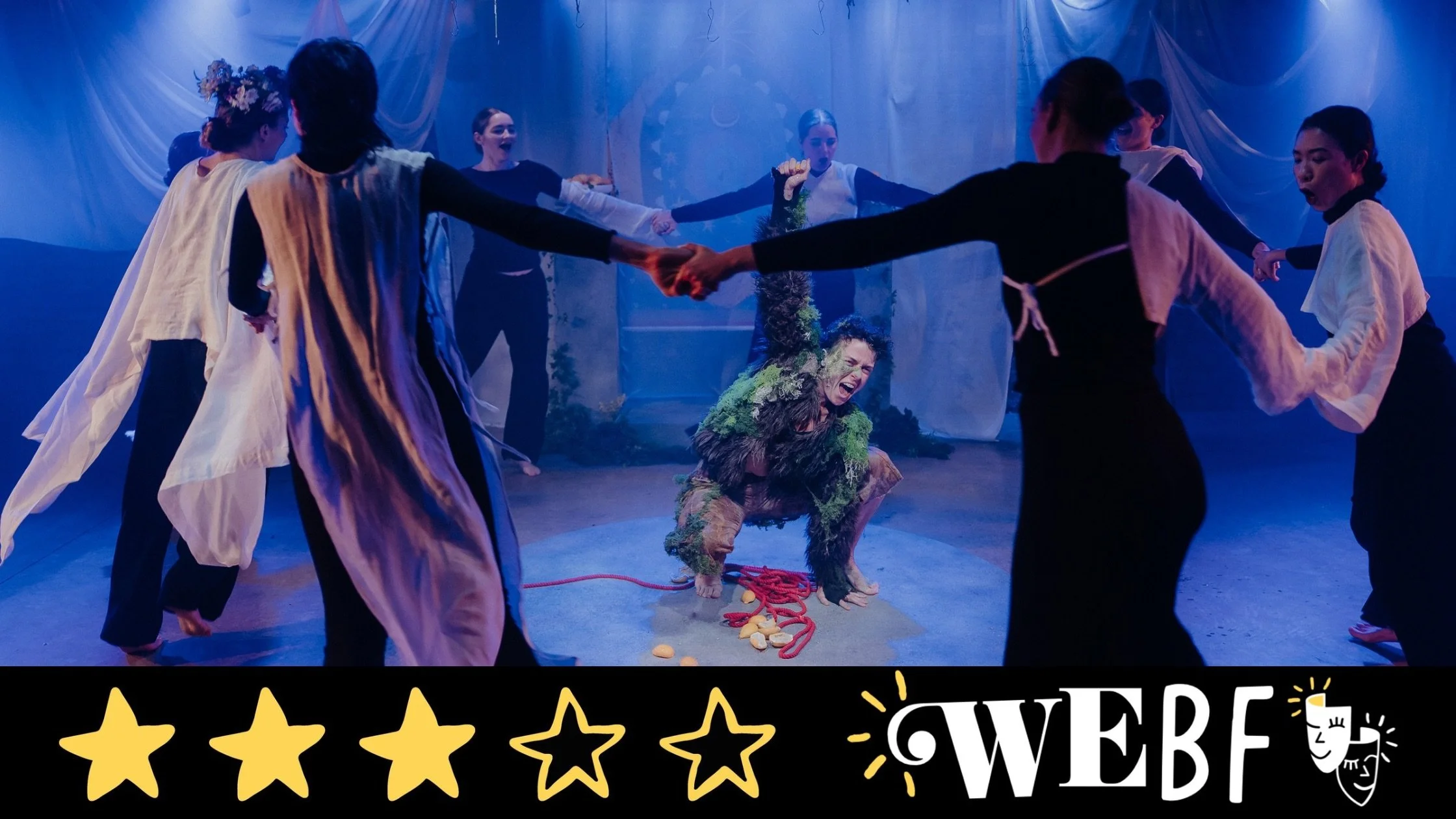
Photo credit: Supplied by the production
On a moody evening at the Arcola Theatre, nearly 900 years after Hildegard von Bingen created Ordo Virtutum, Bitter Visions: By Order of Hildegard, created and directed by Florence Carruthers-Andrews, reimagines this early morality play about a Soul led astray from the Virtues by the Devil. What happens when the darker parts of ourselves are not something to be rejected, but acknowledged as part of who we are? Here, Hildegard’s story is brought into a contemporary conversation around desire, agency and shame. This ambitious project, taking a work from the 12th century, asks what it might have to say to us now. Combining electronic music with Hildegard’s medieval chants, choreography and immersive elements, the collaboration becomes a meeting between time and style.
Walking into the space, the opening image is already on stage, encountering us with figures in white, veiled and swaying. They inhabit a dimly lit space bordered with greenery, while lemons hang overhead. It is beautiful, slightly strange, and establishes an ambiguous world with a sense of ritual.
Where the work is strongest is in the assurance of its voices. Florence Carruthers-Andrews leads the nine-person ensemble as the Soul, with Eleanor Westbrook as the Devil, Salome Siu, Miranda Ostler and Amy Kearsley among the Virtues, alongside Lydia Ward, Emily Beech, Issy Roberts and Sara Knight. Every voice has a beautiful, haunting quality, soaring individually before melting into one another and into the electronic score. At times, it becomes difficult to tell where the sound is coming from, creating a subtle play between sound and space.
In the intimacy of the Arcola’s Studio 2, the production is described as immersive, but it is not always clear what we are being invited to immerse ourselves in. Audience members are given a piece of black sheer fabric on arrival, and the programme invites the audience to place it over their heads, but this is not clear for all: some place it over their heads like a veil while others simply hold it. The image is evocative, but without a clearer invitation, it feels more like an atmospheric gesture than an immersive one. The description of immersive can be too general, and in this case it is. More thought into the relationship between performance and audience is needed to make the description feel fully earned.
The same restraint appears in the movement. Katie Kelly’s choreography uses continuous shifts in weight to create a gentle sway, while percussive gestures sit within the harmonies and soaring vocals. The intention is clear: to find a physical language that sits somewhere between ritual, music and something more primal. But the execution does not always reach that place. At times, the performers appear too conscious of the movement itself, creating a sense of carefulness where there needs to be release. The gestures remain largely conceptual rather than fully embodied, and the physicality needs to trust its more instinctive impulses to go further.
This is where the contrast with the vocal work becomes particularly noticeable. Bitter Visions clearly has an interest in the relationship between music and the spiritual and physical worlds. The ensemble creates a genuinely meditative soundscape, but the physical response to it does not carry the same force.
When the performers break through that restraint and connect more directly with the audience, the work suddenly feels more vulnerable and alive. These moments are strong, suggesting a physical and emotional freedom that could be explored much further.
The ideas and themes are there: desire, feminine agency, shame, spirituality and the question of what we inherit from older ideas of virtue. The source material is fascinating, as is the ambition of the work; what is missing is a little more willingness to let those ideas truly live and develop through the performance, unrestricted.
Bitter Visions is an ambitious attempt to bring a medieval work into the present. Its vocal work is its greatest strength, while its physical language and relationship with the audience feel less fully realised. There is something compelling here, but the production needs to trust its own instincts a little more.
*** Three stars
Reviewed by: Stephanie Osztreicher
