
Review: ATLANTIS, Chichester Festival Theatre
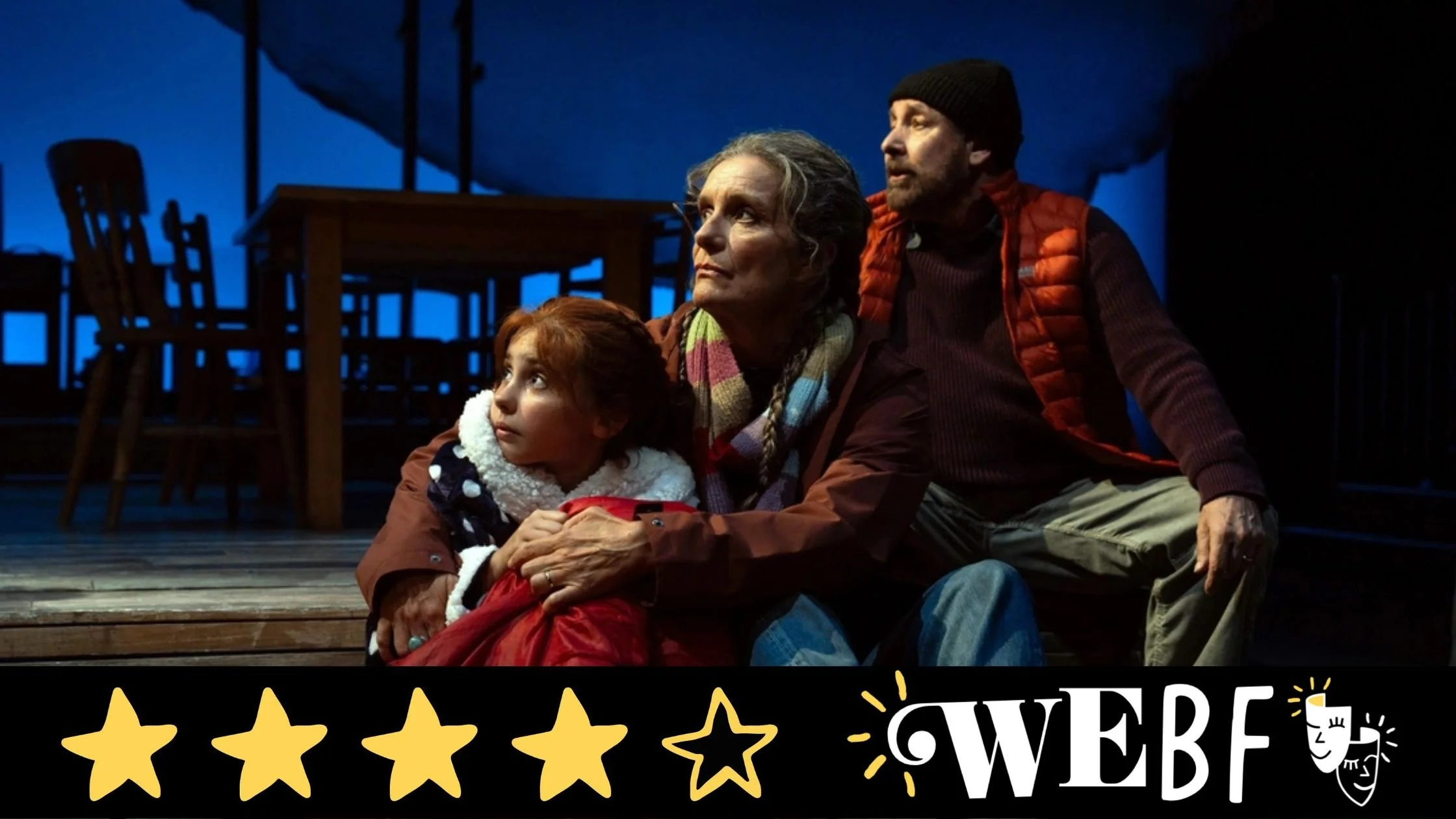
Photo credit: Danny Fitzpatrick
If theatre is going to challenge us and make us think about the world that we live in and the society that we leave for our kids, then Atlantis is a wonderful example of how to go about this. Emily White’s new play is engaging, amusing, and thought provoking, only occasionally veering into the hectoring lecture protest style of delivery. She has set it firmly in Wales with its lyrical lilting speech patterns and mythical past because of the true story of Fairbourne in North Wales, abandoned when the council declined to spend more on sea defences. Yet it could be set on any small island or coastal resort threatened by erosion and rising sea levels. She also tries to cram too many other themes about the human condition and familial tensions into the narrative which make it feel, at times, a little contrived. It covers care home pay, dementia, abortion, hunger strikes, veganism, religion, single parenthood, teenage rebellion, social media, and alcoholism.
At the heart of the story are four generations of a Welsh family affected by climate change erosion of the shoreline that is overwhelming the family home over a period of 28 years from 2011 - 2039 and, in particular, the senior two members of that family, Gwen (Vivien Parry) and Bryn (Richard Elfyn). Gwen is the strong-willed veteran of the Greenham Common protests that took her away from her husband for long periods and now, inspired by the suffragette movement, devotes herself to campaigning in London to change the world attitude to climate change. Bryn is more practical, keeping the fight local to protect the family home. The chemistry between the two loving but different characters is superbly written and played, and it is impossible not to be moved by Bryn’s despairing desperate decline as the years pass by. They epitomise the two sides of the argument beautifully, should we campaign to change the world and those countries most guilty of fuelling climate change, or keep it personal to protect ourselves and our families first from the impact?
Their daughter Claire (Catrin Aaron) is a widowed mother of two trying to eek out a life on minimum wage in a care home and is dependent on her parents for a roof over their heads. She brings the story closer to home, to those who can’t afford to change the world by protest as all her energies are focused on working to bring up the children. We saw Iris Dempsey confidently play her young daughter Rhiannon, and Rex Bamber cutely and charmingly play young Philip, having some of the best lines early on. As time passes, we see them grow up into rebellious teenagers before maturing down different paths. We see Alfie Llewellyn (Phillip) fall awkwardly in love with Astrid (Sara Otung) and then marry with a child David (Benjamin Miglioli) settling for the sanctuary of her home as so many of us do. While his sister Rhiannon (Eirlys Lovell-Jones) follows her grandmother’s path of protest as a little heard journalist screaming for change in a storm of noise and concerned for the future of young children. There is enough in these relationships to create a powerful emotional family story without layering in so many other themes which, at times, provides little more than a quick protest joke.
Frankie Bradshaw’s clever set design merges the seashore and the threatened family home very effectively with a practical sand and pebble forestage and furniture doubling as coastal rocks. Director Guy Jones uses the intimate Minerva Theatre thrust stage and this setting very well, with neatly choreographed transitions between locations or time periods and powerful moments of reflection as characters recall lost ones. Holly Khan’s compositions and sound design reinforce the ‘Welshness’ of the story but adds drama to the key moments.
This is a play that calls for us to at least debate our attitude towards climate change and our campaigning approach to bring about change, but also calls for us to think about the current and future generations of our own family. How much sacrifice now is worthwhile and what difference will it make to the global challenge? Would we sacrifice our own lives to protect future generations? It does not provide answers. It argues that these oceans that threaten the shoreline are made up of tiny drops and we, as individuals, may only be drops in the population but if enough drops join together then perhaps, we can save the world. It argues that for now there is no Planet B.
**** Four stars
Reviewed by: Nick Wayne
Atlantis plays at Chichester Festival Theatre until 15 August, with further info here.