
Review: ARCHDUKE, Royal Court Theatre
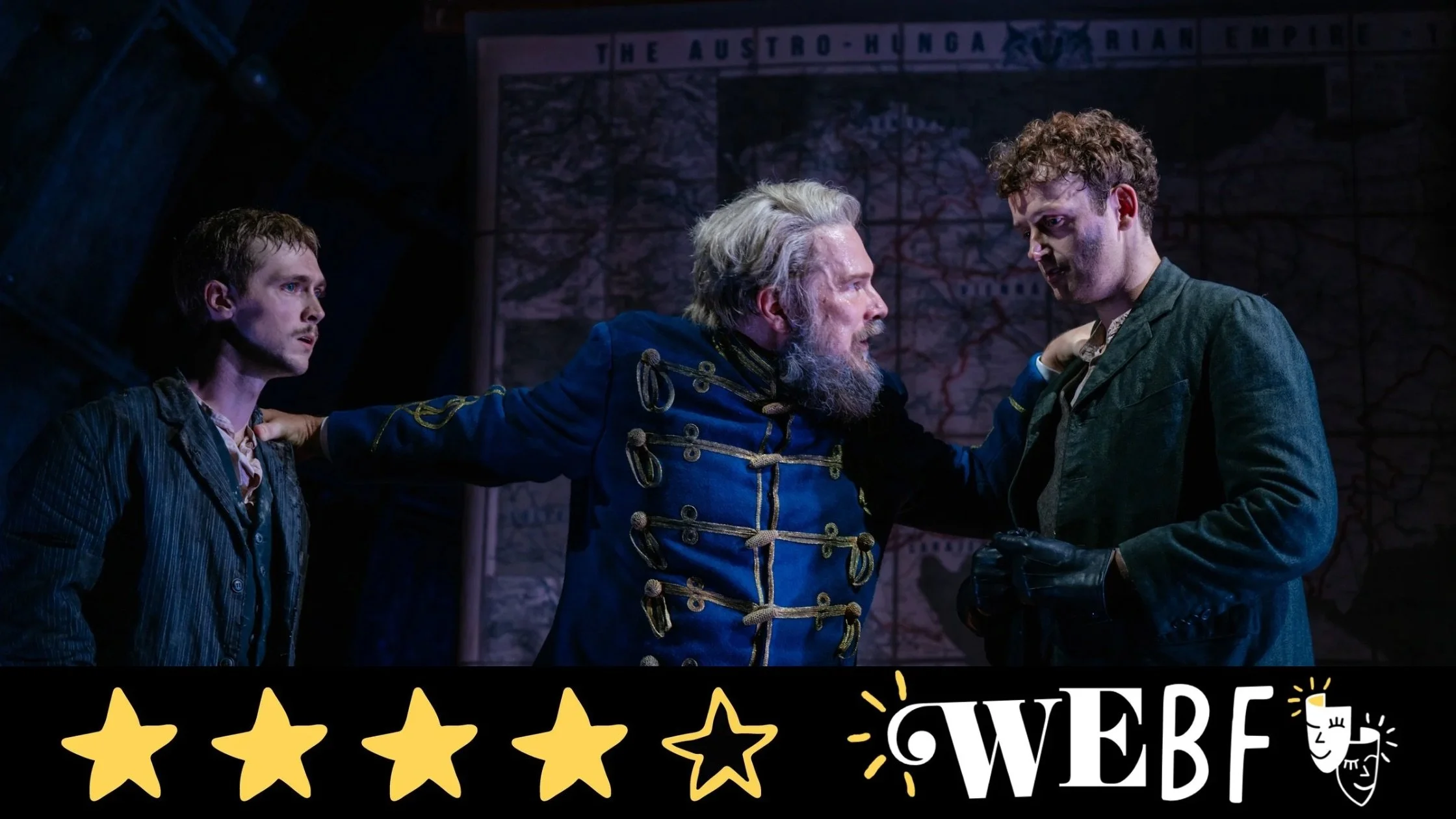
Photo credit: Helen Murray
We hear "Gavrilo Princip" and immediately think of Archduke Franz Ferdinand, the outbreak of the First World War, and one of the most significant assassinations in history. Rajiv Joseph's Archduke, though, isn't really interested in any of that – not at first, anyway. Instead, it introduces us to a handful of frightened young men who haven't got the faintest idea what they're doing with their lives.
Gavrilo (Stanley Morgan) and Nedeljko (Chris Walley) have just been told they have tuberculosis. Gavrilo takes the news with weary resignation, while Nedeljko is horrified to discover he might only have a month left to live, information nobody had apparently thought worth sharing with him. It's a brilliantly funny exchange, and a perfect introduction to the play's wonderfully dark sense of humour.
The pair have been told to meet "a guy", someone who's supposedly going to give their lives some purpose, and the fact that this mysterious figure, Trifko (Abraham Popoola), appears to know little more than they do is part of the joke. Everyone seems to be making it up as they go along, bluffing confidence they don't really have because they're not revolutionaries yet; they're just boys looking for somewhere, and someone, to belong.
Of course, everyone sitting in the Royal Court already knows how this story ends, and that knowledge hangs over everything from the very beginning. You never quite forget where it's heading, but Joseph is clever enough to make you wonder how these confused, vulnerable young men could possibly become the names we've all read about in history books.
Marc Wootton looks like he's having the time of his life as Captain Dragutin Dimitrijević, a man whose own desperate need to matter has spilled over into everyone else's life. He's vain, loud, self-important and often unintentionally hilarious, but beneath all the bluster is someone terrified of being forgotten. Wootton pushes him right to the edge of absurdity before somehow pulling him back just in time to stop him becoming a caricature.
Then there's Janice Connolly's Sladjana. At first, she's little more than the Captain's "lady cook", drifting around the edges while the men shout over one another and convince themselves they're changing the world. But Joseph keeps bringing her back, and little by little she becomes the person with the clearest view of what's happening. Maybe she's a witch. Maybe she's just older and wiser than everyone else in the room. Either way, she's the only one who sees where all this is heading. The tragedy, of course, is that no one listens to her.
Watching it unfold in 2026 is surprisingly unsettling. These young men are frightened, lonely and desperate for their lives to mean something, which makes them easy targets for anyone willing to offer certainty, purpose and someone else to blame. One of their biggest fears isn't dying itself, but dying without ever having been loved or desired, and that longing slowly curdles into resentment. 'Incel' might be a modern word, but the frustrations and resentments behind it are anything but. Joseph never labours the point, but it's impossible not to recognise echoes of the present in these boys from 1914.
That's what makes Joseph's writing so impressive. It never slips into becoming a history lesson, although it occasionally brushes against it, and it never turns into full-blown farce either, despite some gloriously ridiculous moments. The comedy arrives almost by accident, through a throwaway line, someone's reaction, or simply the absurdity of the situation. By the time everyone was talking about "lady bones", the audience was roaring with laughter.
Es Devlin's set deserves a standing ovation of its own. It seems to transform endlessly, becoming an underground bunker, the Captain's dining room, a chapel and, most impressively of all, a railway carriage that drew an audible murmur from the audience. It's endlessly inventive and somehow makes the Royal Court stage feel twice the size it really is.
What’s interesting about Archduke is that it’s not really about the assassination itself; it’s about the people who carried it out. And Joseph isn't interested in turning them into heroes or monsters – they're just young men, frightened of dying, frightened of being forgotten, and painfully easy for the wrong person to exploit.
Watching their anger, insecurity, and uncertainty slowly channelled towards a cause feels disturbingly familiar. More than a century has passed since these events, but it doesn't take much to recognise the pattern. Yes, the faces have changed, the slogans are different, but the desire to belong, to matter, to leave some kind of mark on the world hasn't changed very much at all.
Perhaps that's the most unsettling thing about Archduke – it reminds us how easily history can repeat itself.
**** Four stars
Reviewed by: Lisamarie Lamb
Archduke plays at London’s Royal Court Theatre until 25 July, with further info here.
