
Review: ARCADIA, Duke of York’s Theatre
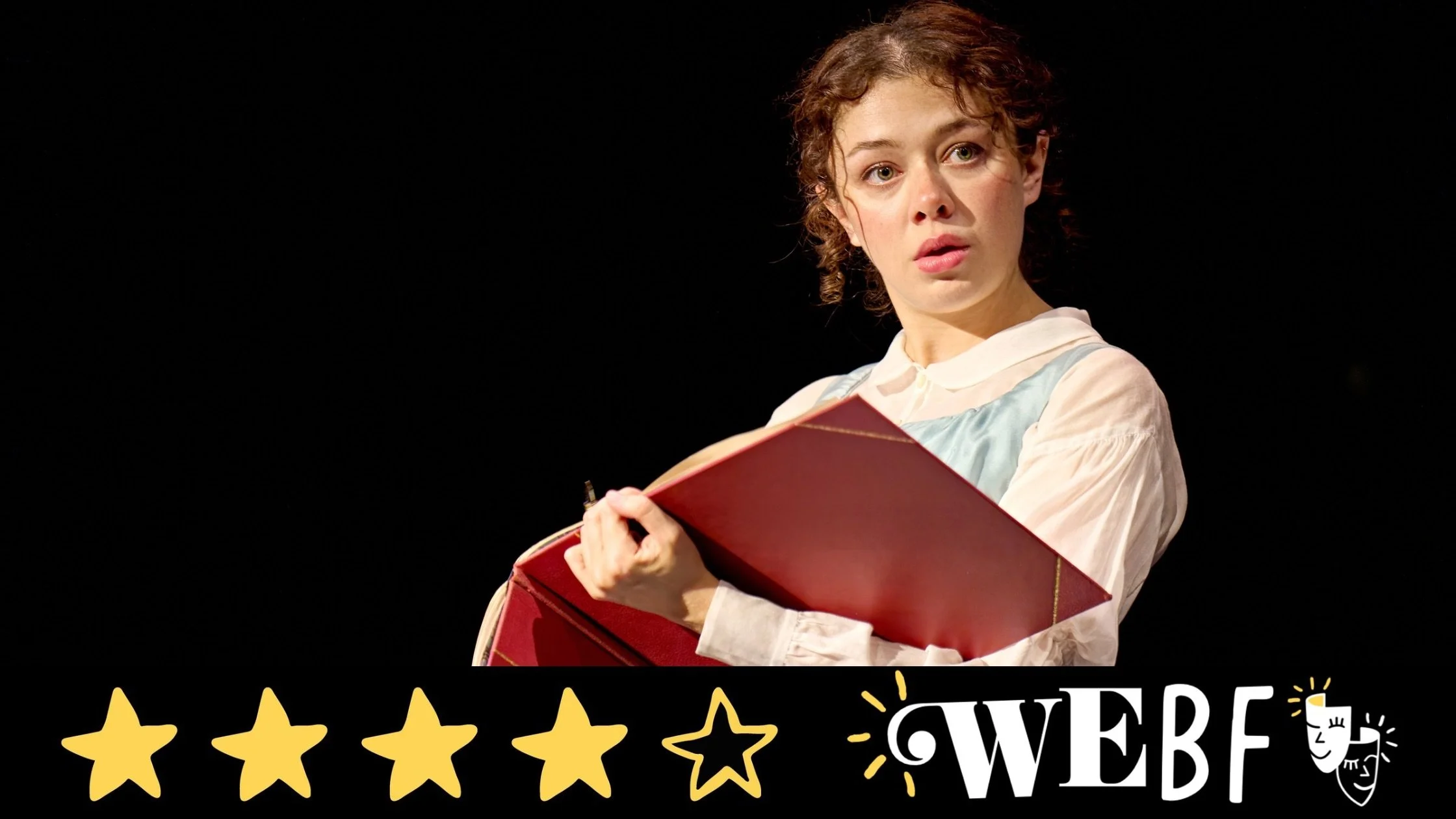
Photo credit: Manuel Harlan
Tom Stoppard described Arcadia as a comedy of ideas; there is plenty of both in Carrie Cracknell’s production.
The general plot of Arcadia plays on the classic country house mystery setup. Set in one room in Derbyshire’s fictional Sidley Park, a pair of late 20th century scholars are trying to piece together what had happened there in the early 1800s, drawing on artefacts that include letters, student notebooks and game-shooting logs.
By interweaving scenes from both time periods, so that the audience knows what had actually happened while the scholars rely on a mix of evidence, intuition and supposition, Stoppard wittily explores the unknowability of what has gone before. This central theme of how we can know truth remains pertinent in our age of fake news.
But Stoppard does not stop there and within this structure Arcadia also explores, to name but a few, the mathematics of chaos, determinism, classical and romantic ideals and, ultimately, the connection between head and heart.
A delight of Stoppard’s writing is how an idea gets played out in different forms across the play. For example, in the opening 1809 scene Thomasina Coverly, daughter of the house, is musing on the fact that while jam can be stirred into rice pudding, blending the two to pink, you can never stir backwards to recover the jam out of the mix.
Thomasina’s intuitive understanding of entropy and the Second Law of Thermodynamics (yes, the programme contains a glossary) not only provides a thread that allows Stoppard to explore irreversibility, loss, and free will, it also mirrors the play’s structure, with scenes across the two time periods becoming increasingly indistinguishable.
Stoppard was always insistent that a dramatic text was not sufficient and that a play had to be theatrical event. Thanks to Carrie Cracknell’s tight direction and the design team’s pared back aesthetic, this is such an event.
Alex Eales’ minimal set is centred on a table upon which items from past and present gather, ending up by the end as a collection which, as Stoppard noted, makes perfect sense to the audience but would appear quite random to an outsider.
While Eales’ gently revolving set marks time passing, Guy Hoare’s lighting evokes orbits and planets, evoking a sense of the specifics of the play being part of something more universal.
It is then left to the cast to bring Stoppard’s heady brew of ideas to life. Among a strong cast, the standout performance is Isis Hainsworth’s Thomasina. As a mathematical prodigy, Hainsworth gives us a 13-year-old Thomasina who takes delight in ideas, then later transitions into a 17-year-old, now sensing the pleasures of the heart.
Seamus Dillane brings a sensitivity to the role of Thomasina’s tutor, Septimus Hodge, and movingly presents unrequited love. Hainsworth and Dillane’s scenes together crackle and zip along.
Thomasina’s intuitive understanding for mathematical ideas, grounded in puddings and roses and leaves, would not become mainstream until over 150 years later, so it is left to latter period characters, to flesh these ideas out.
It is here that the play flags somewhat. Stoppard gives the 1990s characters a lot of exposition, whether it is Angus Cooper’s engaging Valentine Coverly setting out chaos theory or the superb Oliver Chris as Bernard Nightingale rehearsing his (misplaced) theories about Lord Bryon. It is all very wordy and with some questionable sexist ‘banter’ brings ‘mansplaining’ to mind.
Is Arcadia everyone’s cup of tea? Probably not. Does it deserve its reputation as a classic? Definitely.
In this age of AI and instant answers, Stoppard reminds us that it is not the getting of answers that matters but the search for them, the wanting to know. To misquote Nightgale’s observation about Byron: “You can’t stick Stoppard’s head in your laptop”.
**** Four stars
Reviewed by: Mike Askew
