
Review: APPLICATION 39, Aviva Studios - Tour
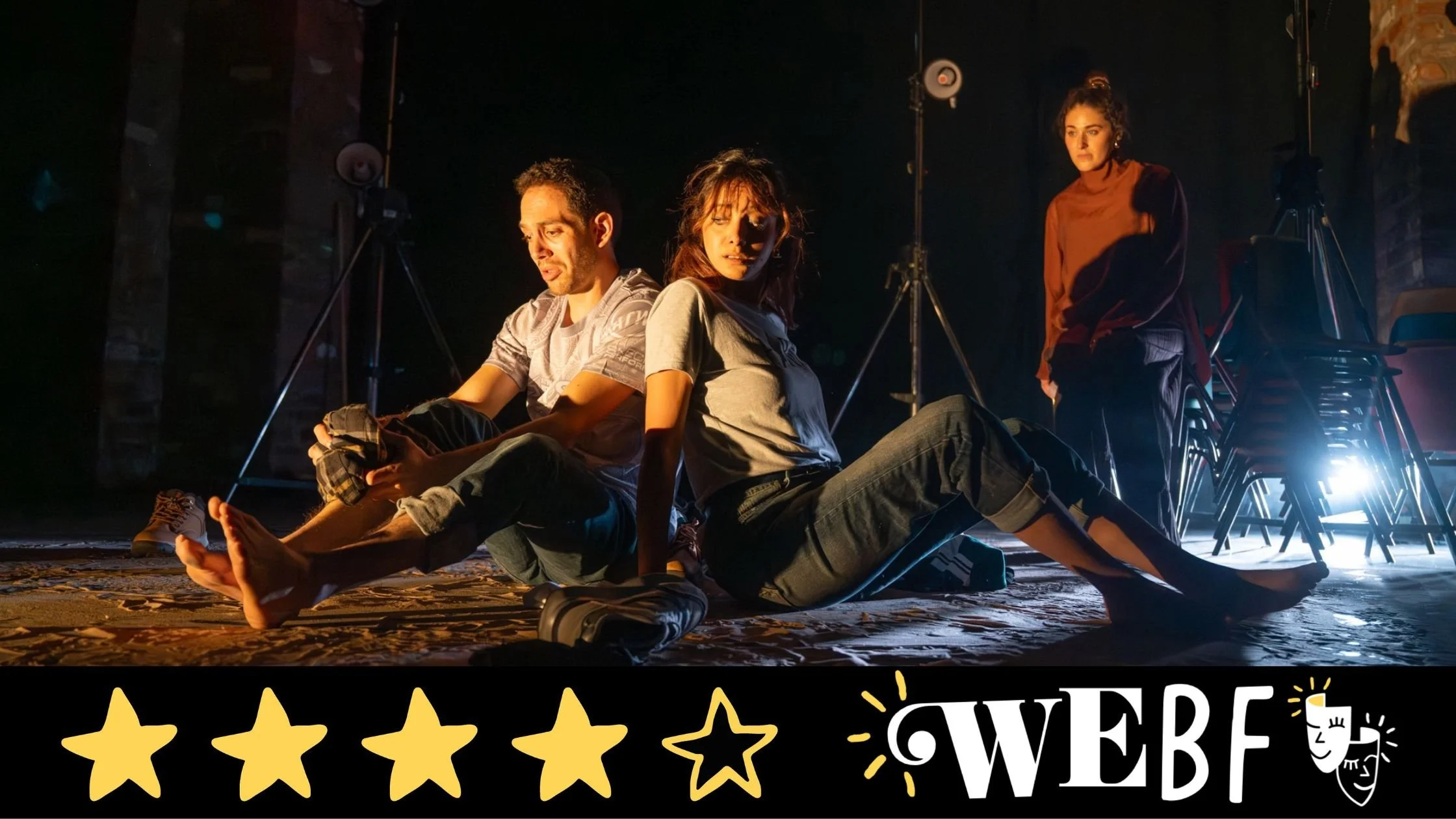
Photo credit: Tommy Ga-Ken Wan
Palestinian writer Ahmed Masoud’s Application 39 doesn’t ask us to imagine Gaza in 20 years time, it shows us, and plants the hope of a better future forged in togetherness. Directed by Cressida Brown and co-produced by ETT, Matthew Schmolle Productions and Stratford East, this satirical piece of dark humour illustrates the power of hope to make change of olympian proportions.
We begin in the year 2040. The International Court of Justice no longer exists, and the International Olympic Committee (IOC) has just selected Gaza as the host of the 2048 Summer Olympic Games, exactly 100 years after the Nakba. Can the radical hope of two young IT workers, orphaned by the present day genocide, unite their city, their country and the world, through sport?
We meet two friends, Rayyan (James El-Sharawy) and Selma (Sama Rantisi), as they await the verdict of their President (Ghantus Wael) on their forgery of his signature on ‘Application 39’ to the IOC. Despite the objections of his Vice-President Lamma (Nadia Dawber), the President rules that their actions have consequences, good ones, and that Gaza will host the games.
Here begins the task of constructing hope in the form of velodromes and an athlete’s village, in a landscape of constant surveillance, armed robots and when you can only use 3km of the ocean that washes against the shores of your land. Masoud’s writing powerfully intersperses sharp satirical comment on the geopolitical landscape of 2040, alongside verbatim descriptions of the present day genocide rooted in the testimonies of his family.
The hope that powers Application 39, and the plot of this artistic activism, begins beneath the rubble in the aftermath of an airstrike on a Gazan refugee camp in 2024. It is first heard in the voices of two terrified nine year old children; it continues into the walls of the hospital out of which Dr Hussam Abu Safia, who remains hostage in an Israeli prison to this date, is marched by the Israeli soldiers; and into the planning room for the sporting event of 2048.
Masoud writes the complexity of hope into his four characters who themselves battle with the concept. For Vice-President Lamma, hope brings risk of further conflict; a fear well masked by the constructed hope of the President’s yoga routine. Their pretence and reluctance contrasts sharply with the joyful hope of Rayyan, buoyed by the strength of hope held by his best friend, Selma.
Brown’s direction puts Masoud’s characterisation into the sharp focus of surveillance cameras. It is under their glare that the President and his Vice argue out the potential for the games; that Lamma inspects her own innermost fears; and that two best friends survive their present, and scheme up their future. The production is well paced throughout, the energy of the sporting event paused to foreground the testimony of those living through a genocide in Gaza as we watch the performance unfold on the stage in Manchester. It is only the conclusion that could benefit from additional minutes and development, for the clarity of the message to have even further gravitas.
This pair of friends, Rayyan and Selma, are played with a natural and effortless chemistry by Rantisi and El-Sharawy, whose fierce intelligence and loyalty to memory contrasts with the cheeky humour, respectively. El-Sharawy’s versatility and care as a performer is clear in his later delivery of the testimony of Israeli military detention in a harrowing monologue; the words of Masoud’s nephew, who was murdered aged 17 alongside his mother in the ongoing genocide, while his uncle was in rehearsals for this play.
The arc of the President’s character, as he is fortified by the hope of those over whom he presides from caretaker of a fragile ceasefire to leader of his land, is skillfully portrayed by Wael, who shows potential to develop the role further if his character had further scope towards the end of the plot.
Dawber gives a stand out performance as Lamma; her previous work in production and direction evident in her presence, the gravitas of her delivery of Masoud’s writing that anchors the plot, and voices the optimism and reservation that orientates this theatrical portrayal of hope in all its guises.
Emphasis is further imbued on Masoud’s words by Dawber’s movements; under the direction of Kate Sagovsky, she declares Lamma’s power in her assured steps, but also depicts the confines of her influence in her curtailed routes across the stage.
In fact, none of the actors ever leave the stage, remaining in the shadows of Charlotte Espiner’s narrow, cyclical set when they are not within the ring of sand, present throughout as the Palestinian land, the rubble of once-cherished homes or the foundations for Olympic infrastructure. On the vast stage of the Aviva Studio’s Hall, the drama is as confined as the characters are within checkpoints and curfews.
Imogen Clarke’s lighting design is simple, sparse, constant and inescapable. Apart from the moment when it cuts completely, the stage and the audience plunged into darkness. A decision that, combined with Ed Lewis’ soundscape and the vocal composition of Sami El-Enany, renders the evocation of the immediate aftermath of an airstrike even more impactful.
When radical hope is put under the microscope, we are shown that it is strongest when it is felt, and acted up, together. With its dark-humour, this future-facing drama evokes our action in the present day; Application 39 is recommended for everyone, because we all have more to learn, and to do, together.
**** Four stars
Reviewed by: Lauren Wilson