
Review: ANIMAL FARM: AS WITNESSED BY MOSES THE RAVEN, Barons Court Theatre
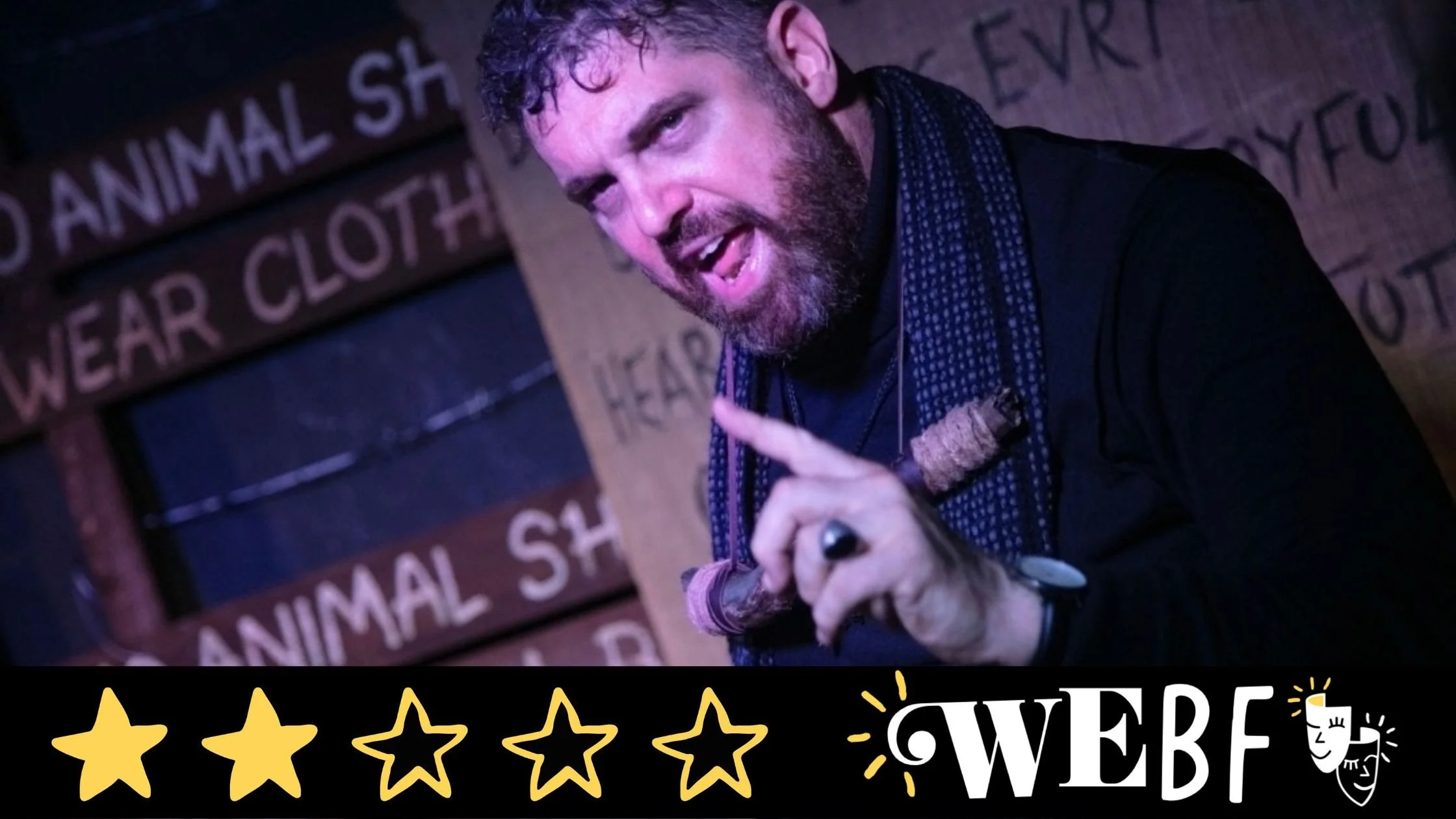
Photo credit: Steve Thewis
Animal Farm is one of George Orwell’s most well-known works, a political satire that has always been incredibly popular on both the page and the stage. In this fresh new take, Dov Citron (writer, performer and producer) ambitiously transforms Orwell’s novella into a one-man, one-act play. Animal Farm: As Witnessed by Moses the Raven is a bold interpretation currently taking to the stage at Barons Court Theatre with the hope of embarking on future productions at schools.
Under Victoria Waddington’s direction, Dov Citron performs this play with heaps of impressive energy and throughout Animal Farm: As Witnessed by Moses the Raven, he takes on a range of impressions, switching effortlessly between characters. The use of hats or props quickly signals to the audience which character is taking to the stage next, so each character switch is instantly recognisable and highlights Citron’s stamina. The voices and mannerisms are accurate, as are the animal sound effects Citron vocally replicates (even amidst song lyrics), truly bringing the farm to life.
The attention to detail of the production is instantly noticeable from the moment audiences descend the stairs and enter the space, which is adorned in posters of animal testimonies and rules of the farm. Terry ‘Tex’ Gibbon’s set design deserves great praise and really draws upon nuances from Orwell’s story as a source of inspiration. Citron even wears full blacks with a raven necklace, a costume both neutral enough to become a canvas for a multitude of characters whilst having beautiful embellishments that instantly signal him as Moses.
Prior to the performance starting, an attempt is made at an atmospheric pre-show. For part of the duration of the house being open, Citron interacts with audiences as a drunk Farmer Jones. Engaging with the audience at this stage has potential but it isn’t executed well, it’s slightly off-putting and undermines the significance of starting the play with Moses on stage instead. Perhaps a more effective pre-show could have been Citron as Jones acting as an extra usher, greeting audiences at the door and stumblingly showing them their seats, playing on the fact that the theatre itself is located under a pub. Instead, Citron’s few lines as Farmer Jones just became a bit repetitive and it would have been more effective to tease this character at another point early on in this production, or simplify the script slightly by cutting this section altogether.
Lighting cues have potential to elevate pivotal plot moments but instead, they serve as nothing more than a distraction as they are regularly late and rarely add much nuance to the story on stage. It would have been better for the lighting plot to be simplified so the cues aren’t jarringly mistimed and misplaced so there is more focus on the acting, as random flashes of blue in scenes where it is incredibly out of place or overly elongated strobe is just a distraction from the story as a whole and makes it harder to focus on the brilliance of the script. Extra technical elements start to become all bells and whistles, undermining the raw potential for this darkly comedic story and shifting focus away from the characterisation at the core of the piece.
The premise, and title, of the show suggest this story gets told through the eyes of one of its most enigmatic figures, Moses the Raven. Yet, there is incredible brevity of the character of Moses, despite the title suggesting the character’s deep importance making it misleading. Moses is a fairly minor character in Orwell’s original novella and is equally minor in Citron’s production, despite it being a titular role. It would have been nice to see the concept more fleshed out, or alternatively just give the show a different title that focuses on the fact it is a one-man play as a unique selling point, instead of a rather absent symbol being such a titular focus and then failing to consistently follow through with it.
If taking on all of the characters of one of literature’s most famous books sounds overly ambitious, that’s because it is. Whilst Citron’s diverse characterisations, impressions and general concept are applaudable, the wider production bites off more than it can chew. There is a lot of room for potential but at this stage, from dropped props to delayed lighting cues, the production remains unpolished in a way that shifts focus vastly away from the core messages of the piece.
** Two stars
Reviewed by: Heidi Downing
