
Review: AN OAK TREE, The Other Palace
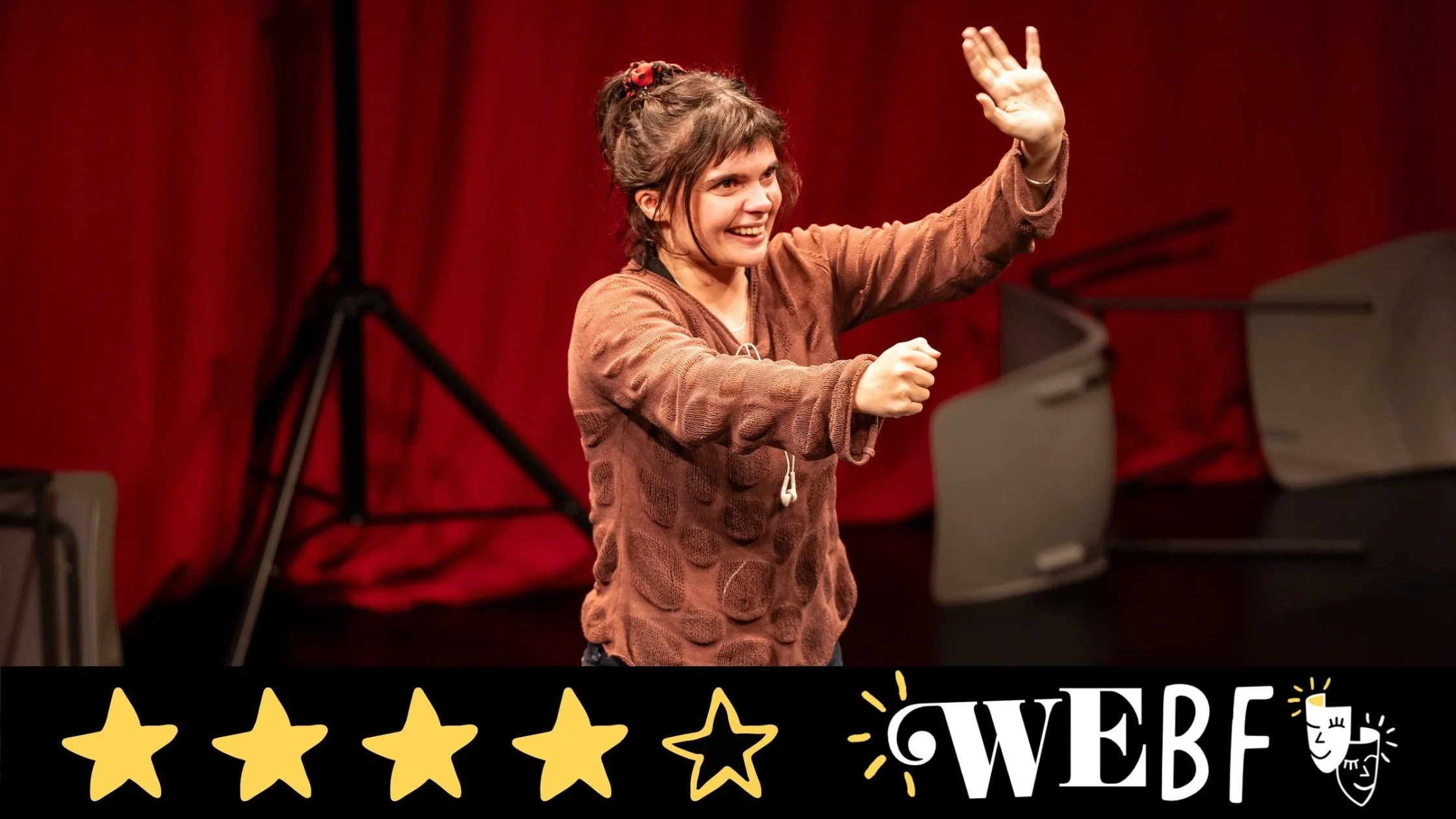
Photo credit: Pamela Raith
Gwyneth Keyworth, at last night’s press performance, had no idea what Tim Crouch was about to ask her to do. He knows the script, understands the characters, and has performed An Oak Tree countless times before. She, on the other hand, is discovering the whole thing as it happens, relying on him to tell her where to stand, what to say, and occasionally what on earth is going on. It's an unusual way to put on a play, particularly one dealing with something as painful as the death of a child, but it's a format that Crouch has been using since the production first appeared in 2005. Every performance features a different guest actor, none of whom has read the script or attended a rehearsal, and Keyworth proves to be an excellent choice for this particular evening.
Crouch plays a stage hypnotist whose involvement in a fatal car accident brings him face to face with the grieving father of the young girl he killed. Their encounter takes place during the hypnotist's act, with Keyworth playing the father and discovering his story as the performance unfolds.
Throughout the play, Crouch feeds Keyworth lines and instructions, sometimes speaking directly to her, sometimes using a microphone and headphones so that only she can hear him, and occasionally handing her pages of the script. It's all done in full view of the audience, with the practical business of putting on the play becoming part of the entertainment. The set is equally straightforward, with just a handful of chairs, speakers, and a piano stool, and there's something rather appealing about how little is needed to create the different situations.
It sounds as though it should be terribly distracting, but it actually works rather well. Keyworth is particularly enjoyable to watch, not least because she seems perfectly happy to embrace the ridiculousness of some of the situations she's placed in. She laughs, looks occasionally bewildered, and throws herself into whatever Crouch asks of her, including an enthusiastic bout of imaginary piano playing accompanied by such vigorous foot-stomping that she appears almost out of breath. There's something rather infectious about her amusement, and it would be difficult not to warm to her. Yet when the mood changes, she's equally convincing in the more painful scenes, and the contrast makes those moments more effective than they might otherwise have been.
Crouch has quite a lot to juggle, too. As well as playing the hypnotist, he's effectively directing the performance while it's happening, supplying dialogue and making sure the story continues. He makes it look remarkably easy, although his complete command of the evening occasionally works against the sense of uncertainty that makes the production so appealing. There's also an interesting connection between Crouch and the character he's playing, as both are responsible for directing someone else's behaviour, raising questions about how much control the other person actually has.
The father, meanwhile, has become convinced that his dead daughter is now an oak tree. It's a strange idea, and one that makes absolutely no sense to anyone else but to him, it's completely real. The title refers to a piece of conceptual art by Michael Craig-Martin, who presented a glass of water and declared it to be an oak tree. It's the sort of thing that might provoke an interesting discussion or simply an eye-roll, but there's a point to be made about what people are willing to accept as reality. After all, the audience is happy to watch Keyworth play a grieving father, despite knowing she isn't one. If that transformation can be accepted, perhaps the father's belief about his daughter isn't quite so difficult to understand.
There's actually quite a lot of humour, which isn't necessarily what audiences might expect from a play about a child being killed in a car accident. Some of it comes from Keyworth's reactions, while other moments are deliberately funny, and the laughter generally feels natural rather than inappropriate. Occasionally, though, the movement between comedy and more serious material is less successful, with an emotional moment losing some of its impact when attention returns to the mechanics of the performance.
For all the unusual staging, there's a genuinely sad story underneath it. The father is trying to hold on to his daughter in whatever way he can, while the hypnotist has to live with the knowledge that he's responsible for her death. The production is at its best when it concentrates on that relationship rather than drawing attention to its own cleverness, and some of the most affecting moments are also the simplest.
An Oak Tree isn't without its frustrations, but there's no denying the originality of Crouch's writing or the skill involved in making it work. Keyworth is a delight, and the changing guest cast makes the prospect of seeing it again with someone else particularly appealing. An unusual, funny, and surprisingly moving production that's well worth experiencing.
There's no actual oak tree in An Oak Tree, of course. But by the end, it hardly seems necessary.
**** Four stars
Reviewed by: Lisamarie Lamb
An Oak Tree plays at The Other Palace until 15 November, with further info on guest performers here.
