
Review: ALICE IN WONDERLAND, Riverside Studios
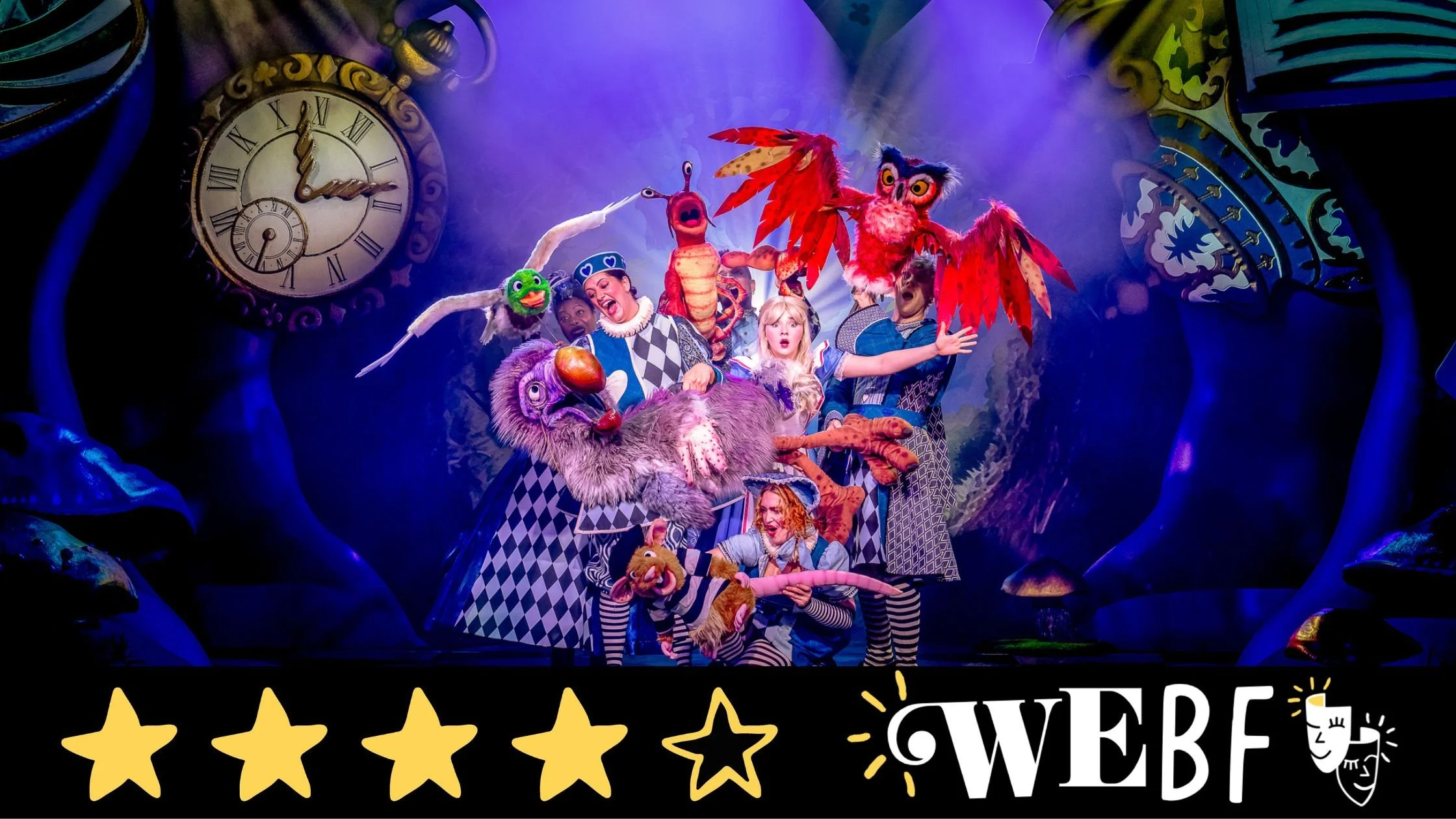
Photo credit: Steve Gregson
There are two main challenges to be faced by stage adaptations of Alice in Wonderland: the episodic nature of the story and the challenge of presenting shrinking and growing. Both are intelligently addressed in this returning production at Riverside Studios, directed and designed by Nate Bertone, which was enjoyed by an attentive and silently awed family audience. It was fascinating to see them all lean forward as one in order to convincingly see the (entirely imaginary) miniature door.
Penny Farrow’s one-hour adaptation, honed after many performances presumably, makes some sensible decisions about which characters to include. She omits the Duchess sequence and the Mock Turtle but imports Tweedledum and Tweedledee (and the Flowers) from Through the Looking Glass. Other than that, the main characters and sequences are all included.
The basic set is suitably other-worldly, and comes into its own once Alice falls, quite convincingly, down the rabbit-hole. The White Rabbit provides something of a narrative thread for this most disjointed of tales, and the cast of nine alternate between featured roles and operating puppets or playing ensemble parts. Occasional spoken narration also helps to keep the storyline clear.
Ailsa Erskine is a traditional Alice and quickly engages the audience, despite a rather unconvincing wig. With that one small point aside, visually this is an enormously lavish and beautifully designed production, with puppets that pay homage to the Tenniel illustrations but take Alice’s world into a realm of colour. The Cheshire Cat is immediately recognisable but the colours of its fur and the use of internal lighting - plus skilled puppetry - create a version of this character that is unforgettable. The excellent Dormouse is a great audience favourite, as wis the fully staged croquet match, even though the flamingoes seem oversized.
Other effects are more subtle but equally effective, as with the pool being filled by puppet teardrops or the use of stretchy material so that the playing cards can grow or shrink. The sequence with the Drink Me bottle, leading to Alice shrinking, is suggested by substituting ever bigger versions of the bottle: a deft solution, although it would have been even more effective if each version replaced the one before rather than them all being seen together.
Although it’s not a musical, there is good use made of Sam Rapley’s music, especially at times when the stage world is changing or the story is moving to the next phase. It’s a hard-working cast who know how to engage their young audience, with Daniel Page’s Queen of Hearts making good use of his experience as a Panto dame. The trial scene forms an appropriate finale to this thoughtful, beautifully designed and impressive production, an ideal summer outing for families with children of all ages.
**** Four stars
Reviewed by: Chris Abbott
