
Photo credit: Johan Persson
You are probably wondering why you have all been gathered here today. The reason is simple: you have collectively witnessed a murder. As the nights draw in, there are few things audiences find, bizarrely, more comforting than watching an inevitable killing shake the unlikeable upper-middle-class world of period country-house England. It is a genre that Christie popularised to enormous success and judging by the audience at Richmond Theatre last night, still has an enduring appeal across a wide range of ages.
The Hollow is one of the lesser-known Poirot cases, first published as a novel in 1946 and adapted by the author herself as a play in 1951. However, in the original adaptation, Christie omitted the world-renowned detective, who is reinstated here by adaptor Tamsin Oglesby in a patchwork of the original novel and play, mounted here for a UK tour.
As part of his tour of the nation, Poirot is taking a well-earned break from his work as a private detective as a guest of Sir Henry Angkatell (Michael Praed) and his wife, Lady Lucy Angkatell (Sarah Moyle), at their country house. His crime-solving reputation precedes him, and the gathered guests excitedly anticipate a murder, which Poirot concedes is "an occupational hazard" when he is present. However, despite meeting the Belgian detective very early on, there is a long wait for the inevitable death, heavily foreshadowed by multiple references to poison, guns, strained relationships and secret affairs, all of which cast suspicion across a wide range of potential culprits.
Oglesby's adaptation is surprisingly funny and macabre, with a keen focus on class status and the nature of celebrity, explored through both Poirot and Hollywood starlet Veronica Craye, played with classic old-Hollywood fervour by Kemi-Bo Jacobs. Oglesby is keen to highlight the lack of empathy and emotional distance between the 1940s high-society English socialites and some of their less privileged guests. Much of the comedy comes from Poirot's misunderstanding of English idioms and his frequent misidentification as a Frenchman.
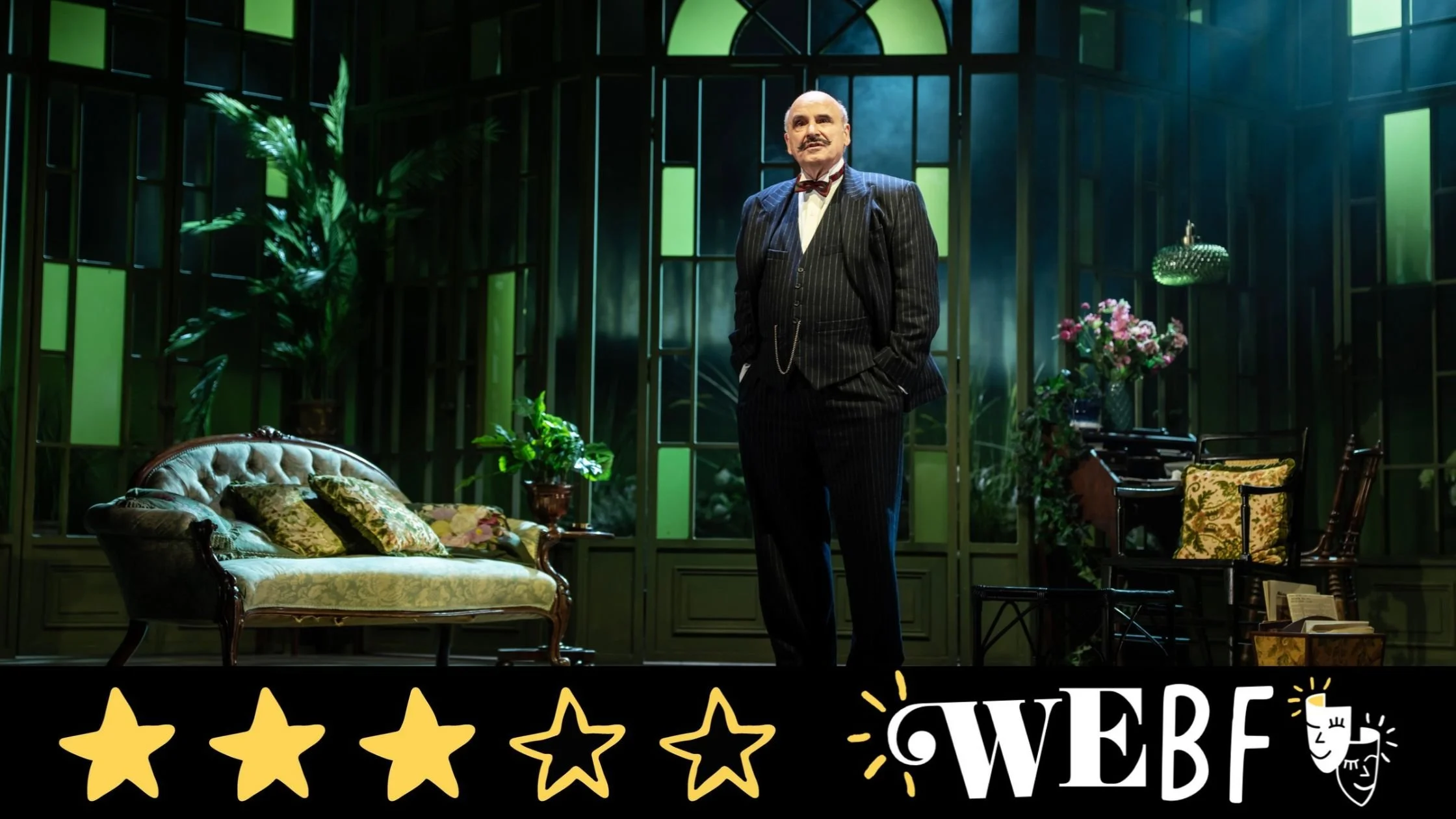
One of the biggest challenges for any Christie adaptation is balancing the large ensemble cast. Oglesby ensures all the characters remain regularly in play and writes with period wit and authenticity, although she is somewhat restricted by Joanna Parker's attractive but static observatory set, which must be repeatedly contrived to gather and disperse the various relationships and interactions. Director Lucy Bailey is well-versed in Christie stage adaptations, with her site-specific Witness for the Prosecution a long-running hit in London's County Hall, and she directs here with equal confidence.
The start is a little slow to establish the story and despite a welcome early introduction to Poirot, he is absent for long stretches. However, once the play settles into its stride, Bailey keeps her cast busy, drawing strong reaction-based comedy from the ensemble.
The comedic turns are most notable from Sarah Moyle's eccentric Lucy Angkatell, who delivers a standout performance as the unsympathetic, eccentric lady of the manor, garnering most of the best lines. James Clyde also gives a strong comedic turn as the exasperated butler, Gudgeon. However, while the comedy is warmly received and undoubtedly enhances the evening's entertainment value, it occasionally risks tipping the production into parody. Christie is so synonymous with the country-house murder mystery that many of the familiar motifs can feel like affectionate caricatures verging on parody, until you remind yourself that the legendary author popularised many of these conventions in the first place.
Other notable performances include Luke Allen-Gale in the dual role of John Cristow and the Inspector. As the philandering Cristow, Allen-Gale seems to have stepped straight out of a Christie novel, completely embodying the archetypal rogue, while his Inspector is presented as a much timider and more haphazard figure. Tilly Steele brings nuance and complexity to Cristow's long-suffering wife, Gerda, while Victoria Blunt and Grace Darling deliver charming period-specific performances as Henrietta Angkatell and Midge respectively.
Of course, all eyes are on Peter Polycarpou, who faces the challenge of breathing new life into the widely portrayed and loved private detective, Hercule Poirot. Wisely avoiding an impersonation of his famous predecessors, Polycarpou instead delivers a subtle and refined performance. His little grey cells bubble away enjoyably as he shuffles around the set, declaring secret liaisons aloud and becoming increasingly frustrated by the evasiveness of his suspects, all through a well-judged Belgian accent.
All in all, this is less of a whodunnit and more of a whydunnit. For hardened Christie fans, it is unlikely to test their detective skills too rigorously, but its broad appeal will satisfy purists and introduce a new generation to Poirot through a comforting theatrical experience and a satisfying return to the traditional Poirot formula.
*** Three stars
Reviewed by: Phil Meikle