
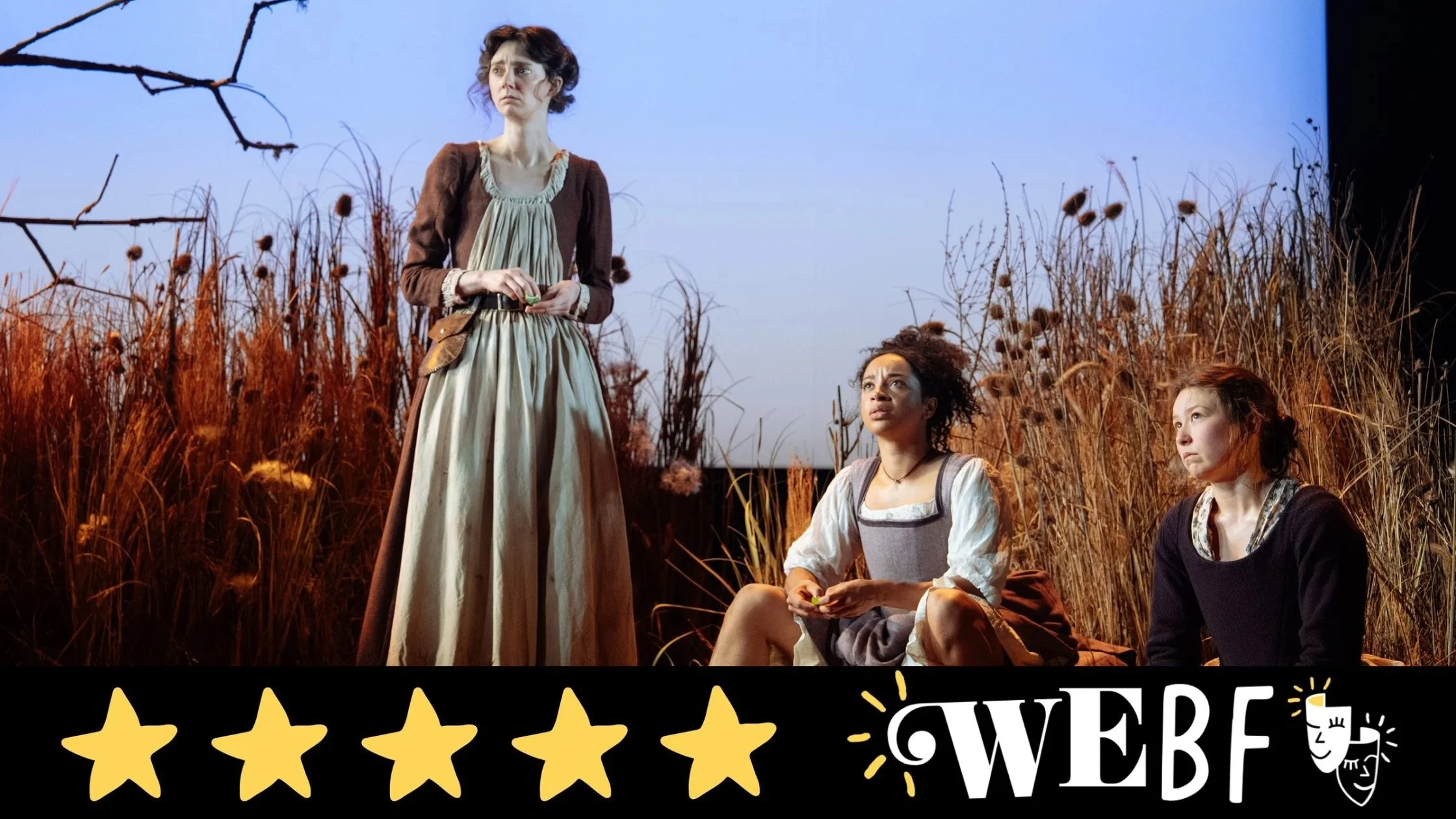
Photo credit: Helen Murray
History is often told by the victors - and, in many instances, those victors have primarily been men. Countless women throughout history have played pivotal roles in major events, yet we are rarely privy to their side of the story. One woman who stands out as particularly wronged is Anne Boleyn.
King Henry VIII’s second wife was someone he moved heaven and earth to marry, only to later dispose of on what appeared to be a whim. Rumours surrounded her downfall, yet we never hear her rebuttal. Even the details of her trial remain largely undocumented.
This is where Ava Pickett steps in with the sensational 1536. Set in Tudor England, the play opens in a field in Essex, where we meet Anna, Jane, and Mariella - three childhood friends gathering to hear gossip from London about the Queen’s imprisonment.
As the play develops, the women’s lives begin to mirror the royal drama unfolding in London. They start as carefree and playful, but gradually come to understand how misogyny and political upheaval ripple through society, shaping their behaviour, perceptions, friendships, and relationships.
1536 tackles incredibly dark themes, and what it does so well is demonstrate how little voice women had during that period. It didn’t matter whether they were telling the truth; if their words did not fit the desired narrative, they were twisted to serve men’s interests - even if that resulted in women’s deaths.
The play lays everything bare. One line delivered by Mariella - “I suppose it isn’t rape if he’s your husband” - was particularly hard-hitting for the audience, perhaps because we now live in a society where that way of thinking is no longer considered acceptable.
Despite its heavy subject matter, the script balances the darkness with quick-witted humour. Much of this comes through Jane’s simple and earnest nature. Her horror upon discovering that “you only get one leaf” is especially funny and provides a welcome moment of levity.
With such an important script and message, director Lyndsey Turner has assembled a cast of five that is nothing short of exceptional. Siena Kelly’s Anna and Liv Hill’s Jane represent opposite ends of the imposed moral spectrum: Jane striving to be good and proper, while Anna embodies freedom and fun - traits that later backfire on her.
Kelly and Hill share excellent onstage chemistry, authentically portraying the complexities of friendship and the ways relationships shift under outside pressures. Both women become entangled with the same man, Richard, played by Oliver Johnstone. Although we rarely see much tenderness between Richard and his betrothed Jane, the anger he directs towards her in the final scenes is striking.
It is Johnstone’s performance opposite Kelly that truly ignites the piece. His facial expressions, voice, and demeanour fluctuate depending on what Richard wants from Anna. He is simultaneously slimy and charming, creating an unsettling tension that leaves the audience deeply uncomfortable at times.
Tanya Reynolds’ Mariella delivers a nuanced performance, positioned somewhere between her two friends. A midwife by trade, she frequently remarks that most of Essex seems to be pregnant. Her dry humour is conveyed wonderfully throughout the play, and she is perhaps the most aware of the limitations imposed upon her by both class and gender.
George Kemp’s William initially appears to occupy a more peripheral role, seemingly existing to support Mariella’s subplot. However, by the play’s final flourish, his importance becomes devastatingly clear. The raw emotion Kemp displays in the closing scenes is extraordinary, and the heartbreaking situation that unfolds between William and Mariella - weaponised by those around them - is utterly gut-wrenching.
The production itself is equally impressive. Set against the backdrop of a dried grass field, with a large screen looming behind, the staging allows Jack Knowles’ lighting design to dictate the mood and build suspense. The warm glow of a balmy summer’s day gradually transforms into vivid, dangerous reds during moments of conflict.
The costumes further elevate the production, remaining historically accurate while subtly reflecting each woman’s perceived virtue. Jane’s dresses are modest and covered, while Anna’s lower-cut bodices, thinner fabrics, and stockings hanging around her ankles suggest a freer spirit. Mariella, once again, sits somewhere between the two.
A production can only succeed when all of its elements work together - and they unquestionably do here. The acting is stellar, the production values are outstanding, the pacing is fluid, and the subject matter remains both thought-provoking and deeply insightful.
Pickett’s writing creates such a profound piece of theatre, that this is a 5-star must see.
***** Five stars
Reviewed by: Emma Littler
1536 plays at London’s Ambassadors Theatre until 1 August, with tickets available here.