Photo credit: Reading Museum
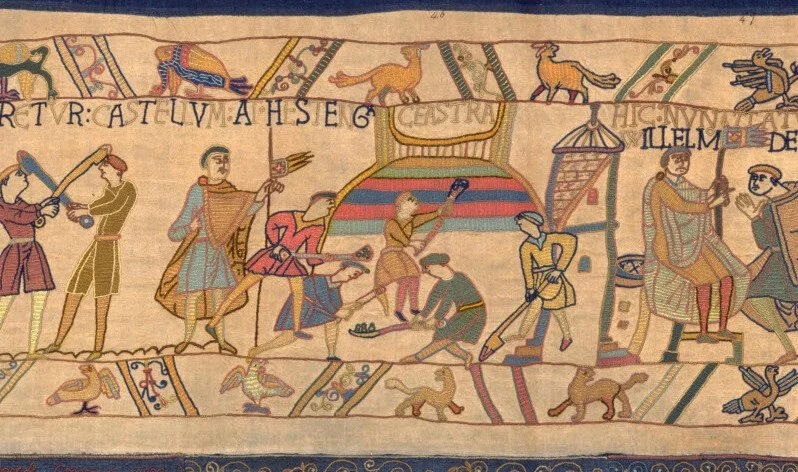
Besties, you will have seen the headlines of queues for the hottest ticket in London to see the Bayeux Tapestry at the British Museum until next summer, but did you realise the significance of this temporary visit to the UK? The 70-metre-long embroidered linen scroll has been kept in the treasury at the Bayeux Cathedral in Normandy where it has been on permanent display there since 1983. It has been loaned back to the UK where it was originally stitched because the Bayeux Museum is undergoing renovation ahead of the 1000th anniversary of the birth of William The Conqueror. Legend has it that it was commissioned by Queen Matilda, William’s wife, but was more likely commissioned by his half-brother Bishop Odo of Bayeux, later Earl of Kent and made in Canterbury. But the history of the Norman invasion has a strong link with the town of Reading and as a result, the town is linking with eight other territories in 2027 to celebrate the Year of the Normans.
In the1086 Domesday Book, the settlement at Reading is shown as being owned by King William, Henry De Ferrers and Battle Abbey as a consequence of the Norman invasion. The Saxon village, created by the Viking invaders in 870, and minster had been owned by Edward the Confessor but was changed after the Battle of Hastings. Battle Abbey was built in Hastings and was given the land in Reading between the Thames and Kennet river. In 1121, William’s son Henry announced plans to build a large Royal Abbey and Palace in Reading but died in 1135 before its completion and was buried in front of the high altar of the Abbey. The location is now thought to be under a Victorian school building. The Abbey was very large for the number of monks but became a Royal Residence as an outpost to avoid plagues in London or hold important gatherings. The Abbey was officially opened in April 1164 but was destroyed in 1538 as part of Henry VIII’s dissolution of the monasteries. The Abbey Gateway remains where, in 1785/86, Jane Austen attended school.
This significant role in Norman History will be celebrated in the Reading Year of the Normans supported by the Reading Economy and Destination Agency (REDA). The full programme is still being developed but will include medieval guided walks, a medieval weekend in Dinton Pastures (18/19 September 2027), river trips and Reading’s WaterFest. You also, of course, can see the 140-year-old replica of the Bayeux Tapestry, which has been displayed at Reading Museum for over 100 years.
But at the heart of the celebration will be the premiere of a new play from RABBLE Theatre, supported by France’s Region Normandie and In Itinere Collectiv, who will assist in casting two French speaking actors from Normandy to provide authenticity. Every performance will be subtitled. RABBLE were established in Reading in 2012 and have adopted a policy of telling local stories of national significance and working closely with local schools to bring the history to life and be relevant to today’s society. Toby Davies, the founder and artistic director, proudly announced that their latest play - William the Conqueror - will be staged at the Hexagon in Reading from 28 September - 2 October 2027 as part of Reading Council’s reopening of the venue after adding a studio space and refurbishing the seating as part of the Hexagon’s own 50th Anniversary. It will tour eight venues ending at Chichester Festival Theatre. It will visit York Theatre Royal on the tour, which is only 10 miles from the site of The Battle of Stamford Bridge which Harold won before marching (or sailing) south to meet William at Hastings.
It is a prequel to two of their previous productions Henry I (which was staged in the Abbey ruins in 2023) and Matilda the Empress (daughter of Henry I), staged at St James’ Church Reading in 2017. The first told the story of the power struggle between the brothers when William the Conqueror died, the second told of the struggle for the English throne between her, his only legitimate heir, and her cousin Stephen in what was known as the Anarchy. All three are written by Beth Flintoff. The challenge for the creative team will be to stage the Battle of Hastings (1066) in which William defeated Harold (as shown in the Bayeux Tapestry) with a cast of just seven! Co-directors Hal Chambers and Gareth Taylor, with fight and intimacy director Dani Mac and Illusionist John Bulleid, will create these key scenes using the music of Brain Rays (Benjamin Hudson), sharply defined lighting and parkour movement.
However, the real interest in the story will be to relate it to today’s society and whether the final script paints William the Conqueror as a hero who shaped Britain or a ruthless ambitious expansionist. We sometimes forget the impact that the Normans had on Britain as a society, in land ownership and even in our language. As we walked around Reading town centre, Matthew Williams of Reading Museum reminded us that the layout of the town streets owed a lot to the Norman occupation. The narrative of the play will also invite comparison with the ambition, loyalty and use of propaganda (fake news, like the Bayeux Tapestry itself!) of modern political leaders. RABBLE works hard to engage local schools In their productions through workshops and education packs, and seeks to break down the barriers for young people to enjoy live performance. The production can engage them, make history more relevant and share the excitement of dynamic storytelling.
We, at West End Best Friend, plan to follow the creative process of this important new play over the next year as it develops, evolves and comes to the stage. If you are interested in supporting the production, you can fund more at Patrons & Supporters - RABBLE Theatre or book a ticket at Reading Hexagon here.
Nick Wayne